
Over 200 Prachin Buri residents demand waste plant closure decision on Nov 1
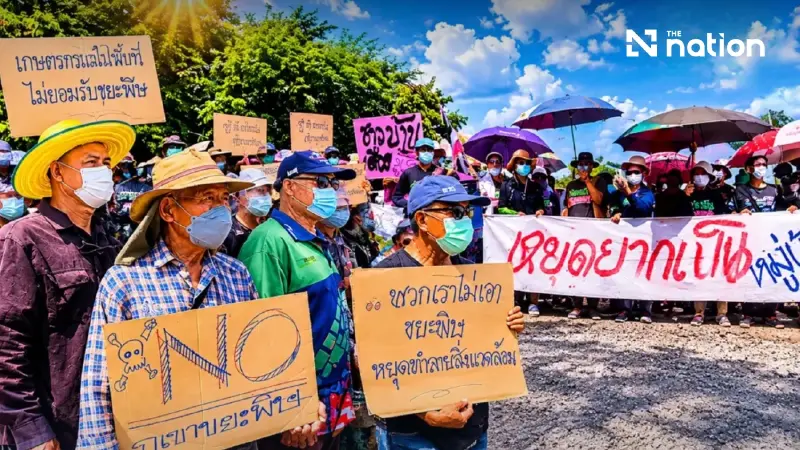


Prachin Buri residents say a seven-day pledge on factory closure remains unmet, as they demand pollution clean-up and compensation.
More than 200 residents rallied outside an industrial waste landfill in Prachin Buri on November 1, 2026, demanding that Industry Minister Varawut Silpa-archa provide a decision on permanently closing the facility.
Residents said Varawut had promised to expedite investigations and provide an answer on closure within seven days during an inspection on October 19. More than 10 days later, the residents complained, they still had no clear response.
Residents demonstrating outside Green Environment Technology Co Ltd in Prachin Buri blamed its industrial waste landfill for oily, polluted water they said had entered local waterways and farmland during recent floods. The rainbow-coloured sheen prompted residents to dub the water the “seven-coloured river”.
Protesters in Prachin Buri carried placards demanding justice and burned chillies and salt as a symbolic expression of anger. Chaturon Chaisang, a member of parliament, attended to hear their complaints.

Residents report pollution spreading beyond Si Maha Phot
Siriporn, a representative of Prachin Buri residents, said black water contaminated with chemicals had spread beyond Si Maha Phot district into Si Mahosot and could soon reach Ban Sang.
Siriporn said Green Environment Technology was subject to a three-month suspension under Section 39 of the Factory Act, but residents had seen no tangible progress in tackling the problem. Even the tarpaulins covering industrial waste piles did not fully seal them, she added.

Prachin Buri residents challenge fish-eating event
Representatives of Prachin Buri residents objected to a fish-eating event intended to restore public confidence, arguing that it should not be used as reassurance without official test results confirming the safety of aquatic animals.
The Prachin Buri representatives said conditions in Prachantakham, where the event was held, differed from those in Si Maha Phot, Si Mahosot and Ban Sang, the districts at the centre of residents’ pollution concerns.
Campaigners demand permanent closure of two Prachin Buri factories
Prachin Buri civic groups called on the Industry Ministry to permanently close two factories at the centre of the dispute under Section 39, paragraph three, of the Factory Act.
Residents argued that existing licences should not prevent permanent closure, particularly where facilities stood on low-lying land that receives floodwater. The residents said such locations were unsuitable for these operations and that climate variability increased the risk of severe floods and renewed pollution.

Sunthorn Khomkhai, a human rights defender working on the environment, natural resources and community rights with the Strong Prachinburi Network, said any closure must follow sound technical principles and include proper pollution control and compensation for affected residents. Simply shutting a factory and leaving the community to deal with the consequences would not resolve the problem, Sunthorn argued.
Prachin Buri campaigners also demanded clear progress reports from the Industry Ministry, the Agriculture and Cooperatives Ministry and the Public Health Ministry, saying the agencies had yet to provide clear answers.

Prachin Buri groups propose national pollution committee
Prachin Buri civic groups were preparing a proposal, citing Section 9, asking the government to urgently establish a national committee to address the crisis. The groups argued that pollution affecting several districts had exceeded the capacity of regional authorities acting alone.
Under the Prachin Buri civic groups’ proposal, the national committee would have full decision-making authority over budgets, the provision of equipment and machinery, and coordination between agencies. Its purpose would be to accelerate pollution control and environmental restoration while protecting residents’ lives and property.

