
PM Anutin Vows to ‘Reinvent Politics’ as He Unveils Thailand’s Three-Pillar Overhaul
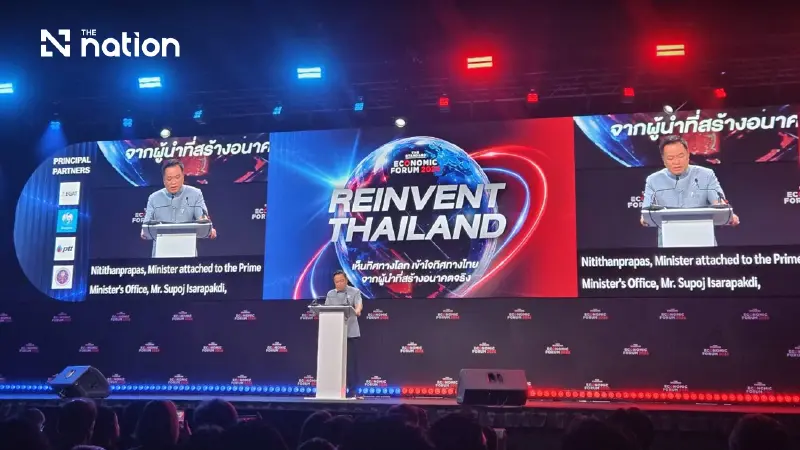


Prime Minister tells The Standard forum that energy security, new economic engines and skills must be matched by a more constructive political culture
- Prime Minister Anutin Charnvirakul asserts that Thailand must first "reinvent politics" by fostering a constructive, fact-based political culture, viewing stability as a prerequisite for economic progress.
- The national overhaul is built on three pillars: achieving energy security, developing new economic engines in future industries like semiconductors and AI, and investing in human capital through upskilling.
- To boost the economy, the government plans to reform regulations and launch a "Thailand Fast Pass" program, creating a one-stop service to attract investment and remove bureaucratic bottlenecks.
- The human capital pillar focuses on preparing the workforce for technological change by promoting AI skills and requiring foreign investors to contribute to local employment and knowledge transfer.
The prime minister tells The Standard forum that energy security, new economic engines and skills must be matched by a more constructive political culture.
Prime Minister Anutin Charnvirakul has called for a fundamental change in Thailand’s political culture, telling business leaders and diplomats that the country cannot “reinvent” its economy without first reinventing the way its politicians behave.
Opening the three-day “Economic Forum 2026: Reinvent Thailand”, hosted by The Standard, Anutin, who is also interior minister, said Thai politics remained a drag on national progress.
“Today it is still negative,” he said, describing a contest in which every side wants state power but too few respect the rules of the game.
“Reinvent politics” was, he said, an uninvited addition to the forum’s agenda, but one he felt compelled to make as head of government. A healthier political culture, he argued, would replace insults, sarcasm and the belittling of opponents with constructive debate.
Scrutiny should rest on verifiable facts rather than fake news or unprovable hearsay, he added. He stressed that he was not seeking to silence criticism.
“That is impossible in a democratic system like ours,” he said, but the goal must be to put the nation and its people first, rather than to humiliate rivals or delay the work of government.

Stability as a prerequisite
The prime minister tied political stability directly to economic delivery. Reflecting on his appearance at the same forum a year ago, when he led a minority government, he noted that his party had since won the most seats at the election and now leads a stable majority administration, which he said has made policy implementation far more effective.
Without such stability, he argued, policy tends to stall. If different parties oversee investment promotion in turn and each pulls in a different direction, he said, “nothing can move."
Governments, he said, should be given the confidence to remove obstacles for those who deal with the state. Anutin said he expected his cabinet to survive an upcoming no-confidence debate, adding that all ministers had worked hard and could answer the charges levelled by MPs.
Self-reliance and “sufficiency economy”
Anutin said his frequent overseas trips, during which he meets government leaders and business chiefs, had convinced him that resilience, or self-reliance, was the common theme worldwide.
For Thailand, that means security in energy, food, defence industry and public administration. He pointed to the Thailand Pavilion at the recent IMF–World Bank meetings, which drew delegates from 192 countries.
It showcased the late King Bhumibol Adulyadej’s philosophy of the sufficiency economy, which, he said, the heads of both institutions praised in their closing remarks. “Using internet language, His Majesty was truly ahead of his time,” he said.

The philosophy, Anutin stressed, does not mean halting development, closing the country or rejecting technology. Rather, it calls for informed development, an understanding of one’s own strengths and preparation for risk, driven by knowledge and responsibility.
He cited climate disruption, rapid advances in artificial intelligence, an ageing society and geopolitical tension as pressures forcing every nation to build strength from within.
He then set out three pillars of reinvention: energy, the economy and people.
Pillar one: energy
Citing Indonesia’s decision last month to reduce natural gas exports to Singapore and Singapore’s response that it must keep options open, including studying nuclear power, Anutin said Thailand must ask how to make its own energy system more secure, sustainable and flexible.
He said Thailand already enjoys a degree of energy security, but the government is pursuing an energy transition set out in its policy statement earlier this year.
The latest step is a people’s solar scheme. The aim, he said, is not merely rooftop panels but giving households the choice to manage their own energy costs while adding more clean power to the national grid.
Pillar two: the economy
To “reinvent the economy”, the government is adding new economic engines and laying the groundwork for industries of the future, including modern agriculture, food technology, the defence industry, semiconductors and data centres to attract digital and AI investment.
That, he said, requires reviewing regulations, reforming laws and improving enforcement. Economic change must go hand in hand with public sector reform, with fewer unnecessary procedures and rules aligned with the needs of industry, entrepreneurs and investors.
As part of this, the Board of Investment (BOI) has been told to run a “Thailand Fast Pass” programme. Investors will no longer have to trudge from one agency to another, he said.
Instead, the BOI will act as a one-stop host and “break down the bottlenecks” on behalf of the government. Deputy Prime Minister and Finance Minister Ekniti Nitithanprapas was due to address the forum later in the day on the government’s economic policies.
Pillar three: people
The third pillar, human capital, is essential because economic change will not last if people have no chance to adapt and learn, Anutin said. While AI will displace some jobs, it will also create new ones and demand new skills.
The government is therefore running programmes to teach Thais to use AI, working with schools, employers and entrepreneurs so that lifelong learning meets present and future labour-market needs.
He said he spends as much time, if not more, with business, industry and investment communities abroad as with political leaders, and tells them the same thing.
Anyone wishing to invest in Thailand, he said, should be asked how many local people they will employ, how they will transfer knowledge and technology, and what partnerships they will form with Thai educational institutions. The aim is to prepare Thais to be genuine economic partners with the rest of the world.
Concluding, Anutin said reinventing Thailand was not the job of the government or any single group alone, but a collective task requiring every sector to contribute its strengths “like pieces of a jigsaw” for a secure Thailand in a new economic era.
"Every change begins with conversation, understanding and a shared goal: the greatest benefit of the country and the wellbeing of its people," he said.
