
What’s next for Thai-Cambodian overlapping maritime petroleum talks?
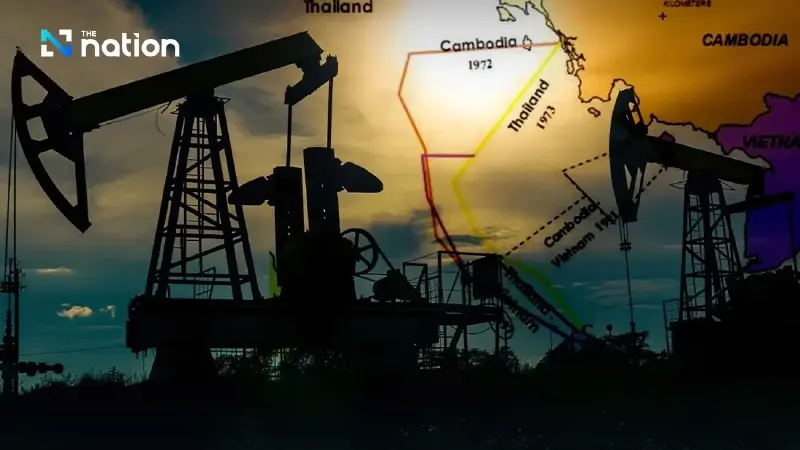


Recent clashes between Thailand and Cambodia have made negotiations to harness undersea resources in their overlapping maritime zone increasingly difficult.
The overlapping maritime continental shelf between Thailand and Cambodia, covering around 26,000 square kilometres, has been a source of conflict for more than 46 years. The dispute dates back to 1969, when Thailand established a negotiation committee on continental shelf rights and boundaries, followed by Cambodia’s unilateral declaration of its continental shelf in 1972.
Over successive administrations, both countries have attempted to negotiate a resolution, with proposals often centred on the creation of a Joint Development Area (JDA).
Talks were revived under former prime minister Gen Prayut Chan-o-cha but failed to reach a conclusion. His successor, Srettha Thavisin, outlined in his policy statement to parliament the intention to pursue negotiations with neighbouring countries to secure shared maritime benefits.
On January 3, 2024, during the debate on the national budget bill for fiscal year 2024, his government reaffirmed its commitment to addressing overlapping energy claims through foreign policy negotiations.
The current administration under Prime Minister Paetongtarn Shinawatra has pushed the matter further. In her policy address to parliament, she pledged to advance talks on the overlapping claims area (OCA) with Cambodia to help reduce energy costs.
The issue was raised during her meeting with Cambodian Prime Minister Hun Manet on the sidelines of the ASEAN Summit in Laos on October 9, 2024.
Paetongtarn stressed that joint exploration of the contested area is among her government’s top 10 priorities. She said Thailand urgently needs to increase its dwindling energy reserves, stabilise electricity prices, and curb rising dependence on imported energy.
A source from the Ministry of Energy has revealed that negotiations over the overlapping maritime area between Thailand and Cambodia remain stalled, particularly on the issue of establishing a JDA.
The source said the matter is still awaiting discussion between the foreign ministries of both countries.
They suggested that neutral parties such as the International Tribunal for the Law of the Sea or the International Court of Justice should be invited to mediate in order to reach a fair settlement for all sides.
“At present, the government has not appointed a new head of the negotiation team. The leadership still formally rests with Gen Prawit Wongsuwan. With the ongoing land border dispute with Cambodia, the talks over the maritime overlapping claims area are likely to become even more difficult. Personally, I believe that involving a major power like the United States as a co-negotiator would help deliver progress or a conclusion, rather than allowing us to lose out on undersea resources worth an estimated 10 trillion baht without putting them to use,” the source said.
According to reports, the Department of Mineral Fuels earlier proposed that maritime negotiations should proceed in parallel with talks on boundary demarcation north of latitude 11 degrees, as the two cannot be separated. The department also outlined six key issues for consideration:
- Benefit-sharing ratio between the two governments
- Revenue collection system to be applied in the joint development area
- Rights allocation for existing concession holders from both countries, as well as determination of operators
- Governance structure to oversee budget allocation, domestic legal frameworks and regulatory mechanisms
- Customs, taxation and environmental management
- Other issues such as fisheries, pipeline routes, hydrography and oceanography
Past negotiations over overlapping maritime areas have produced different outcomes. Thailand and Malaysia concluded talks in 1979 after 11 years, agreeing to establish a JDA. The negotiations with Vietnam ended in a boundary demarcation agreement in 1997 after about eight years, Hanoi has prioritised its disputes in the South China Sea.
The Thai-Cambodian OCA is believed to hold strong petroleum potential. Adjacent to the disputed zone on the Thai side, several petroleum fields such as Erawan and Arthit have already been discovered and proven commercially viable.
Thailand first awarded concessions in the area in 1968, but exploration was halted in 1975 following a Cabinet resolution to suspend operations in all overlapping zones with neighbouring countries.
Deputy Prime Minister and Energy Minister Pirapan Salirathavibhaga recently said that resolving the Thai-Cambodian OCA dispute may require a shift in strategy. Instead of focusing solely on maritime boundary demarcation, he proposed emphasising shared energy development through new mechanisms.
One idea under discussion is the creation of a joint company or organisation, co-owned by Thailand and Cambodia, which would operate with the approval of both governments. This model would enable the two sides to benefit from petroleum resources without linking the issue directly to boundary disputes, which are legally and politically complex.
Pirapan stressed that tying boundary demarcation to energy cooperation would make negotiations impossible, as the legal frameworks governing the two matters emerged in different eras. “If Thailand and Cambodia jointly establish a company or body and both governments endorse it, then it can proceed to utilise resources without reference to boundaries,” he said.
Meanwhile, the Department of Mineral Fuels has been working closely with the Department of Treaties and Legal Affairs of the Ministry of Foreign Affairs to prepare policy guidance. They have outlined three key objectives for negotiations:
- Resolving the overlapping claims area, covering 26,000 square kilometres of the continental shelf.
- Implementing the 2001 Memorandum of Understanding (MOU) between Thailand and Cambodia, which calls for two parallel processes: maritime boundary negotiations north of latitude 11°N, and a joint petroleum development agreement south of latitude 11°N.
- Using the Thai-Cambodian Joint Technical Committee (JTC), as already agreed with Phnom Penh, to oversee negotiations and technical arrangements.
