
JIC clarified Cambodia’s MK-84 dud bomb claim with RTAF BDA findings
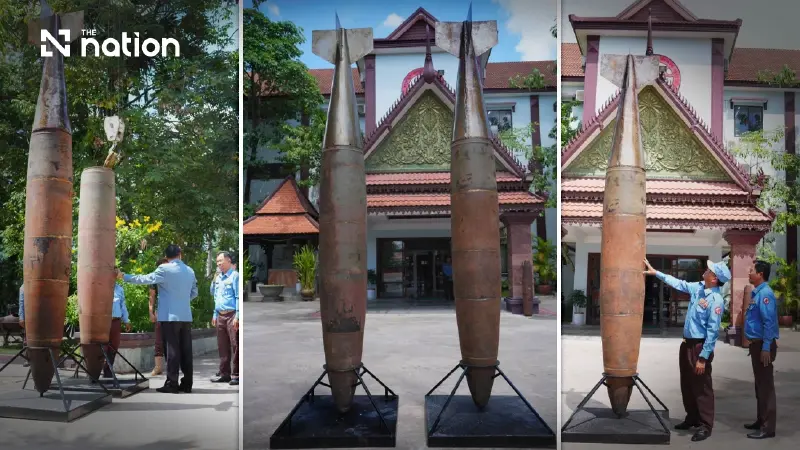


Air Chief Marshal Prapas Sornchaidee says technical and forensic checks are needed before any weapon can be attributed to either side.
- Thailand's Joint Information Centre (JIC) stated that Cambodia's photographic claim of a dud MK-84 bomb is not verifiable proof of origin without proper forensic analysis.
- The Royal Thai Air Force (RTAF) used its Battle Damage Assessment (BDA) system, which confirmed that all weapons deployed in its mission functioned correctly and detonated, contradicting the dud bomb allegation.
- Experts expressed doubt over the claim, noting the object's intact condition is inconsistent with the severe impact damage an air-dropped bomb would sustain, even if it failed to explode.
ACM Prapas Sornchaidee, director of the Joint Information Centre on the Thailand-Cambodia Situation (JIC), clarified on Wednesday (June 24, 2026) the case of the Cambodian side publishing images of an object resembling an MK-84 bomb and alleging that it was evidence of an attack by the Thai side.
He stressed that photographs alone could not confirm the origin of a weapon or identify the responsibility of any side without technical and forensic verification in line with international standards.
Based on its external appearance, the object could possibly be a 2,000-pound bomb in the Mk 84 family, or an older 3,000-pound M118 bomb, which was widely used in earlier wars by the US military.
However, its origin could not be identified from external appearance alone.
Production numbers, parts, possession history and forensic evidence would all have to be examined together.
“Showing an object to the public and identifying it as the weapon of any side without verifiable technical evidence amounts only to an allegation, not proof,” Air Chief Marshal Prapas said.
The Royal Thai Air Force (RTAF) has a Battle Damage Assessment (BDA) system, which uses imaging technology and closely tracks the use of weapons from F-16 and Gripen fighter aircraft.
The inspection results confirmed that every weapon used in the operational mission functioned completely through its operating cycle, detonated on target and allowed the damage in military areas to be fully verified.
No information was found to support the claim that any dud bomb remained as alleged.
Another point that has raised doubts among experts is the condition of the object that was publicised, which remained intact in both its body and tail fins.
In principle, an air-dropped bomb would be exposed to enormous impact and, if functioning normally, would detonate or suffer severe damage.
It would therefore be difficult to find such an object in a condition close to its original factory state.
Air Chief Marshal Prapas also said weapons experts had noted that even in the case of a dud bomb, in-depth examination would still be required to confirm its type, origin and chain of possession.
A conclusion could not be drawn from still images or one-sided claims.
Thailand, therefore, remains committed to international law, humanitarian principles and resolving problems through peaceful means, while calling on all parties to use verifiable information and allow facts to be established transparently and impartially.
The key point society should recognise is that “a photograph is not evidence that can confirm the origin of a weapon by itself”, because in military forensics, attributing any weapon to any side requires empirical evidence and an internationally standardised verification process, not judgment based solely on photographs or one-sided political allegations.
