
UN Envoy Defends Cambodia Border Report Amid Thai Rebuttal
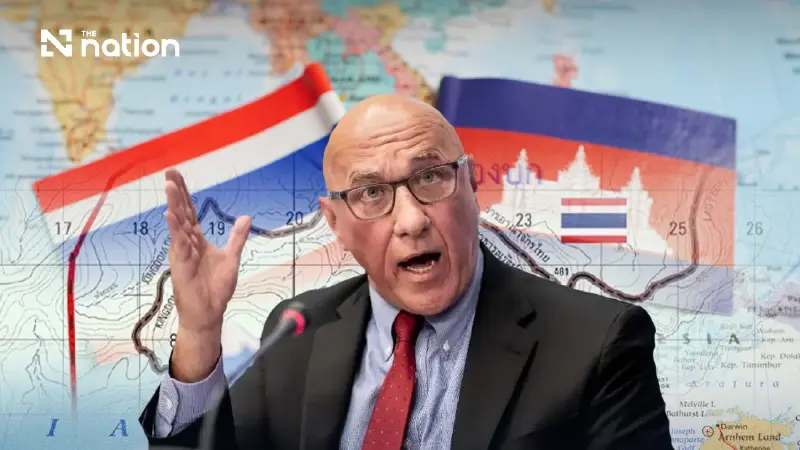


Tom Andrews rejects claims of non-consultation, standing by displaced figures while urging peaceful dialogue over border dispute
- UN Envoy Tom Andrews defended his report by stating he provided a draft to Thai authorities two days before its release but received no response.
- The Thai government rebutted the report, disputing its procedural delivery and factual accuracy, particularly the claim of 650,000 displaced Cambodians.
- Andrews stood by the displacement figure, clarifying it was sourced from existing UN reports and that his focus is on human rights regardless of territorial disputes.
- Despite the disagreement, the envoy urged for peaceful dialogue and expressed a desire to engage with Thai officials before submitting his final report to the UN Human Rights Council.
Tom Andrews rejects claims of non-consultation, standing by displaced figures while urging peaceful dialogue over border dispute.
The United Nations Special Rapporteur on the situation of human rights in Cambodia, Tom Andrews, has rejected allegations from the Thai government that his recent assessment of the Thai-Cambodian border conflict was published without prior consultation with Bangkok.
In a statement posted on the official Facebook page on Thursday (6 August), Andrews clarified that an advance draft of the relevant section of his report was submitted to Thai authorities two days prior to its public release in Phnom Penh. Having received no response within that timeframe, he proceeded with the scheduled announcement.
"I welcome feedback on my statement, including from the government of Thailand," Andrews said. "That is why I sent the Thai government an advance draft of the portion of the statement concerning the border conflict two days before it was issued... While I did not receive a response to that communication, I remain open and eager to discuss the Thai government’s perspective."
The clarification follows sharp criticism from Thailand’s Deputy Prime Minister and Minister of Foreign Affairs, Sihasak Phuangketkeow, who disputed both the procedural delivery and the factual accuracy of the envoy's press conference.
Sihasak emphasised that the findings represented an individual rapporteur's assessment rather than an officially endorsed UN document, noting that the material had not yet undergone formal review by the UN Human Rights Council in Geneva, where member states can contest specific points.
The Thai foreign minister argued that independent experts must maintain strict impartiality and verify facts directly with all affected nations rather than presenting one-sided claims at a public press conference.
Central to the dispute is the envoy's reference to approximately 650,000 Cambodians displaced by the ongoing border friction.
The Thai Foreign Ministry firmly rejected this figure, arguing that it incorrectly counts Cambodians residing in border villages that encroached onto Thai territory during internal civil conflicts over 50 years ago.
According to Bangkok, these residents do not fit the legal definition of internally displaced persons (IDPs). Furthermore, Sihasak noted that the assessment overlooked Thai civilian casualties, damage to Thai schools and hospitals, and the fact that Thailand did not initiate the border clashes.

Addressing the dispute over the numbers, Andrews reiterated that the 650,000 figure was sourced directly from UN reports, stressing that human rights imperatives apply regardless of territorial disputes.
"While noting Thailand’s perspective, the figure was drawn from UN reports and my reference to those displaced is based on human rights concerns which apply regardless of conflicting territorial claims," Andrews stated.
The UN envoy also addressed allegations surrounding Cambodian migrant workers, which Sihasak had previously clarified were not forcibly deported by Thai authorities but had rather returned home following calls from the Cambodian government itself.
Looking ahead to his formal submission to the UN Human Rights Council next month, Andrews expressed a strong desire to engage with Thai officials before finalising his comprehensive report.
He called for a swift, peaceful resolution to the border standoff to enable civilians to return home safely and resume cross-border commerce.
"Because whether one is Thai or Cambodian, human rights matter," Andrews concluded.
