
Thailand says Cambodia closed the door on land-boundary talks
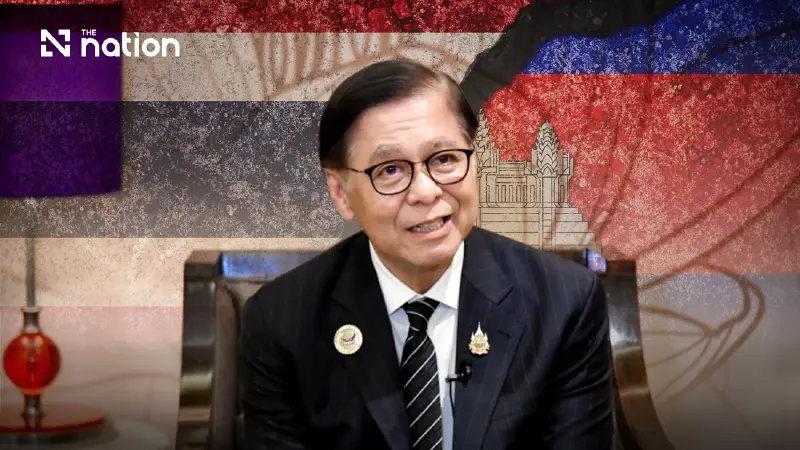


Thailand remains open to bilateral land and maritime boundary talks, while Sihasak says border demarcation needs trust and co-operation.
- Thai Foreign Minister Sihasak Phuangketkeow claims that Cambodia has closed the door on land-boundary negotiations, not Thailand.
- Sihasak stated that Cambodia rejected Thailand's proposal to discuss the maritime boundary first and instead moved towards compulsory conciliation without attempting bilateral talks.
- Thailand's position is that negotiating the maritime boundary could build trust and allow for technical discussions on some land-boundary matters.
- Sihasak also noted that before land demarcation talks can advance, confidence-building measures like demining and tackling border scam operations are needed.
Minister of Foreign Affairs Sihasak Phuangketkeow, who was visiting Manila in the Republic of the Philippines to attend the ASEAN Foreign Ministers’ Meeting, said the meeting had followed developments along the Thailand-Cambodia border.
He said Thailand remained committed to the outcome of talks between the two countries’ leaders in Cebu, the Philippines, where both sides agreed to hold bilateral discussions, build mutual trust, and gradually restore relations.
Thailand therefore wanted to return to its earlier proposal that the two sides discuss the maritime boundary before proceeding to other mechanisms.
Beginning with the maritime boundary could also allow some related land-boundary matters, such as technical preparations, to be discussed.
However, Cambodia had closed the door on talks and moved towards compulsory conciliation.
Thailand had no objection to that process, he said, but questioned why Cambodia would not first talk to Thailand.
He stressed that Thailand had not closed the door to negotiations; Cambodia had.
On the maritime boundary, Sihasak said Thailand had consistently sought negotiations under MOU 2001, but no progress had been made.
Thailand’s intention was therefore to hold talks under rules respected by both sides.
When MOU 2001 was concluded, Cambodia was not yet a party to the United Nations Convention on the Law of the Sea (UNCLOS), but it had since become one.
Both countries respected international law, he said, asking why they should not try to negotiate.
Sihasak reiterated that negotiations on the maritime boundary could also allow some discussion of land and border issues.
Thailand had made the proposal, but Cambodia did not respond and instead wanted to pursue compulsory conciliation, even though voluntary conciliation was also available.
Cambodia had therefore decided against the path of negotiation, amounting to “closing the door on negotiations over the land boundary”, he said.
Regarding a statement issued by Cambodia’s Foreign Ministry on Monday (July 20, 2026), which said the two countries should negotiate the land boundary without involving procedures under UNCLOS, Sihasak said the convention’s process still allowed room for talks before other mechanisms were used.
Cambodia had asked Thailand to convene a meeting of the Thailand-Cambodia Joint Boundary Commission (JBC), yet would not agree to discussions through channels under UNCLOS, a position he said was self-contradictory.
He reiterated that Thailand wanted bilateral discussions on both the land and maritime boundaries.
The Cabinet had approved the new chair and members of Thailand’s JBC panel, but this was an internal technical matter and did not mean Thailand was beginning negotiations with Cambodia.
The two matters were separate, he said.
Cambodia’s call for land-boundary talks came as disturbances continued along the border, causing concern among Thais.
Sihasak said the JBC dealt with boundary demarcation, while the border situation extended beyond demarcation because it involved a range of incidents.
Before a boundary-demarcation meeting could take place, measures were needed to give Thailand confidence and establish co-operation between the two sides, including demining and joint efforts to tackle scam operations.
These measures were included in the Thailand-Cambodia joint statement issued in Malaysia.
Such co-operation would allow boundary demarcation to advance.
However, if problems involving landmines or scam operations remained unresolved, mutual trust could not be built, or provocations continued, the JBC’s technical work would be difficult to advance.
He stressed that JBC meetings did not resolve border security problems.
