
As the world fragments, Singapore plans to build more partnerships
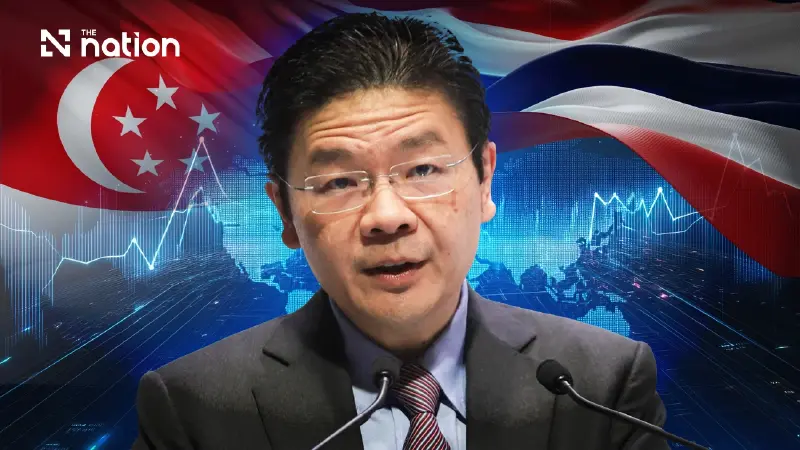


Singapore’s Lawrence Wong says trust, openness and wider partnerships are essential as geopolitical rivalry reshapes trade and global security.
- In response to a fragmenting world marked by geopolitical rivalry and vulnerable supply chains, Singapore's core strategy is to actively build more international partnerships.
- The nation plans to leverage its reputation for trust, built on the rule of law and reliable institutions, as a strategic advantage to attract partners in an unstable environment.
- A key part of this strategy involves strengthening regional integration through its upcoming ASEAN chairmanship and expanding its network of partners both within and outside Southeast Asia.
- This approach combines international openness with domestic resilience, aiming to remain globally connected while securing essential supplies and preparing for future shocks.
Singapore’s economy expanded by 5.9% year on year in the second quarter of 2026, compared with Thailand’s growth of 1.9%. Although GDP alone cannot capture the full health of an economy, the contrast raises an important question: how has Singapore continued to record strong growth amid volatile energy prices, disrupted supply chains and intensifying geopolitical rivalry?
Singapore’s full-year growth forecast has since been raised to between 4.5% and 5.5%, supported partly by strong global investment in artificial intelligence-related technology. Thailand, meanwhile, recorded slower second-quarter growth despite continued support from exports and private investment.
Prime Minister and Finance Minister Lawrence Wong offered part of Singapore’s answer during his National Day Rally on August 23: in a world becoming more divided, Singapore must build more partnerships, not fewer.
A changing balance of global power
Wong began by describing an international system in which the rules and norms that supported decades of stability and prosperity were being overturned.
The United States remained the world’s leading power, he said, but China had risen rapidly to become a peer competitor with considerable capabilities across many fields. Neither country could overpower the other, and neither could afford to disengage entirely.
Yet the world was not shaped by Washington and Beijing alone. Europe remained an important power, India was rising rapidly and middle powers were increasingly asserting their interests.
Influence was therefore becoming more widely distributed, while countries competed for markets, technology, resources and, ultimately, the authority to determine the rules of the international system.
Three crises expose global vulnerabilities
For several decades, countries reduced trade barriers, opened their economies and allowed supply chains to spread across borders. Tariffs declined, while the World Trade Organization and other international institutions provided broadly accepted rules.
Businesses assumed that when one supplier failed, another could readily take its place.
That confidence was shaken by three major crises.
The Covid-19 pandemic exposed the fragility of supply chains as countries competed for masks, medical equipment, vaccines and even basic household goods.
Russia’s invasion of Ukraine then demonstrated the risks of excessive dependence on one supplier, particularly when Russia cut gas deliveries to Europe.
The crisis in the Middle East and disruption to shipping through the Strait of Hormuz revealed further vulnerabilities involving energy, food and other essential supplies.
Countries have learnt from these shocks, Wong argued. Security now carries greater weight in economic decisions, while governments increasingly use trade, technology and investment to pursue strategic and national-security objectives.
Trade is no longer driven by economics alone
Wong pointed to US trade measures as evidence of this wider shift.
After earlier tariff policies faced legal setbacks, Washington introduced new pressure linked to allegations that imported goods had been produced using forced labour.
Singapore agreed that forced labour must not be tolerated, but Wong argued that international cooperation and common standards offered a better response than import tariffs.
The United States has also raised concerns that Chinese goods are being routed through other countries, particularly in Southeast Asia, to evade US tariffs.
Wong said the underlying principle was clear: businesses could not disguise a product’s true origin by sending it through another country. Singapore had laws and enforcement mechanisms in place and would investigate credible evidence of wrongdoing.
However, he also stressed the practical limits faced by a major re-export and transshipment centre. Goods passing through Singapore arrive from around the world, making it impossible for the authorities to verify every part of every product’s supply chain.
Singapore would continue explaining its position to Washington, but the wider reality was that international trade was no longer as free as it once had been.
Trade policy had become inseparable from strategic rivalry and security concerns.
Regional wars could escalate beyond their borders
Tariffs were only one symptom of deeper global tensions, Wong said.
Great-power competition was intensifying, while major conflicts continued in Europe and the Middle East. Although such wars might appear distant from Southeast Asia, they could draw in other powers through alliances, national interests or events that forced governments to respond.
New technology had also increased the danger. Relatively inexpensive drones could inflict serious damage even on much stronger military forces.
One side might take action and another respond, with each claiming self-defence. Step by step, a regional confrontation could expand far beyond what either had initially intended.
Major wars were not always deliberately planned, Wong warned. They could emerge when events escalated beyond anyone’s control.
Countries also faced pressure below the threshold of conventional warfare, including economic coercion, foreign interference, disinformation and cyberattacks against critical infrastructure.
This more contested, unstable and dangerous environment was not a temporary disruption, he said, but a new normal that Singapore would have to navigate for years.
Trust becomes a strategic advantage
Singapore’s response would not be to retreat from the world.
The country had succeeded by remaining connected, creating value within global supply chains and serving as a centre for business, finance, capital, talent and ideas.
All those strengths depended on one essential asset: trust.
Countries, companies and investors trusted Singapore because of its rule of law, strong institutions and respect for contracts and commitments.
“When Singapore gives our word, we keep it,” Wong said.
In a world where trust was becoming increasingly scarce, that reputation remained one of the country’s greatest advantages.
Singapore would therefore strengthen its international connections. As other countries pulled apart, it would pursue “more connections, not fewer”, widen its network of partners and make itself increasingly relevant to the global economy.
ASEAN central to Singapore’s response
Singapore will assume the ASEAN chairmanship in 2027 and intends to use the role to strengthen the grouping’s unity and centrality.
Wong said Singapore would seek deeper regional integration and a more effective single market, while expanding partnerships with countries outside Southeast Asia.
The objective would be to bring diverse partners together, identify common ground and keep channels for dialogue and cooperation open.
This did not mean relying entirely on other countries. Singapore would still have to maintain the capacity to stand on its own and protect its people during a crisis.
Its strategy therefore combines openness with resilience: maintaining international connections while securing essential supplies, strengthening domestic capacity and preparing for future shocks.
A lesson extending beyond Singapore
The broader lesson for Thailand is that a fragmented world does not necessarily require smaller countries to choose isolation or dependence on one major power.
Instead, they can diversify partnerships, strengthen ASEAN, enforce internationally recognised trade rules and develop a reputation for reliable institutions and consistent policies.
Singapore’s economic performance also shows the value of positioning the country within expanding industries and international supply chains while continuing to invest in technology, skills and institutional credibility.
The challenge is to remain open without becoming vulnerable, and connected without becoming excessively dependent.
Wong’s central message was that Singapore could no longer rely on the global environment of the past. As geopolitical competition intensifies, trade fragments and technology reshapes industries and employment, the country must strengthen its own resilience while building deeper links with the outside world.
For Singapore, the more divided the world becomes, the greater the need for trusted partners.
Source: Krungthep Turakij
