
Thai military warns of full response if Cambodia attacks
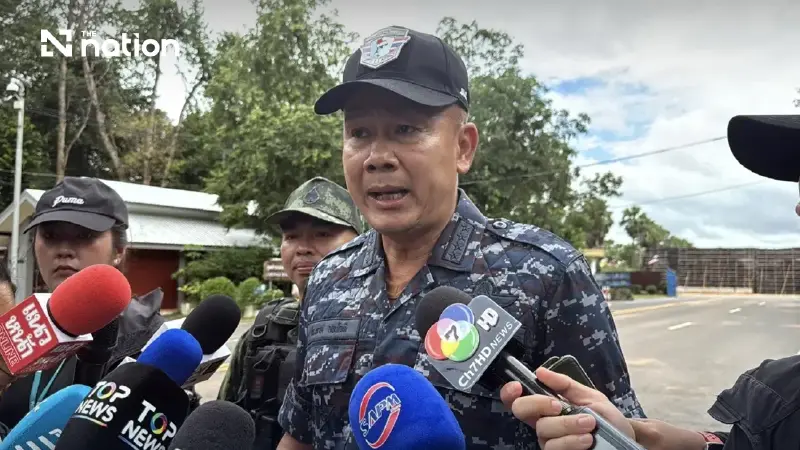


Prapas Sornchaidee urges bilateral talks and reduced provocation, saying Thai deployments are defensive and not intended to redraw the border.
Air Chief Marshal Prapas Sornchaidee warned on Monday (September 7) that Thai forces would respond at full strength, using ground troops, air power and artillery, if Cambodian soldiers attacked Thai personnel near the Chong Chom border checkpoint in Surin.
However, he urged both sides to reduce provocations, build mutual trust and resolve their differences through bilateral talks, acknowledging that the proximity of their forces increased the risk of confrontation.
Prapas is assistant commander-in-chief of the Royal Thai Air Force and director of the Joint Information Center on the Thailand-Cambodia Situation (JIC).
He spoke in the O Smach area after leading the ASEAN Observer Team (AOT), together with Thai and international journalists, on a visit to the permanent crossing in Kap Choeng district.
He also stressed that Thailand’s current deployments were not intended to determine the boundary or seize Cambodian territory.
Infiltration and gunfire allegations
Citing reports from personnel in the area, Prapas alleged that Cambodian forces had attempted to enter and had cut barbed-wire fencing at two or three points.
Thai troops had captured people he described as Cambodian soldiers attempting to infiltrate the area disguised as villagers. He said such incidents had occurred two or three times.
Thai soldiers had to act in accordance with their rules of engagement, he said, arguing that a failure to respond could allow Cambodian troops to establish a position in the area.
Prapas said the air force was ready to support ground troops.
“If Cambodian troops attack, destroy the barbed-wire fence and harm Thai soldiers, that would mean hostilities have begun, wouldn’t it?” he said.
“And once that happens, we will have to respond at full strength, with ground forces, air power and artillery.”
Separately, Lt Col Khayakorn Chotiphanat, commander of the 25th Infantry Battalion, alleged that Cambodian forces were continuing to fire provocatively along the sector under his unit’s responsibility. He was responding to a question about whether provocations had continued after tensions eased.
Prapas rejects territorial ambitions
Prapas said Thai forces were operating under the Chakrabongse Bhuvanath Plan to defend the border and the country, with coordination among all three armed services. He reiterated that the plan was not intended to seize Cambodian territory.
“If we were going to seize Cambodian territory, we would have to fight across the entire country, and it would become a fairly large war requiring everyone to work together,” he said.
He added that a united effort would be needed if Cambodia did not stop. Prapas also said he had been told that Cambodia had many “ghost soldiers”, with troop numbers differing from those officially reported, and that some personnel were afraid.
He sought to reassure the public that Thailand was not standing idle and had defensive positions and equipment ready to protect the country.
On diplomatic efforts, Prapas said the Foreign Ministry was presenting Thailand’s account of the facts and chronology to international audiences. He accused Cambodia of distorting events and said he believed the international community would recognise what he described as false claims.
Reducing provocations, building trust and using bilateral channels remained the best way forward, he said.
Anti-tank defences and weapons at Chong Pling
The delegation also inspected more than 10 kilometres of surrounding terrain that Prapas described as sensitive. He said Thai troops had established strong defences, including anti-tank ditches that would prevent Cambodian tanks from entering.
At Chong Pling, Thai forces had retaken a position using a single battalion, he said. The site had held explosives and ammunition, particularly rocket-propelled grenades (RPGs), all of which he said had been destroyed.
Thai forces had also removed one truckload of Cambodian weapons to retain as evidence. Prapas said the discoveries indicated, in his view, that Cambodian forces had intended and prepared to carry out some form of operation.
The visit also included a moo kratha barbecue meal for the entire battalion to boost the morale of personnel who had been working intensively, he said.
Khayakorn said troops remained ready at all times to defend Thai sovereignty and that the unit’s equipment was combat-ready. Commanders at every level had conducted regular inspections, with full support provided to address any shortages.
The battalion had received all the military equipment and specialised tools needed to continue its duties, he said, adding that morale remained very high.
