
Indonesia fires scorch 202,000 hectares, fuel cross-border pollution
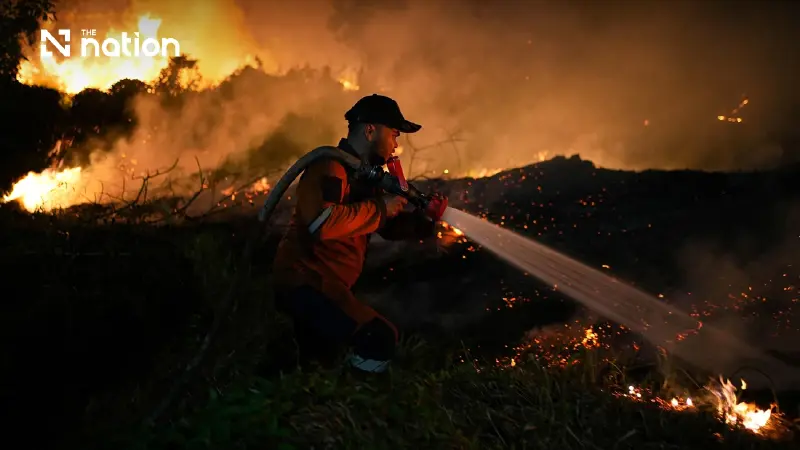


Peat fires in Indonesia are sending haze across Southeast Asia, while cheap land clearing and funding shortages complicate prevention
- Over 202,000 hectares of forest and land in Indonesia burned in the first seven months of the year, an area nearly three times the size of Singapore.
- Smoke from the fires has created a cross-border haze, polluting the air and affecting public health in neighboring countries such as Malaysia, Singapore, and the Philippines.
- While an El Niño-fueled drought has intensified conditions, the fires are primarily attributed to human activity, specifically the use of fire as a cheap method for clearing land for agriculture.
- The burning of carbon-rich peatlands is a major concern, causing tens of thousands of respiratory infections locally and threatening to release enormous amounts of stored carbon into the atmosphere.
Forest and land fires have burned more than 202,000 hectares in Indonesia during the first seven months of 2026, as smoke spreads across Southeast Asia and exposes weaknesses in peatland protection and fire prevention.
Haze from burning forests and peatlands has affected Malaysia, Brunei and Singapore, and reached the Philippines, threatening public health and wildlife.
Indonesia’s Forestry Ministry recorded more than 202,000 hectares of burned land between January and July, equivalent to over 1.26 million rai and nearly three times Singapore’s size. About 94,539 hectares burned in July alone, with much of the damage concentrated in Sumatra and Kalimantan.
The January–July total has already exceeded the figures for the same periods in 2019 and 2023, although it remains below the 2.6 million hectares burned during the whole of 2015. Indonesia’s Forestry Ministry

Drought intensifies the risks from land clearing
Indonesia’s Meteorology, Climatology and Geophysics Agency, or BMKG, has identified El Niño as a factor intensifying the fires. Prolonged drought dries out vegetation, fallen branches and leaves, allowing a small ignition to spread rapidly.
Fire hotspots have also emerged beyond the main affected areas, including Java, Sulawesi and West Papua.
Yosi Amelia, climate and ecosystem programme lead at environmental organisation Madani Berkelanjutan, said Merauke in South Papua was becoming another centre of concern as forests were cleared for large agricultural estates and energy projects.
Degraded peatlands compound the danger. Naturally waterlogged peat resists burning, but drainage for agriculture and industry lowers the water table and leaves the soil highly combustible.
Ronny P Sasmita, a senior analyst at the Indonesia Strategic and Economic Action Institution, argues that drought alone does not explain the crisis: human activity accounts for about 99% of ignitions.
He points to the financial incentive to burn. Mechanical clearance of a hectare of peatland costs approximately US$566–850, compared with US$28–57 using fire—potentially a saving of around 95%, before environmental damage is considered.

Peat fires release carbon stored for centuries
Once ignited, dry peat can burn beneath the surface for weeks or months, making fires difficult to locate and extinguish.
Dr Nisa Novita, a peatland researcher at Yayasan Konservasi Alam Nusantara, or YKAN, said waterlogged conditions slow decomposition, allowing carbon to accumulate underground over thousands of years. Drainage and fire can turn these stores into “carbon bombs”.
One widely cited estimate puts Indonesia’s peat carbon stock at around 57 billion tonnes, or approximately 55% of the world’s tropical peatland carbon. That estimate does not represent 30% of carbon in all peatlands worldwide. Nature Communications research
In parts of Kalimantan, peat deposits exceed 20 metres in depth and can store more than 6,000 tonnes of carbon per hectare. Expressed as carbon dioxide, that stored carbon is comparable to the annual emissions of roughly 4,800 cars. The comparison describes the carbon stock, rather than the emissions necessarily released by a single fire.
Restoring water levels and blocking drainage canals can reduce emissions and make degraded peat less susceptible to burning. However, restoration does not guarantee that fires will cease permanently, and its effectiveness depends on local conditions and implementation. Research on peatland restoration
Health effects extend across borders
More than 50,000 acute respiratory infections were reported in fire-affected areas during July and August, including over 12,000 cases among children under five. Copernicus wildfire update
Indonesia’s Health Ministry has also reported elevated respiratory infection numbers nationally, identifying the dry season and forest fires as contributing factors. Those nationwide figures should not be interpreted as cases caused solely by wildfire smoke. Health Ministry comments reported by Antara
For volunteers confronting the fires, smoke is an immediate hazard.
Fahrin Ramadhianto, a volunteer firefighter in Banjarbaru, South Kalimantan, described it as the worst part of the work. Burning peat produces a distinctive smell resembling charred, rotting wood because the soil contains accumulated decomposed timber and other organic material.
Another volunteer, Dwi Sujatmoko, compared the smoke to tear gas.
“When the smoke hits your nose, your eyes immediately start burning,” he said. “Everyone says these fires are unusually intense, both the flames and the thick smoke, and that is true. If the underground peat fires spread beyond control, the losses will be enormous.”
Across the border, hundreds of schools in Malaysia’s Sarawak state temporarily closed to protect pupils from haze. CNA’s reporting on the school closures
In the Philippines, haze pushed pollution in the Manila area to more than four times the World Health Organization’s recommended level, prompting advice to wear N95 masks. Unhealthy air recorded in the Philippine capital region amid haze
Arrests and calls for stronger prevention
Indonesian police have arrested 72 suspects and are examining financial evidence to establish whether companies commissioned or funded land clearing linked to the fires.
Rizal Irawan, a senior Environment Ministry official, said authorities would investigate whether fires were accidental or deliberately started, while applying strict liability when fires occurred within corporate concession areas.
Environmental groups argue that enforcement and emergency firefighting must be accompanied by prevention.
Amelia said the crisis should be understood as a structural problem involving forest management, spatial planning, land tenure and water management, rather than simply a natural disaster.
Funding constraints have also weakened the response. Sasmita cited cuts to central government transfers and shortages that left each forest firefighter in West Kalimantan responsible for around 144 hectares, equivalent to 900 rai.
He also criticised administrative barriers that had delayed access to approximately US$3.96 million in emergency funding, while personnel and volunteers struggled with shortages of basic protective equipment and water pumps.
Sasmita called for reforms including:
- Publishing all forest concession maps to improve transparency.
- Using anti-money-laundering legislation to pursue the assets of those responsible for illegal burning.
- Allocating funds through ecological fiscal transfers that reward local authorities for protecting peatlands.
- Strengthening regional cooperation under the ASEAN Agreement on Transboundary Haze Pollution.
