
Thailand and Cambodia head into next UNCLOS maritime round
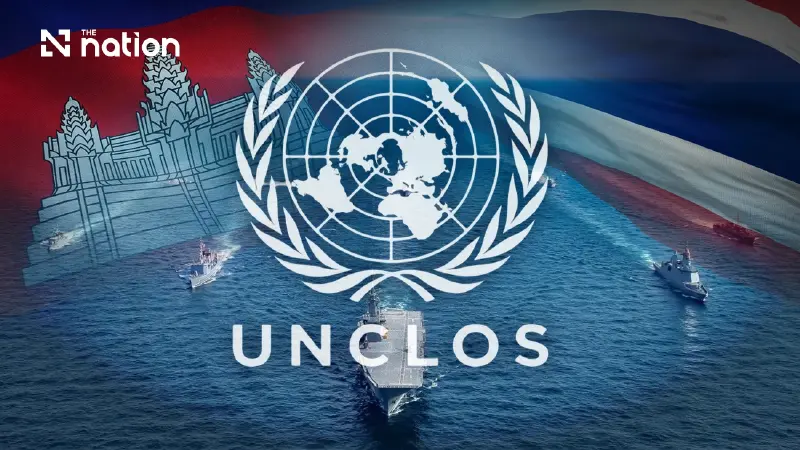


Thailand and Cambodia set out contrasting maritime positions under UNCLOS as talks move to The Hague, with boundaries and offshore resources at the centre.
- Thailand and Cambodia have begun a new round of conciliation talks under the UN Convention on the Law of the Sea (UNCLOS) to resolve their maritime boundary dispute over an area with valuable offshore resources.
- Cambodia, which initiated the process, is seeking either a definitive maritime boundary treaty or an interim agreement for the joint development and equitable sharing of resources.
- Thailand's counter-position is that the maritime boundary must be formally delimited first, before any discussions on sharing resources can begin.
- Following an initial meeting in Singapore, the next round of more detailed technical and legal discussions is scheduled to take place in The Hague.
Thailand and Cambodia are entering a new phase of diplomatic engagement over their maritime boundary dispute and potentially valuable offshore resources, with the two sides setting out markedly different approaches before an international conciliation process.
A key challenge identified in the Thai analysis is not only presenting Thailand’s legal and factual case, but also managing international perceptions arising from the difference in size and capacity between the two countries. Cambodia may be perceived internationally as the smaller party in the dispute, while Thailand has sought to present its own account of the broader border tensions.
The two countries presented their positions at the first meeting of the Conciliation Commission under the United Nations Convention on the Law of the Sea (UNCLOS), held in Singapore from September 14–16, 2026. Opening statements were delivered on September 15. The Permanent Court of Arbitration (PCA) serves as the registry for the proceedings.
Cambodia seeks boundary treaty or joint resource development
Prak Sokhonn, Cambodia’s Deputy Prime Minister and Minister of Foreign Affairs and International Cooperation, led the Cambodian delegation as its Agent.
Cambodia maintained that Thailand’s unilateral termination of the 2001 memorandum of understanding governing negotiations over overlapping maritime claims had removed the existing bilateral framework and led Phnom Penh to initiate compulsory conciliation under UNCLOS.
Prak said Cambodia wanted the process to lead to a treaty establishing a single, all-purpose maritime boundary between the two countries in accordance with international law.
As an alternative, Cambodia said it was prepared to conclude an agreement with Thailand on the joint development and equitable sharing of resources while awaiting a final maritime boundary settlement.
The offshore resources therefore form an important part of Cambodia’s proposed options, although its published opening statement referred to “equitable sharing” rather than specifying a 50:50 division.
If neither a boundary agreement nor a joint-development arrangement can be concluded, Cambodia has proposed that the Conciliation Commission issue recommendations that could provide a basis for a later agreement.
Thailand argues maritime delimitation should come first
Thailand’s delegation was led by Sihasak Phuangketkeow, Deputy Prime Minister and Minister of Foreign Affairs, also serving as his country’s Agent.
In his opening statement, Sihasak challenged Cambodia’s account of the deterioration in relations and its explanation for turning to compulsory conciliation.
He accused Cambodia of presenting itself internationally as a victim while, according to Thailand, acting inconsistently with its stated commitment to international law.
Sihasak cited incidents including rocket attacks that Thailand says killed Thai civilians and landmine explosions that injured Thai soldiers. These were presented as Thailand’s allegations and account of the border conflict, rather than findings by the Conciliation Commission.
He also set out Thailand’s explanation for terminating the 2001 MOU. According to Sihasak, only two rounds of official negotiations had been held over 25 years and the framework had produced no concrete progress.
Thailand therefore wanted to restart negotiations on what it regarded as a firmer common legal basis following Cambodia’s ratification of UNCLOS.
Sihasak said he had proposed direct negotiations on the maritime boundary and suggested that, if no agreement could be reached within six months, the two countries could then proceed jointly to conciliation. He therefore rejected Cambodia’s assertion that it had been left with no alternative after Thailand terminated the MOU.
Koh Kood remains outside the proceedings
Another key Thai position concerns Koh Kood.
Sihasak told the Commission that the UNCLOS proceedings concern only maritime boundary delimitation between Thailand and Cambodia in the Gulf of Thailand and do not concern sovereignty over land territory, including Koh Kood.
Thailand also rejects Cambodia’s 1972 continental shelf claim line, maintaining that it has no legal basis.
Thailand’s position is therefore that maritime delimitation should be settled before discussions on joint development or the sharing of offshore resources.
The Thai government has also stressed that the UNCLOS process is separate from disputes concerning the countries’ land boundary.
Timor-Leste case provides a reference point
Cambodia has cited the compulsory conciliation between Timor-Leste and Australia over the Timor Sea as evidence that the UNCLOS mechanism can break a longstanding maritime deadlock and produce a negotiated settlement.
The cases, however, have different histories, legal circumstances and negotiating positions.
The Timor-Leste–Australia conciliation ultimately resulted in a 2018 treaty establishing permanent maritime boundaries and a special regime for the Greater Sunrise gas fields. The agreement addressed both maritime delimitation and arrangements for resource development.
For that reason, the precedent may provide lessons on the conciliation process, but does not in itself determine how the Thailand-Cambodia dispute should be resolved.
Next round moves to The Hague
The first Singapore meeting marked only the opening stage of the process, meaning neither side’s legal position has been accepted or rejected by the Commission.
Thailand and Cambodia adopted the Terms of Appointment and Rules of Procedure and presented their respective positions before holding more detailed discussions with the Commission. The overall conciliation process is expected to take around 12 months, after which the Commission is expected to issue a report containing conclusions or recommendations that are not legally binding.
The Thai government said the next meeting is expected to take place in The Hague, the Netherlands, with both sides moving into more detailed technical and legal discussions.
“The Thai position is that maritime delimitation should come first, with other matters considered afterwards,” Sihasak said following the Singapore meeting.
He said the next stage would involve technical details, particularly the different claim lines, the principles on which they were drawn and their precise locations.
“We will have to examine all of that. From now on, we have homework to do,” he said.
“Thailand is prepared, with a team from the Ministry of Foreign Affairs and relevant agencies, including the Royal Thai Navy, as well as our advisers. We have already begun discussing how we need to prepare from now until the next meeting.”
Thailand’s official delegation includes specialists from the Foreign Ministry, the Royal Thai Navy’s Hydrographic Department and Naval Operations Department, and the Department of Mineral Fuels under the Energy Ministry.
Wider political and economic pressures
Thailand sees little need to rush the negotiations thanks to greater room for manoeuvre in domestic politics, economic relations, energy supplies and security.
Meanwhile, Cambodia is facing pressures including domestic political considerations, economic effects from border restrictions, investment concerns and the impact of crackdowns on transnational scam operations.
What is clear from the two countries’ formal statements is that they currently differ over the sequence of any settlement.
Cambodia has proposed either a comprehensive maritime boundary treaty or, as an alternative, joint development and equitable sharing of resources pending final delimitation. Thailand, by contrast, has placed maritime boundary delimitation at the centre of the proceedings and says resource-sharing should not take precedence over determining the boundary.
With the process now moving into more detailed legal and technical discussions, the dispute remains unresolved, and the Conciliation Commission has yet to make any conclusions or recommendations on the competing positions.
Source: Krungthep Turakij
