
Border markers 52–59 fuel political row between Hun Manet and Cambodian critic
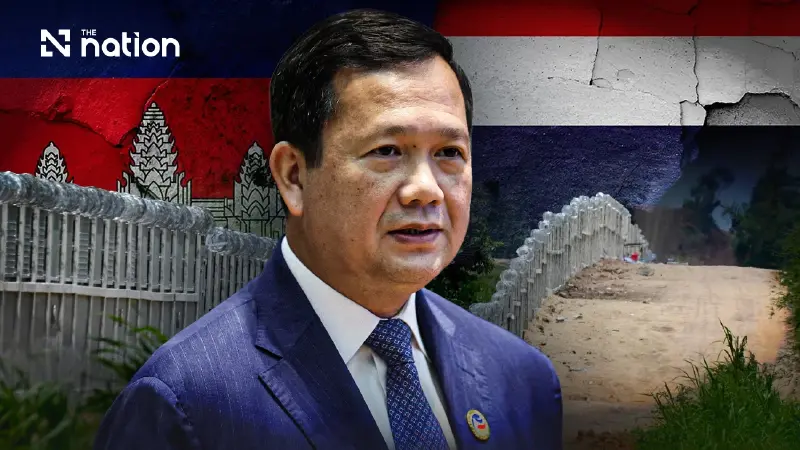


A Thai border-fence project near markers 52–59 has become a political flashpoint in Cambodia as Hun Manet challenges an opposition critic to prove land-loss claims.
A Thai-Cambodian border-fence project in Chanthaburi has become a political flashpoint in Cambodia, after former opposition lawmaker Um Sam An accused Prime Minister Hun Manet’s government of allowing Cambodian territory to be lost to Thailand.
The controversy centres on the border sector between Boundary Markers 52 and 59, opposite Pong Nam Ron district in Chanthaburi and Cambodia’s Battambang province.
Thailand is developing an 8.38-kilometre pilot security fence along the sector, while the two countries have also conducted joint technical work through the Thailand-Cambodia Joint Boundary Commission (JBC).
Um has alleged that temporary boundary markers installed through the bilateral process were placed inside Cambodian territory and has accused Hun Manet’s government of conceding land to Thailand in exchange for peace and political power.
Hun Manet has rejected the allegations and challenged Um to present documents and evidence to Cambodian border experts for verification. Cambodia’s government has also offered security guarantees for Um or representatives acting on his behalf.
Um plans to send delegation to Cambodia
Um, who lives outside Cambodia, initially raised concerns about returning personally and called for legal and political guarantees before making the trip.
Hun Manet subsequently offered him the option of appointing a delegation to meet the State Secretariat of Border Affairs and examine evidence relating specifically to markers 52–59.
Um later announced on Facebook that he would accept the invitation by sending representatives to Cambodia.
“I will send a delegation representing me to Cambodia next month in response to Hun Manet’s invitation,” he wrote, adding that he would submit an official response and the names of his representatives before the end of October.
Hun Manet has set conditions for the discussions.
They must focus exclusively on technical questions concerning markers 52–59, while Um’s representatives must bring documents and evidence supporting the allegation that Cambodia has lost territory.
The delegation will not be permitted to use the visit for other political activities.
Cambodian authorities said discussions could take place after November 28 because the government would first be occupied with other international commitments.
Border issue emerges ahead of Cambodian elections
The dispute has added another politically sensitive border issue to Cambodia’s domestic debate as the country prepares for commune and Sangkat council elections on June 6, 2027, followed by a general election in 2028.
Border sovereignty has long been a highly sensitive subject in Cambodian politics, with both government and opposition figures facing intense public scrutiny over territorial questions.
The latest disagreement has therefore moved beyond the physical construction of the fence and into a debate over the government’s handling of border demarcation.
For Thailand, however, security officials maintain that the dispute is primarily a Cambodian domestic political matter.
An unnamed Royal Thai Navy source told Krungthep Turakij that there were currently no problems on the ground and that Thai and Cambodian officials continued to communicate and coordinate regularly.
The source said both sides were seeking to maintain an atmosphere conducive to peace, exercise restraint and resolve issues through established mechanisms and international law.
Thailand and Cambodia signed a ceasefire agreement on December 27, 2025, after renewed border fighting. The agreement called for restraint, continued communication and the resumption of border survey and demarcation through the JBC.
Fence construction advances towards Marker 59
The Thai pilot project in Pong Nam Ron covers a total planned distance of 8.38 kilometres between markers 52 and 59.
The initial 1.31-kilometre section between markers 52 and 54 has been completed. Thai authorities have previously described this section as an area where the boundary has been agreed through bilateral mechanisms.
Construction has since moved towards Marker 55.
As of October 24, work on the approximately 3.45-kilometre section between markers 54 and 55 was reported to be more than 70% complete.
The next section is planned to extend about 3.62 kilometres from Marker 55 to Marker 59, with road construction and preparations under way. A bridge across a canal is also being considered as part of that section.
The entire project would bring the security fence to about 8.38 kilometres.
Thai military officials have maintained that construction is being coordinated with Cambodia and that the fence is intended to strengthen border security, surveillance and efforts against illegal crossings and transnational crime rather than alter the international boundary.
The political dispute in Cambodia, however, remains focused on the temporary border markers and Um’s allegation that their placement disadvantaged Cambodia.
With Cambodia approaching its 2027 local elections and 2028 national poll, the dispute risks keeping the border question prominent in domestic politics even as officials on both sides continue technical talks and construction work along the frontier.
Source: Krungthep Turakij
