
Thailand Vows to Defend Sovereignty Whilst Upholding International Humanitarian Law
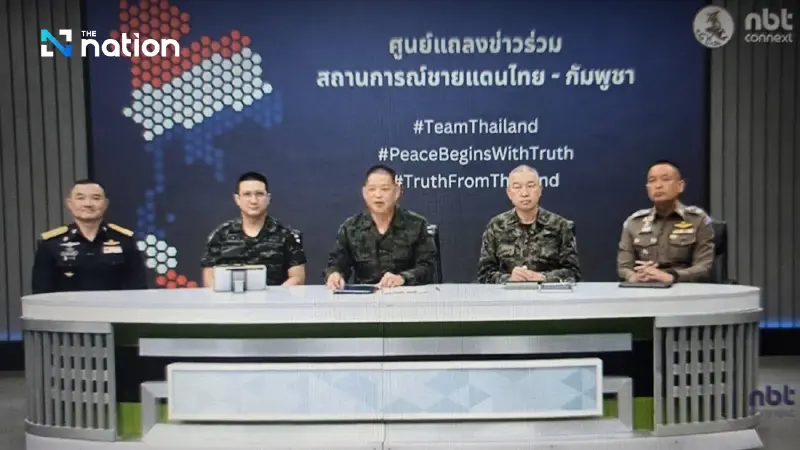


Government pledges strict adherence to IHL as military operations continue following border clashes that left one soldier dead, 29 injured
- Thailand is conducting military operations along its border with Cambodia to defend its national sovereignty and territorial integrity following recent deadly clashes.
- The Thai government publicly affirms that all its military actions strictly adhere to international humanitarian law, emphasizing the protection of civilians, proportionality, and distinction of targets.
- Officials have briefed international diplomats on this dual stance, stating that military measures will continue until Cambodia ceases hostilities, while remaining open to peace.
- Thailand contrasts its focus on military targets with alleged indiscriminate attacks by Cambodian forces on civilians and medical facilities to underscore its own lawful conduct.
Government pledges strict adherence to IHL as military operations continue following border clashes that left one soldier dead, 29 injured.
Thailand has reaffirmed its commitment to defending national sovereignty whilst strictly adhering to international humanitarian law, as military operations continue along the Cambodia border following clashes that began on 7th December 2025.
The newly established Joint Press Centre, comprising officials from the Ministry of Defence, Ministry of Foreign Affairs, and security agencies, held its inaugural briefing on 9th December, emphasising Thailand's determination to protect its territorial integrity through lawful military action.
"Thailand reaffirms that all Thai actions strictly adhere to international humanitarian law with the objective of limiting the severity of clashes, emphasising the protection of civilians and the wounded, distinction of targets, proportionality, and military necessity," Thai Rear Admiral Surasant Kongsiri, spokespersons of the Ad hoc Centre for the Thailand - Cambodia Border Situation declared.
Firm Stance on Sovereignty
The Thai government has taken an unequivocal position on defending national territory, with the Ministry of Foreign Affairs outlining Thailand's stance to diplomats from 73 countries and international organisations.
"Thailand is determined to defend its sovereignty and territorial integrity, and therefore military measures must be taken as necessary to protect Thailand's sovereignty and territorial security," officials stated during the diplomatic briefing.
The government emphasised that military operations would continue "until Cambodia changes its stance such as returning to the genuine path of peace," signalling a firm resolve to safeguard national interests whilst remaining open to peaceful resolution.
Officials noted that the Thai public has lost patience with what they described as actions disregarding Thailand's dignity and honour, stating that "the Thai government must place utmost priority on protecting and safeguarding the sovereignty and our people until such hostilities from Cambodia cease."
Commitment to International Standards
In a stark emphasis on lawful conduct, Thai authorities highlighted the distinction between their operations and alleged actions by opposing forces.
Thai operations focus solely on military targets to reduce Cambodian military capabilities, officials stated, while expressing concern over alleged indiscriminate weapons use.
"This stands in stark contrast to the weapons used by the Cambodian forces which have caused harm to civilian lives and property," Rear Admiral Surasant said, adding that "Cambodia's use of weapons continues to be directed at innocent civilians, civilian sites, and medical facilities with apparent intent to cause chaos and panic among the population."
Thailand's adherence to international humanitarian law encompasses protection of civilians, proportionality in military response, distinction between military and civilian targets, and limitation of unnecessary suffering—principles that officials emphasised guide all operations.

Coordinated Military Response
The Royal Thai Army has conducted operations covering all five provinces along the Thailand-Cambodia border, successfully gaining ground and securing areas for public safety.
One Thai soldier has been killed and 29 injured in the clashes that began when Cambodian forces allegedly initiated fire into Thai territory on 7th December in Sisaket province.
The Royal Thai Navy conducted operations in Trat province, with the Royal Thai Marine Corps emphasising that actions were based on proportionality and the right to self-defence—key principles of international law governing armed conflict.
The Royal Thai Air Force continues providing support using fighter jets and military aircraft, whilst the Royal Thai Police have enhanced deployment to protect civilian areas and secure shelter centres for evacuated residents.
Additional security measures have been implemented for ongoing events including the SEA Games 2025.
Peace Through Security
"Thailand desires peace, but peace must come with safety and security of the people," Rear Admiral Surasant emphasised, encapsulating the government's position that genuine peace requires both sides to respect sovereignty and cease hostilities.
The government stated that Cambodia has violated ceasefire agreements and a joint declaration signed by the two nations' prime ministers in October, resulting in the suspension of that declaration.
Despite this, Thailand maintains that its door remains open for Cambodia to "return to the genuine path of peace."
The Joint Press Centre will continue providing updates through daily briefings at 10:00 and 16:00 hours, broadcast on television channels 5 and NBT, as well as through participating agencies' websites.
Thailand's dual commitment—to defend sovereignty firmly whilst upholding international humanitarian standards—represents the government's effort to balance national security imperatives with its obligations under international law during this developing border situation.
