
TDRI warns populism risks fiscal trap and credit downgrade


Populist handouts risk a fiscal trap and possible credit downgrade; the next government to focus on jobs, sustainable welfare and open data to curb graft
Thai academics and business leaders have warned that election populism is becoming a fiscal trap that could weaken economic stability and raise the risk of a credit-rating downgrade, urging the next government to stop competing on handouts and focus on structural reform.
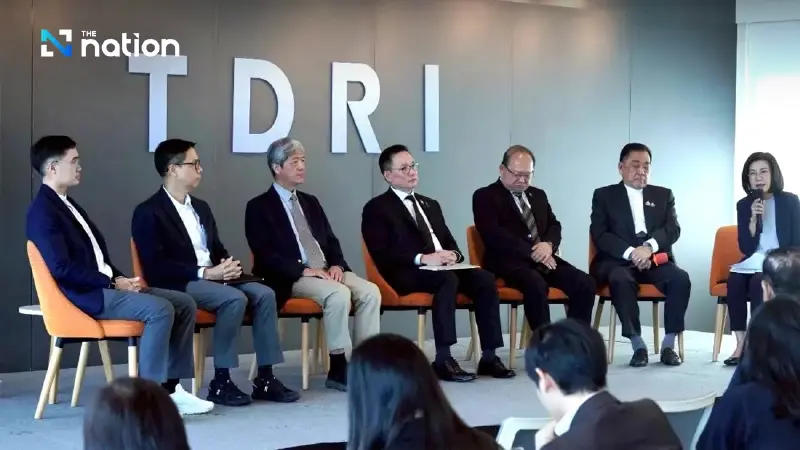
On Tuesday, January 7, 2026, the Thailand Development Research Institute (TDRI) hosted a public forum titled “They hand it out, but we pay: Rethinking political party policies”, gathering views from the private sector and academics on what policies the country needs in the short term (within one year) and the longer term (over four years). The forum argued parties should scale back populist policies that create long-term fiscal burdens.
Private sector: handouts become debt
Poj Aramwattananont, chairman of the Thai Chamber of Commerce and Board of Trade of Thailand, said populist policies are typically funded through the state budget and borrowing, which ultimately becomes public debt that citizens share through higher taxes. He said if one looks back over the past three to five elections, only a small share of campaign promises were implemented — and when they were, they often created follow-on problems, citing schemes such as pledging and price guarantees.
He said politics should shift from consumption-focused populism towards policies that create jobs and income, which would be more sustainable for the country in the long run.
Kriengkrai Thiennukul, chairman of the Federation of Thai Industries, said populist policies are turning into a national trap that undermines economic creativity. He warned that rating agencies have started to take a more negative view of Thailand as fiscal burdens rise. He also said some policies have hurt competitiveness, citing minimum wage pledges, and argued that “handouts” require skill and must be productive rather than causing long-term harm.
Academics: fiscal metrics near red lines
Prof Dr Athiphat Muthitacharoen of Chulalongkorn University’s economics faculty said Thailand’s fiscal position is increasingly worrying. He said tax revenue has fallen from about 17% to 14% of GDP over the past 20 years, while interest payments now account for about 11% of net revenue, close to a 12% credibility benchmark. If Thailand continues running deficits of around 4–5% of GDP as a norm, he warned, the country’s credit rating could come under pressure — even within this year — raising borrowing costs for both the public and private sectors.
Payong Srivanich, president of the Thai Bankers’ Association, compared populist policies to steroids: effective only briefly, while leaving vulnerable groups trapped in poverty rather than lifting them out. He warned Thailand could have less capacity to absorb shocks such as disasters or climate-change impacts, while competitors like Vietnam and Indonesia have more positive outlooks. He also said Thailand’s economy is structurally fragile, noting that about 65% of GDP is driven by only 1% of businesses, while 99% remain vulnerable. He cited rapid ageing, a shrinking base of income earners, and a large informal economy — estimated at 48% — as factors that make it harder to expand the tax base.
TDRI: separate ‘welfare’ from ‘populism’
Dr Somchai Jitsuchon, research director for inclusive development at TDRI, said good policy must distinguish between welfare and populism. A sustainable welfare system must be designed as a full package, with funding sources clearly explained. He said a sustainable welfare state also requires public acceptance of higher taxes in exchange for greater equality — something he suggested Thai society may not yet be ready for.
He added that improving fiscal discipline and value-for-money checks on budget spending is urgent. He said effective “productive” support should build long-term capacity, such as skills programmes delivered through training vouchers, so spending is converted into lasting skills rather than short-lived consumption.
Anti-corruption: open data first, then AI
Assoc Prof Torplus Yomnark, director of the Knowledge Center for Anti-Corruption, stressed transparency, calling for linked open data to prevent corruption in government projects. He said Thailand still lacks effective data integration. While parties increasingly talk about AI, blockchain and big data, he said these are “end goals” — because AI cannot work without data to analyse.
He cited global standards such as the Open Data Charter, which sets out at least 30 datasets, and said research indicates Thailand should open and link 25 key datasets as a baseline. If those 25 datasets can be linked, he said, the use of AI or blockchain to detect corruption would become genuinely effective.
