
Schools authorised to close immediately as Thailand steps up flood response
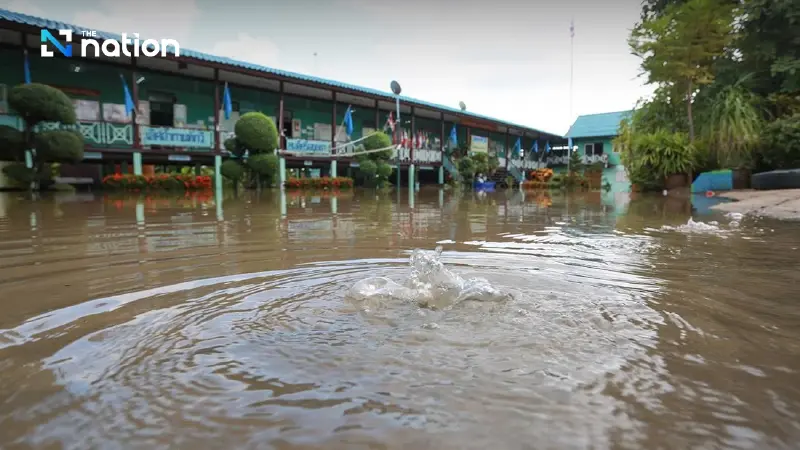


Thailand’s Education Ministry has ordered proactive flood measures for schools nationwide, allowing immediate temporary closures, real-time reporting and alternative learning formats as heavy rain warnings continue.
Thailand’s Education Ministry has empowered school administrators nationwide to order temporary closures immediately if flooding, landslides or flash floods threaten student safety, as the government shifts towards a more proactive disaster-response approach.
Captain Phatdarasmi Thongsaluaykorn, deputy government spokesperson, said on Sunday (June 7) that the measures were designed to protect students as the top priority, while ensuring that schools can respond quickly to rapidly changing weather conditions.
Under the new measures, schools must assess risks on the ground and report flood situations in real time via the LINE application. The reporting system will be used to speed up approval of relief bags and essential supplies for affected schools and communities.
Schools told to switch learning formats during crisis
During flood emergencies, schools have been instructed to adjust teaching and learning formats according to local conditions.
Classes may be shifted to online learning, on-hand learning through printed materials, or on-demand learning where students can study through recorded or prepared content.
Teachers have also been asked to ease homework and examination requirements during the crisis to help reduce stress on students and parents.
The ministry has also instructed schools to prepare safe areas that can serve as temporary evacuation centres for nearby communities if needed.
Recovery plans after floodwaters recede
Once the situation improves, schools must quickly prepare make-up examination plans, provide replacement learning materials and coordinate repairs to damaged buildings.
Vocational education repair centres for communities will be asked to send technician teams to help repair school buildings and facilities.
Schools must then report damage in order to request assistance budgets from the Office of the Basic Education Commission.
They have also been told to work with local administrative organisations on longer-term improvements to drainage systems to reduce repeated flood risks.
Govt shifts from reactive to proactive approach
The measures follow a joint assessment with the Thai Meteorological Department and the Department of Disaster Prevention and Mitigation, which found that flooding, landslides and flash floods were becoming more severe.
Government data from the past three years showed repeated disaster impacts on schools, particularly in 2025, when about 2,000 schools and 160,000 students were affected.
The government said the pattern of repeated and overlapping disasters had made it necessary to move from a reactive response to proactive prevention.
Agencies warn of heavy rain and flash-flood risks
The Education Ministry’s measures come as key agencies continue to warn of heavy rain in several parts of the country.
The Thai Meteorological Department said in its Sunday (June 7) forecast that the East, the western coast of the South and the Central region would see heavy rain in some areas, while very heavy rain was expected in parts of the western North. It warned that accumulated rainfall could trigger flash floods and forest run-off, especially in low-lying areas and communities near waterways.
The department’s seven-day outlook for June 6-12 also warned of heavy rain in parts of Thailand, with very heavy rain possible in the North and upper Northeast. It advised people in risk areas to beware of flash floods, forest run-off and river overflows, while small boats in the upper Andaman Sea were told to remain ashore because of strong waves.
Meanwhile, the Department of Disaster Prevention and Mitigation earlier warned six southern provinces — Ranong, Phang-nga, Phuket, Krabi, Trang and Satun — to monitor forest run-off, flash floods, inundation, landslides and strong waves from June 3-8. The department also instructed local authorities to prepare response teams, machinery and temporary shelters in case evacuations are needed.
