
Thap Lan land rights panel planned to separate villagers from investors
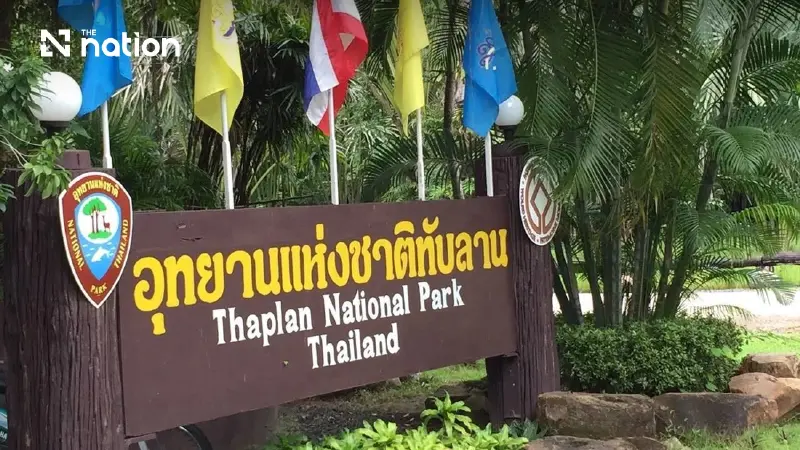


Suchart Chomklin says a Thap Lan rights panel will verify plots case by case, protect genuine villagers and prevent investors exploiting boundary changes
- The Thai government is establishing a committee to verify land rights within Thap Lan National Park.
- The panel will conduct a plot-by-plot verification of claims to distinguish genuine, long-settled villagers from illegitimate claimants.
- A primary goal of the committee is to prevent investors and speculators from illegally acquiring land during a controversial boundary adjustment.
- The initiative addresses public concern that a proposal to remove over 150,000 rai from the park could benefit commercial interests instead of local residents.
Natural Resources and Environment Minister Suchart Chomklin has said the government is preparing to set up a committee to verify land rights in Thap Lan National Park on a plot-by-plot basis, as it seeks to protect genuine long-settled villagers while preventing investors from exploiting the controversial boundary adjustment.
Speaking at Government House, Suchart said the Thap Lan issue should not be reduced to political point-scoring or social media emotion, after influencers, actors and conservation supporters joined the “Save Thap Lan” campaign in response to a proposed adjustment of more than 150,000 rai of national park land.
The minister said the issue had been under discussion before he took office and had to be understood from both sides. While conservation groups fear the loss of protected forest, he said many villagers had lived in the area for decades before the land was later declared part of the national park.

Suchart says villagers’ hardship must not be politicised
Suchart said the public should imagine the situation of families who had lived in the same place for many years, only to find that the land they occupied had later been designated as national park territory.
He said Prime Minister Anutin Charnvirakul had assigned him to help resolve the dispute fairly for all sides, not to favour one group over another.
The minister said academics and specialists had already explained parts of the issue, adding that his own explanations may not have reached the public loudly enough. He said experts should be allowed to help clarify the facts so that the debate does not deepen misunderstanding.
Suchart warned against using the hardship of tens of thousands of families as a political issue or a topic for casual argument. He said the government’s task was to find a practical and fair solution for people who may have been caught in overlapping state land maps for decades.
Viral forest images ‘not from Thap Lan’
Suchart also addressed images being shared on social media showing elephant herds and forest areas, saying they were not from Thap Lan National Park but from other areas.
He urged the public not to spread misleading information, saying inaccurate images could inflame concern and distort understanding of the real boundary issue.
The area that has caused particular concern, he said, includes the Thai Samakkhi village cluster. Suchart said he had already discussed the issue with the ministry’s permanent secretary, department chiefs and groups worried that the land might be handed to the Agricultural Land Reform Office, or ALRO, before eventually falling into the hands of investors.
Rights to be checked plot by plot
Suchart said the government would set up a committee within three to four days to examine land rights in detail.
The committee will verify claims on a plot-by-plot basis to identify villagers who genuinely qualify for land-use rights and to prevent people with no legitimate claim from benefiting from the process.
He said the aim was to make the facts clear to the public and reduce social division over the issue.
Suchart also stressed that ALRO has its own rules for land allocation and use. The land-reform system is intended to support farmers, not to create an opening for capital groups to accumulate land through nominees or misuse of legal loopholes.
A group of villagers is expected to submit a letter at Parliament on June 24 to thank the prime minister for taking up the issue, Suchart said.
Minister rejects claim of one-man decision
Suchart said some villagers were worried that pressure from campaigners could cause the government to reverse course.
He insisted that the decision-making process had involved several committees and was not based on his personal view alone. He said many academics sat on the committees and that the conclusion had been reached unanimously.
He also rejected the idea that he could personally control committee votes, saying the matter involved multiple agencies and experts.
Suchart said the government wanted the media and public to understand that many affected families were genuinely poor and had suddenly found themselves living on land later classified as national park land or agricultural reform land.
Old boundaries still shape today’s dispute
The minister said part of the dispute dated back to overlapping state land decisions in the late 1970s and early 1980s.
He referred to land-reform areas linked to 1978 before Thap Lan was declared a national park in 1981, leaving some communities caught inside the park boundary despite claims that they were already living there.
Suchart said earlier boundary drawing had been intended to protect forest areas at a time when Thailand was dealing with timber concessions and concerns over further forest encroachment.
However, he said communities that existed before the park declaration should now have the opportunity to prove their rights through a proper process.
The wider Thap Lan dispute has long centred on overlapping maps and competing claims between forest protection and communities seeking secure land rights. A recent DNP explanation said the boundary review was intended to resolve a decades-old land-rights conflict while maintaining protection for the Dong Phayayen-Khao Yai World Heritage forest.
Boundary row remains under public scrutiny
The controversy intensified after the National Parks Committee approved a revised boundary plan on June 15, under which 155,865.47 rai would be removed from Thap Lan National Park and transferred to relevant state agencies, mainly ALRO, for land-rights management. Another 109,420.99 rai of disputed land would remain inside the park pending further verification.
The “Save Thap Lan” campaign has reflected public concern that withdrawing land from the national park could benefit investors, land speculators or resort developers rather than local residents. Conservation groups and citizens have also warned that the authorities must clearly distinguish genuine villagers from illegal commercial encroachers.
Suchart said the principle should be to verify the facts. Those who lived there before the park declaration should be allowed to prove their rights, while people who do not meet the criteria should not be allowed to use the process as a channel for land grabs.
Government says fairness is the goal
Suchart said he was not discouraged by the criticism, because he believed he was acting for people who were genuinely poor and had been left in legal uncertainty.
He said the government’s instruction was clear: ensure fairness for all sides and verify the land situation based on facts.
“If we do not solve this today, after 50 years of delay, we may have to wait another 50 years,” Suchart said.
For the government, the next test is whether the planned verification committee can produce a process trusted by both sides, one that protects forest integrity while giving long-settled communities a fair chance to prove their rights.
