
PM Anutin backs six measures to curb outbound drug smuggling
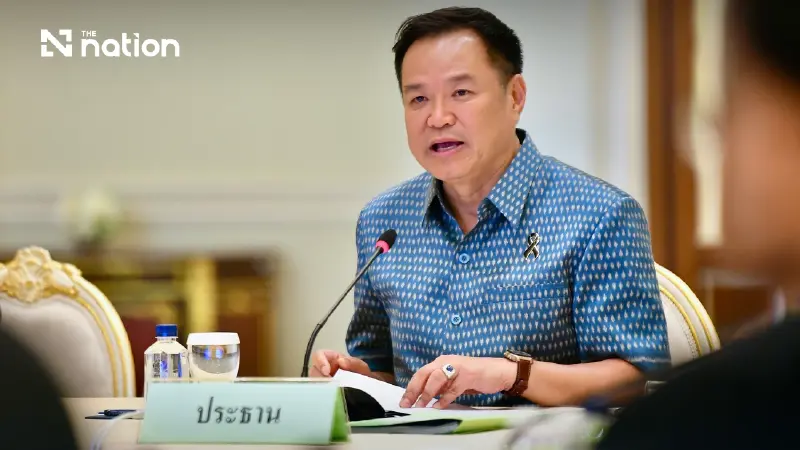


Government agencies were told to share data and tighten baggage checks as measures were set out to stop drugs being carried abroad.
- Authorities will increase the efficiency of outbound screening for both passenger and crew baggage using X-ray scans and K9 sniffer dogs.
- Airlines will enforce strict rules for crew members against carrying items for others, with severe penalties including the revocation of professional licenses for violations.
- A new Passenger Information Unit (PIU) will be established to upgrade the exchange of international passenger data, supported by linked databases between customs, airports, and related agencies.
- The capacity and training for personnel responsible for inspecting passenger and crew baggage will be improved.
At the Phakdi Bodin Building, Government House, Prime Minister Anutin Charnvirakul chaired the Narcotics Control Board meeting.
He emphasised that drugs are a major and urgent problem affecting the public and society as a whole.
He also stressed that he was personally overseeing the Narcotics Control Board in his capacity as prime minister, and asked committee members to give full priority to tackling the problem.
Government Spokesperson Rachada Dhnadirek said the Prime Minister had emphasised that Thailand’s drug situation was affecting and causing hardship to the public.
One cause was that drug production sources were in the Golden Triangle, a high-capacity production area, particularly for methamphetamine pills and crystal methamphetamine.
This had led to drug trafficking networks along the border smuggling drugs into Thailand, staging them in inland areas and transporting them through logistics systems for further distribution across different areas, where they were traded and spread in villages and communities.

Children and young people were at greater risk of entering the drug cycle more quickly.
In addition, drug-related psychiatric symptoms were also causing hardship for many people in villages and communities.
He instructed all agencies, including the Immigration Bureau, Airports of Thailand and related agencies, to link and exchange data to integrate their work and increase the efficiency of preventing and suppressing offences.
The Prime Minister also emphasised the case involving a female Thai Airways cabin crew member, saying all parties must proceed carefully and prudently, focus on gathering complete evidence and coordinate the submission of the case file to Australian authorities for legal action.
The case had caused significant damage to the reputation of Thailand and the airline.

The meeting acknowledged measures to control and intercept drugs from being transported abroad, as follows:
- Airports of Thailand, working with the Customs Department and the Royal Thai Police, will increase efficiency and raise the standard of outbound screening of passenger baggage and transported baggage through X-ray scanning and K9 sniffer dogs.
- Airports of Thailand will make crew baggage checks stricter.
- The Civil Aviation Training Centre, Thai Airways and other airlines will introduce strict rules for crew members on accepting items to carry or items entrusted by others, and will impose serious disciplinary action. Violations will result in professional licences being revoked.
- The meeting approved the Customs Department’s drafting of a Prime Minister’s Office order to establish a Passenger Information Unit (PIU) to upgrade the exchange of international passenger data, Passenger Name Record (PNR).
- The Civil Aviation Training Centre will improve capacity development for personnel responsible for inspecting passengers’ and crew members’ baggage.
- Database links will be established among the Customs Department, Airports of Thailand and related agencies so that information can be managed efficiently.
In addition, the meeting approved in principle the Operation to Eliminate Narcotics, which is in line with the government’s policy statement and the Prime Minister’s instructions to suppress drugs in all forms.
All agencies were assigned to prepare linked and consistent operational plans at every level, from districts and provinces to ministries and related agencies, to drive concrete solutions to the drug problem.
The plans cover seven areas:
- Upgrading international cooperation.
- Strengthening border security.
- Suppressing drug trafficking networks and state officials involved in them.
- Reducing the impact on the public.
- Addressing problems involving drug-related psychiatric patients.
- Implementing the 1 District, 10 Treatment policy.
- Building a safe society.
