
Japan quake kills 13 as rescuers race to find survivors, 300,000 ordered to evacuate


Rescuers are searching a collapsed Kumamoto shopping centre as 260,000 people remain under evacuation instructions after the magnitude 7.1 quake
At least 13 people were killed after a magnitude 7.1 earthquake struck Japan’s southern Kumamoto Prefecture, as emergency teams raced to find survivors beneath collapsed buildings.
Prime Minister Sanae Takaichi announced the revised toll on Wednesday, one day after the earthquake, which had initially been reported to have killed three people.
“Even now, there are people waiting to be rescued, and this is a race against time,” Takaichi told reporters in Tokyo, pledging to deploy all available resources to the rescue operation.
The earthquake cut electricity to thousands of homes, damaged major roads and caused several buildings to collapse or catch fire. The full scale of the destruction remained unclear.

Workers missing after mall collapse
Rescuers pulled eight people from the rubble of a partially collapsed Aeon Mall early on Wednesday.
Two women in their 20s were killed when an apparent explosion tore through the shopping centre about an hour after the earthquake. Authorities were investigating whether the blast had been caused by gas.
Fire rescue teams, police and Self-Defense Force personnel concentrated their search on parts of the building from which calls for help had been received.

Between 20 and 30 mall employees remained unaccounted for on Tuesday, according to public broadcaster NHK.
One side of the shopping centre, the largest in Kumamoto Prefecture and home to around 200 shops, was torn away by the explosion. Footage showed exposed steel beams and debris scattered across the car park.
Mall operator Aeon reported that customers and staff had been evacuated immediately after the earthquake. The precise cause of the explosion had not been established.
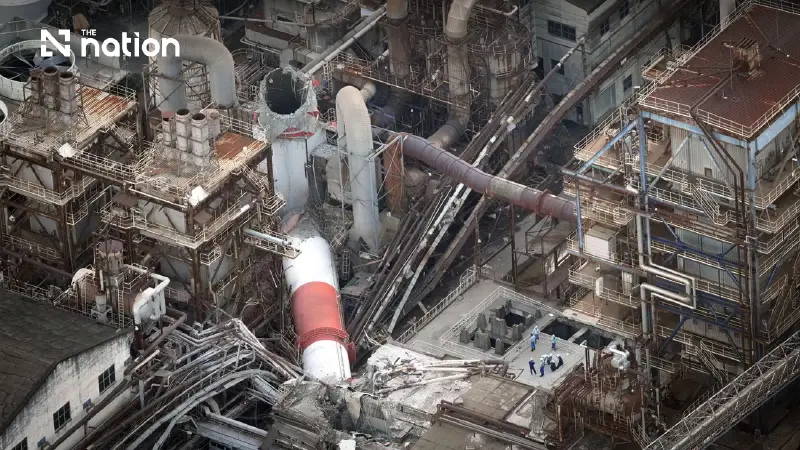
Seven people were also missing after a chimney collapsed at a Nippon Paper Industries factory. Four others were seriously injured, according to a local government official.
Hospitals across the affected area were treating dozens of patients.

Hospitals struggle after power cuts
A hospital in Uki, near the epicentre, was unable to function because of a power failure.
The head of its administrative department described conditions there as resembling a field hospital.
Another hospital in the city suspended new admissions after receiving 86 injured people, including three with serious injuries, saying it could no longer accept additional emergency cases.
Several passengers travelling on high-speed trains when the earthquake struck were also injured, railway operators reported.
Around 260,000 people across Kumamoto Prefecture were instructed to move to evacuation centres.
More than 36,000 homes remained without electricity on Wednesday. Authorities warned that the disruption could increase the danger of heatstroke as temperatures were forecast to reach about 34C.
Residents in areas that experienced the strongest tremors were advised to remain alert for further powerful earthquakes for about a week, as well as possible landslides.
The epicentre was about 20 kilometres south of Kumamoto City, the largest city in central Kyushu, with a population of approximately 700,000.

Factory operations remain suspended
Several major manufacturers with facilities in the region halted production.
Semiconductor equipment manufacturer Tokyo Electron and Honda planned to keep their local plants closed through Wednesday.
Taiwan Semiconductor Manufacturing Company evacuated employees from its Kumamoto plant as a precaution but began gradually resuming operations late on Tuesday.
Aeon shares fell 1.9% in early Tokyo trading, while Japan’s benchmark Nikkei index gained 0.8%.
Major roads were also badly damaged, with large cracks splitting highways and disrupting traffic across the region.
Japan lies on the Pacific Ring of Fire and accounts for about 20% of the world’s earthquakes with a magnitude of 6.0 or higher.
A major earthquake in Kumamoto a decade earlier killed 275 people, injured 2,739 and damaged thousands of buildings, including the walls of Kumamoto Castle.


