
Thai NACC widens local exam fraud probe and vows clarity within 6 months
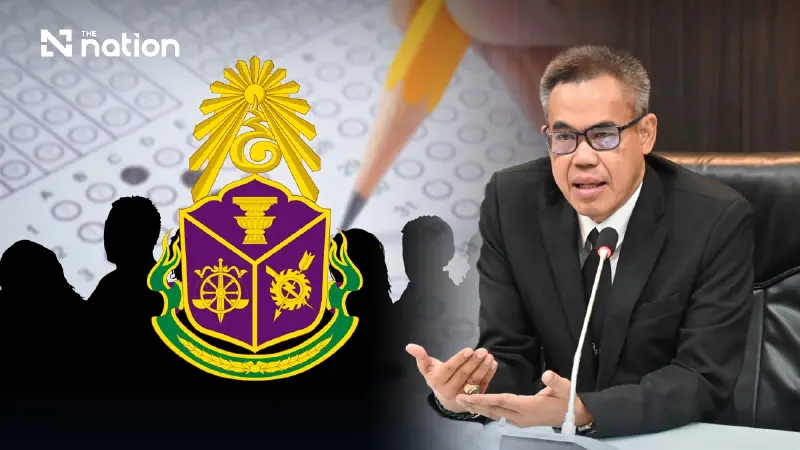


The NACC has resolved to recall local-exam case files previously sent to parent agencies for a special joint inquiry, while a TH-AI Passport complaint remains under examination.
- Thailand's National Anti-Corruption Commission (NACC) is expanding its investigation into local-government exam fraud after discovering financial trails exceeding THB 1 billion.
- The NACC has recalled case files from other agencies to conduct a consolidated, joint inquiry as a special case, finding that a connected group of people was involved.
- The commission has committed to providing clarity on the case within a six-month period beginning in June 2026, despite the case file containing over 800,000 pages.
National Anti-Corruption Commission (NACC) Secretary-General Surapong Intarathaworn gave an update on an investigation into alleged corruption in local-government recruitment examinations at the commission’s Sanambinnam office in Nonthaburi on Thursday (August 20, 2026).
According to Surapong, the inquiry panel was currently examining the matter, while checks on the financial trails of people arrested earlier had revealed fund flows of more than THB1 billion and links to alleged corruption in local-government examinations in 2021.
Surapong said the NACC had therefore resolved to recall case files previously sent to the respective parent agencies and conduct a joint inquiry as a special case after finding that a connected group of people was involved.
Details of the individuals concerned, including whether the links extended to politicians or senior officials, could not yet be disclosed because they formed part of the case files.
The working group nevertheless had information and would extend the inquiry to others involved.
The Anti-Money Laundering Office (AMLO) would help examine the financial trails, with the work already well advanced.
Surapong maintained that the NACC had never been subjected to political pressure.
Anyone implicated by the evidence would have to be held accountable, and the chain of accountability would not be cut short.
Whether any proceedings would be criminal or civil would depend on the evidence.
Surapong described the NACC as an independent body and a pillar of the country, stressing that any action against an individual had to be taken carefully and on the basis of evidence.
In cases where the NACC had found grounds for allegations and prosecutors had decided to bring charges, courts had handed down convictions in as many as 98% of cases.
Surapong maintained that the NACC could keep the case within the required time frame despite concerns that bringing it under the commission’s responsibility could cause delays.
He noted that the commission had scanned and reviewed every case.
Although the local examination-fraud case file contained more than 800,000 pages, he insisted there would be clarity within the six-month period beginning in June 2026.
The inquiry panel would make greater use of technology and consider which types of alleged offences should be handled separately to make the inquiry faster and clearer.
NACC examines TH-AI Passport complaint while project moves ahead
Surapong also outlined progress on a petition filed by Dr Warong Dechgitvigrom, a party-list MP and leader of the Thaipakdee Party, asking the NACC to investigate Minister of Digital Economy and Society Chaichanok Chidchob over whether the TH-AI Passport project involved favouring a private company and tailoring its specifications for that company.
The matter remained under examination.
The TH-AI Passport project is due to begin on Monday (August 31).
Surapong explained that case-related and monitoring measures were already being pursued in parallel, covering proactive and reactive operations, monitoring, law enforcement and corruption prevention.
Investigators were also already on watch in the area.
Public doubts also remained over whether the project could proceed.
Surapong stressed that implementing it was the government’s responsibility, while the NACC’s role was to examine it.
He added that the commission had proactive detection and screening measures which could help reduce corruption complaints, maintaining that there was no need for concern.
