
Deep South budget tops 340bn baht amid renewed attacks
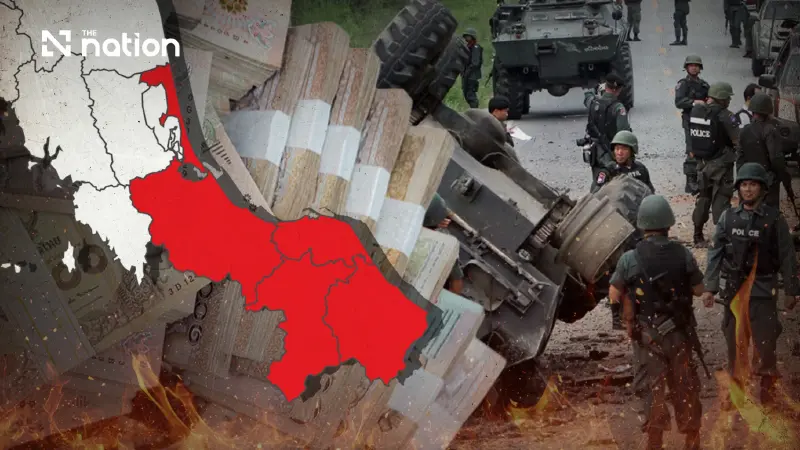


Parliamentary data show 340.7bn baht allocated from 2004–2026, while 23,536 violent incidents and 7,790 deaths were recorded to 2025.
Thailand allocated 340.71 billion baht under its principal programmes for addressing unrest in the southern border provinces over 23 fiscal years from 2004 to 2026, while separate statistics recorded 23,536 violent incidents, 7,790 deaths and 14,794 injuries between January 2004 and December 2025.
The figures have come under renewed scrutiny following a preliminary count of 34 coordinated incidents across Yala, Narathiwat and Pattani on Saturday night (August 22, 2026).
Forward Operations Coordination Centre 4 reported the 34-incident tally as of 9.42pm. It classified the incidents as 22 cases of arson or burning, six bombings, three disruptive shootings and three cases involving property damage or theft.
The attacks targeted telecommunications masts, closed-circuit television cameras, electricity infrastructure, vehicles belonging to local authorities and a convenience store. Caltrops were also scattered on roads in an apparent attempt to obstruct officials.
The simultaneous incidents were seen as evidence that those responsible retained the ability to organise operations across several locations despite more than two decades of government spending and security deployments.
Coordinated attacks spread across three provinces
Yala recorded the highest preliminary total, with 14 incidents in Raman, Bannang Sata, Than To and the Lam Mai area.
Reported actions included burning tyres, CCTV cameras, telecommunications masts and vehicles belonging to Subdistrict Administrative Organisations, as well as scattering caltrops along roads used by security personnel.
Narathiwat recorded 13 incidents across Ra-ngae, Cho-airong, Yi-ngo, Waeng, Tak Bai and Bacho districts.
The incidents included bombings, disruptive gunfire and the burning of tyres, buildings, electricity poles and an excavator. A pickup truck belonging to the Bo-ngo Subdistrict Administrative Organisation was also reported stolen.
Five incidents were initially classified in Pattani, covering Yarang, Yaring and Nong Chik districts.
They included the burning of a local authority vehicle and tyres, disruptive gunfire, the placement of a suspicious object and a bombing at a 7-Eleven branch in Bang Pu.
Details of two further incidents included in the total of 34 remained under examination.

Budget peaks in 2016 before steep decline
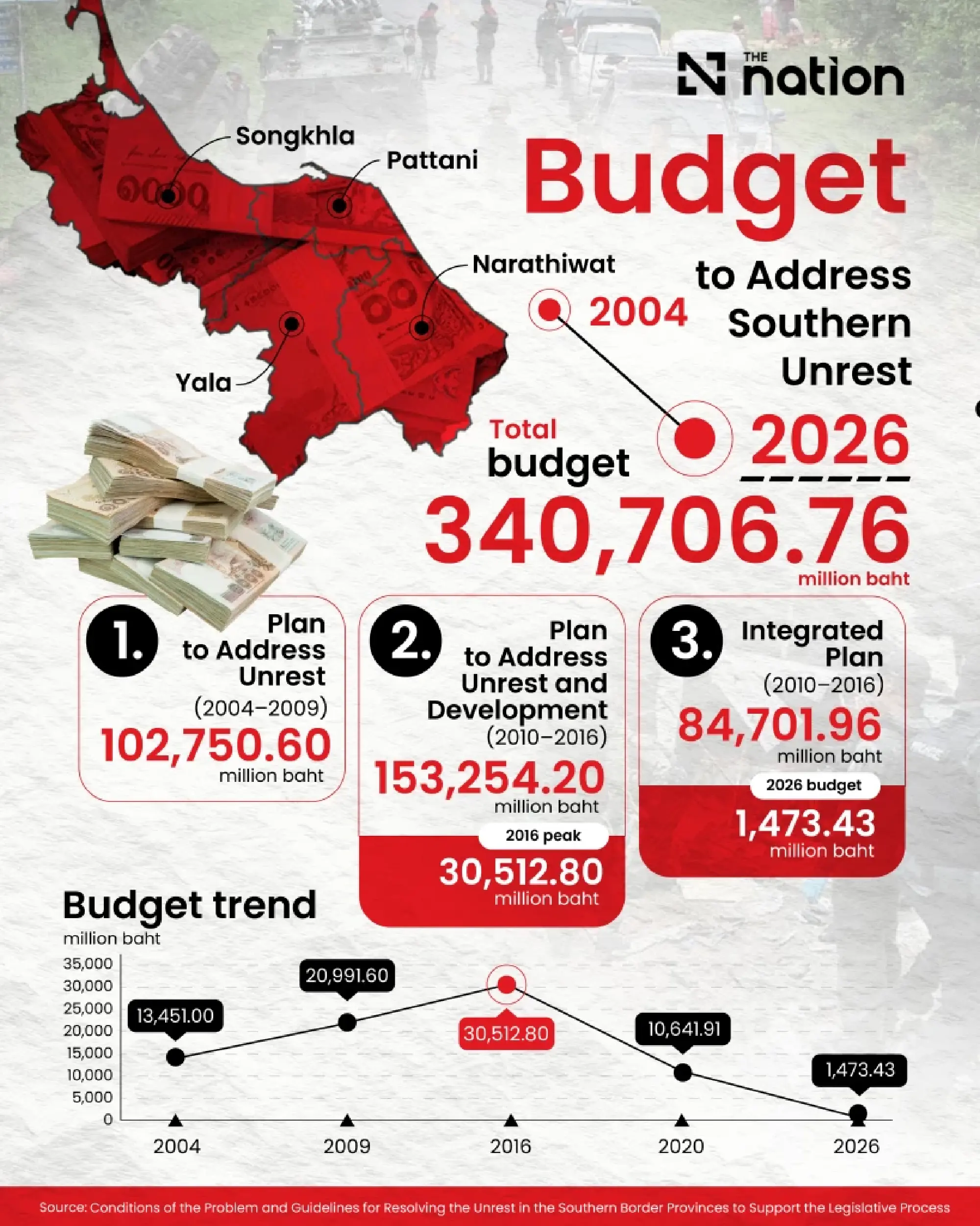
Data attributed to the Parliamentary Information Centre show that 340,706.76 million baht was allocated under the principal operational plans for the southern border provinces from fiscal 2004 through fiscal 2026.
Although the period represents roughly 22 elapsed years, it covers 23 fiscal years when both 2004 and 2026 are counted.
The analysis stated that total funding could approach 500 billion baht if other integrated development subsidies were included, although it did not provide a complete breakdown of that broader estimate.
The main-plan allocations were divided into three phases:
- Plan to Address Unrest, 2004–2009: 102,750.60 million baht. The annual allocation stood at 13,451 million baht in 2004 and 20,991.60 million baht in 2009.
- Plan to Address Unrest and Development, 2010–2016: 153,254.20 million baht. Annual funding reached its highest level in 2016 at 30,512.80 million baht.
- Integrated Plan, 2017–2026: 84,701.96 million baht. The annual allocation fell to 10,641.91 million baht in 2020 and 1,473.43 million baht in 2026.
The three phase totals add up to the stated overall allocation of 340,706.76 million baht.
The declining annual budget reflects changes in the structure of government programmes, but continued violence has prompted questions over whether strategy and resource allocation have kept pace with conditions in the region.
More than 23,000 incidents recorded since 2004
Cumulative statistics covering Pattani, Yala and Narathiwat, together with Chana, Thepha, Na Thawi and Saba Yoi districts of Songkhla, recorded the following totals from January 2004 to December 2025:
- 23,536 violent incidents
- 7,790 deaths
- 14,794 injuries
These figures use a broader incident-monitoring dataset and should not be treated as directly interchangeable with separate statistics based only on cases certified for government compensation.
The comparison also covers different periods: the budget data extend through fiscal 2026, while the cumulative violence figures end in December 2025.
Five structural fault lines identified
As a result, the budget and violence figures indicated that the southern conflict could not be resolved through funding and security operations alone.
It grouped the underlying challenges into five dimensions:
- Historical grievances: Tensions associated with the region’s historical background and the 1909 Anglo-Siamese Treaty.
- Governance and political administration: Centralised policies and state-led nationalism that have affected local identity.
- Identity and religion: The distinct Malay-Muslim way of life and the need for deeper cultural understanding.
- Economic structure: Resource allocation and development programmes that have not always corresponded with community livelihoods.
- Education: Curricula and educational resources that do not sufficiently reflect the linguistic and cultural context of the region.
The 34-incident wave should prompt the government and security agencies to reassess their approach, combining immediate protection and law enforcement with long-term work on historical grievances, cultural understanding and structural development.
Source: Bangkokbiznews
