
Thailand strengthens Mekong data links for faster cross-border flood warnings
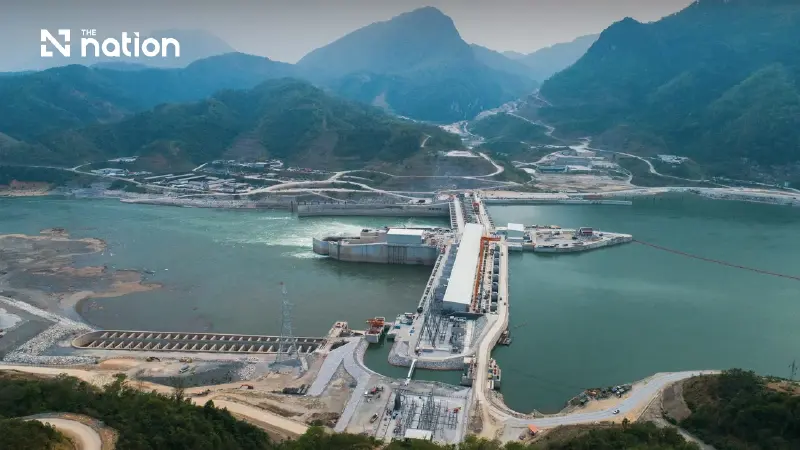


Thailand’s ONWR is linking data from 79 stations and 13 dams across the Mekong basin to improve forecasts, warnings and cross-border water management.
- Thailand's Office of the National Water Resources (ONWR) is enhancing data sharing with upstream Mekong countries to provide faster and more accurate flood warnings.
- The system utilizes the Mekong River Commission (MRC) to receive near real-time data from 79 monitoring stations and 13 major dams across the basin.
- Improved data allows authorities to better anticipate the effects of rainfall and dam releases from neighboring countries, enabling timely public alerts and water management measures.
- The long-term goal is to move beyond simple data exchange to coordinated actions, such as pre-releasing water from reservoirs based on shared forecasts to mitigate flood risks.
The Office of the National Water Resources (ONWR) is strengthening regional data links to improve Thailand’s ability to anticipate floods, dam releases and water-quality problems across the Mekong basin.
The Mekong is an international river stretching about 4,880 kilometres through six countries — China, Myanmar, Laos, Thailand, Cambodia and Vietnam. Changes in rainfall, water volumes, dam discharges or water quality in one country can affect communities further downstream.
Managing the river therefore requires continuous data exchange, coordination and international cooperation rather than action by any single country, ONWR said.
ONWR is positioning itself as Thailand’s central mechanism for connecting domestic water management with cooperation at basin and subregional levels.
The aim is to obtain information from upstream countries more quickly, assess potential effects more accurately and allow authorities to prepare water-management measures and issue timely public warnings.
Chumlap Tejasen, Assistant Secretary-General of ONWR and its spokesman for international water management, said the Mekong must be viewed as “a single system covering the entire basin” because water conditions do not stop at national borders.
“An important role for ONWR is to coordinate information and cooperation with neighbouring countries through international mechanisms and then integrate that information into Thailand’s water-monitoring and management systems,” he explained.

Data from 79 stations updated every 15 minutes
One of the principal mechanisms is the Mekong River Commission (MRC), established through cooperation among Thailand, Laos, Cambodia and Vietnam under the 1995 Mekong Agreement.
The MRC promotes and coordinates the sustainable management and development of water resources. Its work includes sharing meteorological and hydrological information, forecasting and warning of floods, and coordinating responses when water levels rise.
As secretariat of the Thai National Mekong Committee, ONWR connects this regional framework with Thailand’s domestic water-management operations.
It works with the Mekong River Commission Secretariat (MRCS) to monitor conditions along the river around the clock, analyse data supplied by member countries, translate and communicate the findings in Thai, and coordinate urgent alerts when cross-border effects are possible.
Information is currently linked from 79 meteorological and hydrological stations across five countries. Water-level data from the Mekong mainstream and its tributaries are updated in near real time every 15 minutes.
The MRCS also provides ONWR and member countries with five-day rainfall and water-level forecasts for areas along the Mekong, as well as information identifying locations at risk of flash flooding. The data are used to assess conditions and prepare response measures.
ONWR also monitors 13 major dams in four Mekong countries, covering reservoir inflows, water releases and storage volumes.
An urgent coordination group comprising representatives of member countries exchanges information and issues notifications about emergency dam discharges, giving downstream countries more time to prepare.
“Our goal is not merely to know that the water is coming. We must know early enough to manage it and coordinate with neighbouring countries quickly enough to reduce the impact on people,” Chumlap said.
“That is why ONWR attaches importance to improving cooperation on data and cross-border water management.”
Moving from data exchange to coordinated action
ONWR plans to help move Mekong cooperation beyond the exchange of information towards more proactive and coordinated water management.
Proposed measures include increasing the number of dams covered by the system, expanding the types of information exchanged and raising the frequency of updates.
Authorities also want to develop automated data-transmission systems, exchange power-generation and water-release plans in advance, and make emergency-notification mechanisms faster and more systematic.
One proposal under consideration is the pre-release of water from reservoirs.
The approach would use rainfall forecasts and projected reservoir inflows to determine whether some water should be discharged in advance. This could create additional storage capacity, reduce peak water levels and lower the risk of flooding with cross-border effects.
Such releases would need to be carried out through appropriate international coordination and data-sharing mechanisms, ONWR said.
Heavy-metal contamination raised at regional level
Beyond water volumes, ONWR is also using international cooperation to address water quality.
This includes heavy-metal contamination affecting the Kok, Sai and Ruak rivers, which are connected to the wider Mekong basin system.
The issue is being addressed through the MRC and direct coordination with Myanmar, while ONWR has also raised it under the Mekong–Lancang Cooperation (MLC) framework.
ONWR brought the water-quality issue before an MLC ministerial meeting and pushed for it to be included in a draft joint statement by regional leaders.
The move reflects an effort to elevate a problem affecting Thailand from local-level discussions to the wider subregional agenda.
“Future Mekong management must move in a direction in which every country receives information more quickly, coordinates more quickly and can turn that information into decisions more quickly,” Chumlap said.
“ONWR’s role is to connect this cooperation with practical operations in Thailand so that water management can deliver tangible reductions in risks to people’s lives, property and livelihoods.”
ONWR said its responsibilities therefore extend beyond monitoring domestic water conditions. The agency also serves as Thailand’s link to regional water-management systems, promoting joint management of Mekong resources based on shared information, coordination and mutual interests.
