
Global Resilience Under Strain: Key Takeaways from Day Two at the IMF-World Bank Meetings in Bangkok
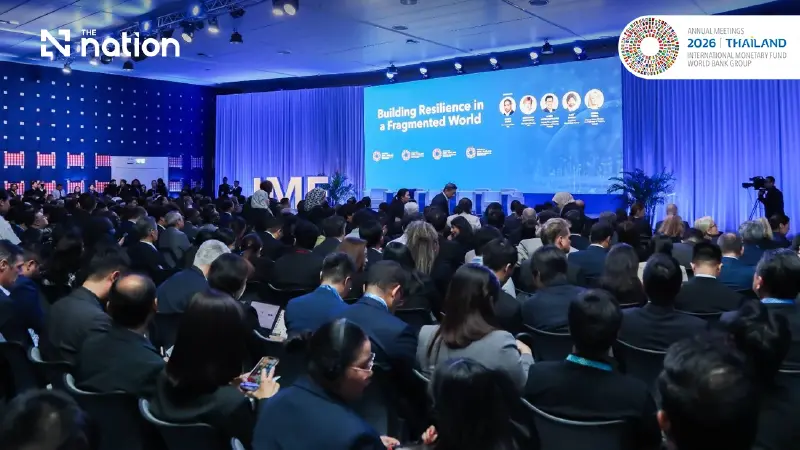


Global finance chiefs in Bangkok reject protectionism, urging fiscal discipline, AI safeguards and trade cooperation to face mounting risks
- The global economy is showing resilience but its safety buffers are thinning, with the IMF warning of downside risks from high public debt, inflation, and reliance on a concentrated AI supply chain.
- Key financial stability threats were identified, including a potential correction in AI stock valuations, a spike in government bond yields, and cyber threats targeting critical tech providers.
- A consensus emerged among global leaders to reject protectionism and self-sufficiency, advocating instead for open trade, cooperation, and diversification to build resilience.
- Discussions highlighted the need for safeguards for emerging technologies like AI and tokenized finance, and an evolving definition of resilience that supports workers and small businesses, not just macroeconomic stability.
Global finance chiefs in Bangkok reject protectionism, urging fiscal discipline, AI safeguards and trade cooperation to face mounting risks.
If there is one clear takeaway from the second day of the 2026 IMF-World Bank Annual Meetings in Bangkok, it is that while the global economy has put up a remarkably tough fight, its safety buffers are running dangerously thin.
The International Monetary Fund set a serious tone right out of the gate with its two flagship reports, the World Economic Outlook and the Global Financial Stability Report.
IMF Economic Counsellor Silvana Tenreyro summed up the mood quite frankly: the global economy has held its ground, but that resilience is under strain, and the risks are firmly tilted to the downside.
Global growth is expected to sit at 3.1 per cent this year before edging up to 3.4 per cent in 2027, with inflation hovering around 4.7 per cent before easing.
Asia-Pacific continues to do most of the heavy lifting thanks to a booming tech sector—India is steaming ahead at 7 per cent growth, China is holding around 4.5 per cent, and host nation Thailand is pegged at a steady 2.1 per cent.

But the IMF warned that we cannot rely on this momentum forever.
Energy inventories are depleted, growth is leaning heavily on a concentrated AI supply chain, and sky-high public debt is clashing with steep borrowing costs.
The Fund’s advice to governments was blunt: start tightening fiscal belts, keep support temporary and targeted, and for countries like the UK, simply stay the course.

Looking closely at financial markets, the stability report flagged three potential triggers that could sour market conditions very quickly.
First, a sudden correction in AI valuations—especially with so much debt and leveraged trading tied up in tech stock hype. Second, a spike in government bond yields driven by sticky inflation and debt worries. And third, cyber threats targeting the handful of tech providers keeping the global system running.
While commercial banks have handled the market swings well so far, the Fund urged emerging markets to build up their cushions before the next shock hits.

When top leaders gathered for Thailand’s flagship panel, Building Resilience in a Fragmented World, the consensus was clear: retreat and self-sufficiency are losing strategies; open cooperation and diversification are the only real way forward.
IMF Managing Director Kristalina Georgieva reminded everyone that macroeconomic stability is our first line of defence, warning against falling into complacency. World Bank President Ajay Banga pointed out that while private capital to emerging markets has surged to $112 billion, funding for the poorest, most fragile states has completely flatlined.

Finnish Finance Minister Riikka Purra firmly rejected the idea that smaller nations are helpless victims, while Thai Finance Minister Ekniti Nitithanprapas framed Thailand as a trusted connector between major powers, memorably declaring that even if others build walls, Thailand will build bridges over them.

This idea of building lasting resilience hit home during a special seminar reflecting on Thailand’s journey since it last hosted these meetings back in 1991.
Panellists noted that while post-1997 financial reforms made Thailand remarkably good at absorbing big macroeconomic shocks—evidenced by 10-year Thai bond yields holding around 2.4 per cent compared to 5 per cent in the US—that stability hasn't automatically translated into faster growth.
An ageing population, high household debt, and slowing productivity mean resilience has to evolve. It is no longer just about protecting the macro picture but actively helping small businesses and workers adapt through reskilling and better access to capital.

Bank of Thailand Governor Vitai Ratanakorn emphasised that monetary, fiscal, and digital policies must pull in the same direction, pointing to the country's PromptPay network—now boasting over 83 million registered accounts—as proof of how digital tools can drive inclusion when trust is built in from day one.
Thailand also used the day to push ahead on regional priorities, outlining a cross-border anti-fraud framework to tackle online scam networks and calling on the World Bank to help unblock the ASEAN Power Grid to power the region's digital future.

Over at the IMF New Economy Forum, the conversation turned to the future of digital finance. Heavyweights from Standard Chartered, Euroclear, Swift, and the Monetary Authority of Singapore agreed that tokenised markets will not run on one master ledger, but across interconnected, multi-network systems.
Making that work requires shared standards, deep liquidity, and central bank money as a trusted anchor. When discussing autonomous AI trading agents, the panel was comfortable giving AI room to operate—provided there are strict boundaries and human institutions remain strictly liable for everything their agents do.


And between the heavy macro debates, the host nation made sure delegates got a taste of local culture—literally. Venue halls were filled with traditional Khon dance performances and street-style fruit carts serving fresh rambutan from Surat Thani, coconut ice cream, and Chiang Rai Phu Lae pineapple, so popular that the first batch vanished within thirty minutes.
