
Finland outlines strategy to balance economic security and openness
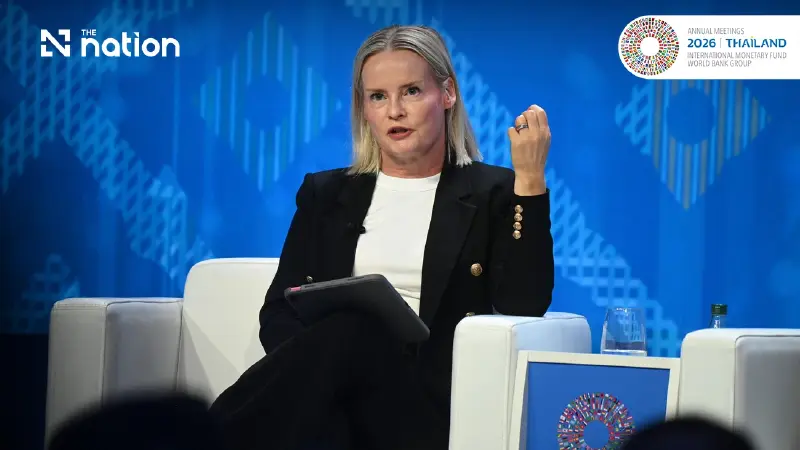


Riikka Purra highlights Finland’s energy strengths and strategic industries, warning that subsidy races disadvantage smaller countries with limited fiscal capacity.
- Finland's core strategy is to balance risk reduction with continued economic openness, rejecting complete self-sufficiency as inefficient and instead targeting specific vulnerabilities.
- The approach involves creating "reciprocal interdependence" by developing strengths in strategic sectors like clean energy, technology, and critical minerals that other countries depend on.
- Finland aims to enhance its security by diversifying supply chains, strengthening logistics, and working with trusted trading partners rather than severing ties.
- The strategy also identifies a key risk in EU-wide industrial subsidy races, which are seen as harmful to smaller economies and a distortion of market competitiveness.
Finland’s Deputy Prime Minister and Finance Minister Riikka Purra said the global shift towards economic security had made interdependence between countries increasingly important.
She was speaking at the 2026 Annual Meetings of the International Monetary Fund (IMF) and the World Bank Group.
That shift could create difficulties for small, open economies such as Finland, whose growth and prosperity have depended on deep integration into global value chains.
Small countries need not always be on the receiving end, however.
Purra cited Finland, which emerged under pressure from two great empires, Sweden and Russia, and learned to adapt and develop.
Its comprehensive security approach has provided a strong institutional foundation for overcoming crises.
Purra described the key economic strategy today as balancing risk reduction with continued economic openness.
Pursuing complete self-sufficiency was both impossible and wholly inefficient, while placing excessive emphasis on security would be self-defeating for an open economy.
Policy responses therefore need to target critical bottlenecks and specific risks strategically, reducing exposure to economic coercion and disruption.

For small countries, building reciprocal interdependence offers a more effective approach than severing existing ties or trying to become self-sufficient.
This involves developing strengths in areas on which other countries depend, while diversifying supply chains, strengthening logistics networks and working with trusted trading partners.
On competitiveness, Purra said Finland was ready to offer economic solutions through its technological expertise and production base in strategic industries.
She highlighted energy resilience, explaining that progress in the clean energy transition and electrification had given Finland the lowest electricity prices in Europe.
“With progress in the clean energy transition and electrification across society, Finland has the lowest electricity prices in Europe because low-carbon or fossil-free energy accounts for 95%.”
Finland is also accelerating investment in areas of comparative advantage, including Arctic expertise, icebreakers, telecommunications, critical minerals and smelting, space technology, quantum computing and cyber security.
Historical and geopolitical lessons involving Russia have driven Finland to remain alert, anticipate threats and prepare rapidly, making it resilient and capable of recovering independently.
“Finland’s sovereignty emerged under pressure from two great empires, Sweden and Russia, and we learned to adapt and develop continually. Our comprehensive security approach has therefore shaped our thinking and provided a strong institutional foundation.”
Purra also issued a measured warning about regional policy risks, identifying the expansion of industrial policy and subsidy races within the European Union (EU) as the most concerning risks at present.
Purra said these policies harmed smaller countries with limited fiscal capacity, leaving them disadvantaged by subsidies or joint procurement that favoured larger countries and large corporate groups.
She added that such competition also distorted markets and eroded competitiveness, the true foundation of economic growth.
