
Narongchai maps four pillars and three reforms for Thailand’s next growth era
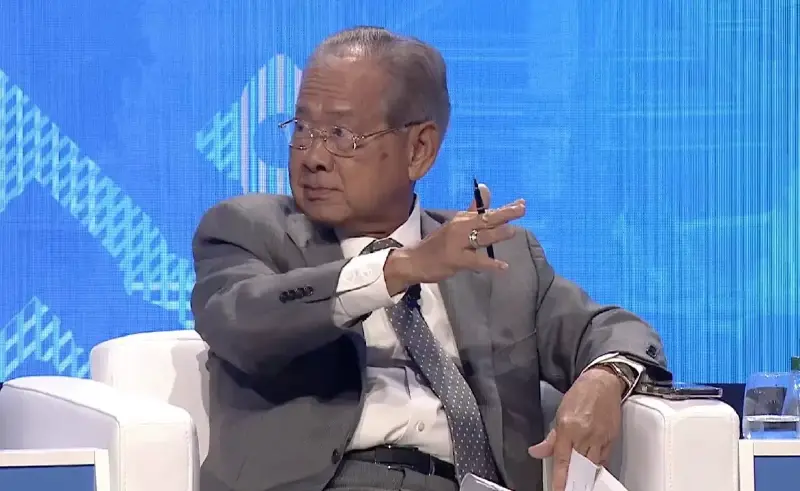


Narongchai Akrasanee says four structural changes built Thailand’s economic foundations over 35 years and urges digital, energy and business reforms for future growth.
Thailand should build on four major structural reforms of the past 35 years while accelerating digital and energy transformation and overhauling businesses, the workforce and regional cities to meet a more difficult global environment, economist Narongchai Akrasanee said on Tuesday (October 13).
Narongchai, chairman of the Institute for Strategic Policy Foundation, was speaking at the Thailand Special Seminar: Bangkok 1991–2026: Thailand’s Path to Resilient, Inclusive Growth during the 2026 IMF-World Bank Group Annual Meetings in Bangkok.
Reflecting on Thailand’s economic development since the country last hosted the meetings in 1991, Narongchai identified four structural changes that he said had become important foundations of the economy: trade liberalisation, financial reform, greater private-sector participation in infrastructure and universal healthcare.
Trade liberalisation built Thailand’s export base
The first pillar began with structural adjustment during the 1980s and continued through the 1990s as Thailand embraced freer trade and deeper regional and multilateral economic integration through ASEAN, the Asia-Pacific Economic Cooperation forum and the World Trade Organization.
Narongchai said Thailand’s exports were worth about US$50 billion in 1997, when he served as commerce minister, compared with more than US$400 billion today.
He argued that decades of integration with international markets had helped create the export base that remains one of Thailand’s main economic strengths.
Financial opening brought a costly lesson
The second pillar was financial liberalisation.
Thailand accepted the obligations of Article VIII of the International Monetary Fund’s Articles of Agreement, strengthened capital-market regulation through the establishment of the Securities and Exchange Commission in 1992 and opened the way for the Bangkok International Banking Facilities (BIBF).
Narongchai said the original intention of the BIBF was largely to facilitate “out-out” banking, in which foreign funds were borrowed for lending outside Thailand. In practice, it increasingly became an “out-in” channel, bringing overseas borrowing into the domestic economy.
He linked that shift to vulnerabilities that contributed to the 1997 Asian financial crisis, when Thailand was trying to maintain a fixed exchange rate while allowing freer capital flows and retaining monetary-policy independence, the combination commonly described as the “impossible trinity”.
Narongchai also recalled how investment bankers encouraged extensive foreign borrowing, with incentives heavily influenced by commissions. He said the finance company he was managing at the time consequently suffered heavy losses.
The crisis, however, forced Thailand to reform its financial system, he said, leaving its money and capital markets considerably stronger today. He described their present standards as being at a “first-world” level.
Private investment transformed infrastructure and business
The third pillar was privatisation and commercial infrastructure, which brought the private sector more deeply into investment and development.
Narongchai pointed to telecommunications and digital infrastructure as well as urban mass-transit concessions dating back to the early 1990s.
The listing of state enterprises and related businesses in energy, telecommunications and transport also helped reshape Thailand’s corporate sector, he said.
Using his own metaphor, Narongchai described the transformation as moving from “cottage to castle”, with smaller and more fragmented businesses developing into larger and stronger corporate structures.
Universal healthcare strengthened human capital
The fourth structural pillar was the introduction of universal healthcare in 2001–02.
Narongchai said the system not only expanded access to healthcare but also provided a foundation for developing doctors, specialists and highly skilled public-health personnel.
He argued that the health system had consequently become part of Thailand’s long-term economic and social resilience.
Digital and energy transformation needed next
Narongchai contrasted the optimism surrounding Thailand’s economy in 1991 with the much more challenging environment confronting the country in 2026.
To adapt, he highlighted two major engines for the next phase of development.
The first is Digital Transformation, or DX, in which artificial intelligence is only one component. He described AI as helping accelerate activity on a wider digital “expressway” already supported by digital finance and Web3 technologies.
The second is what he termed Energy Transformation, or NX, involving more efficient production, management and distribution of energy to meet the rapidly increasing power requirements generated by digital transformation.
Narongchai also backed the World Bank’s emphasis on lifting productivity and developing new industries capable of supporting higher-value growth.
The World Bank’s Building Thailand’s Future Today report identifies five “industries of the future”: advanced manufacturing, sustainable and wellness tourism, digital services, agrifood and creative industries.
Let weak firms exit and make way for future businesses
Narongchai then highlighted three structural directions for Thailand’s next phase, beginning with the Firm of the Future.
He said manufacturing capacity utilisation was stuck at about 60%, meaning machinery and productive capacity were being left idle.
Rather than continually protecting businesses that could no longer compete, the government should develop mechanisms allowing them a “nice way to exit”, freeing capital, labour and other resources for more productive businesses.
Narongchai was particularly critical of the tendency to treat all small and medium-sized enterprises as businesses that should automatically be preserved.
Thailand had talked too much about SMEs as a group and had tried to protect them indiscriminately, he argued, even though not every business was competitive or economically viable.
Allowing weaker firms to leave the market in an orderly and dignified manner would help redirect resources towards the firms of the future, he said.
Thailand needs future workforce and stronger regional cities
The second direction, the Workforce of the Future, requires Thailand to make it easier for highly skilled foreign professionals and workers to enter the country and work alongside Thai companies, Narongchai said.
He pointed to Singapore as an example of how regulatory flexibility could help an economy attract international talent and transfer skills.
His third priority is the City of the Future.
Narongchai proposed giving major regional centres with universities, such as Khon Kaen, greater administrative autonomy so they could develop their economies according to local strengths rather than depend excessively on central government.
The World Bank’s current Thailand strategy similarly places more competitive firms, a future-ready workforce and more productive cities at the centre of the reforms needed to raise productivity and move the country towards high-income status.
Narongchai said Thailand had already demonstrated its ability to undertake major structural change over the past three decades, but the next phase would require the country to respond more quickly to technology, energy pressures, changing labour needs and weak productivity.
“If Thailand can move forward with these recommendations, I believe we will be able to overcome and deal with the challenges of the future with resilience,” he said.
