
Thailand's next growth phase hinges on skills and structural reform
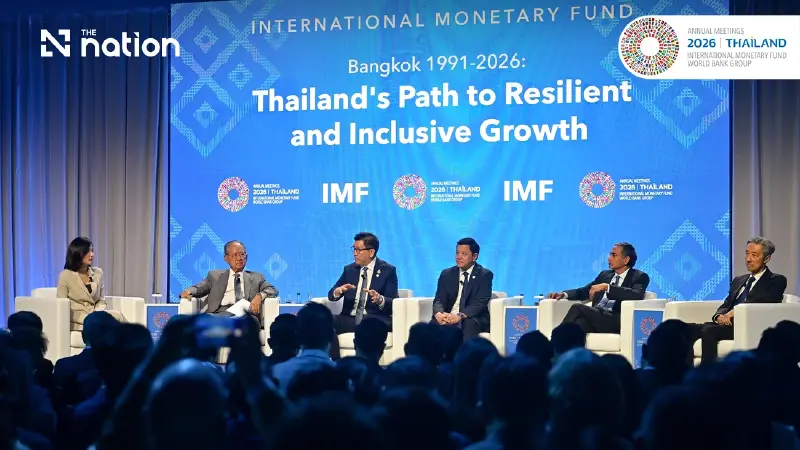


At the IMF–World Bank meetings, Thai policymakers and economists trace Thailand’s industrial rise and 1997 crisis, calling for skills training, AI adoption and reform.
- Thailand's future economic growth can no longer depend on cheap labour and traditional manufacturing, but must instead be driven by higher productivity, a skilled workforce, and significant structural reforms.
- A key priority is upskilling the workforce for high-technology industries like electronics, semiconductors, and AI through curriculum reform and government-led programmes that connect investors with universities.
- Necessary structural reforms include cutting outdated business regulations, improving access to finance for smaller businesses, and adapting key industries, such as automotive, for the green transition and new technologies.
- Experts warn that a major obstacle is the country's historical weakness in implementing reforms, which often lose momentum, hindering its ability to attract foreign investment compared to regional competitors.
Thailand’s next phase of economic growth will depend on higher productivity, skilled workers and sustained structural reform rather than continued reliance on cheap labour and traditional manufacturing alone, senior policymakers and economists told a seminar in Bangkok on Tuesday (October 13).
Speaking at “Bangkok 1991–2026: Thailand’s Path to Resilient, Inclusive Growth”, held during the International Monetary Fund (IMF) and World Bank Annual Meetings at the Queen Sirikit National Convention Center, the speakers examined how Thailand transformed its economy, the lessons of the 1997 financial crisis and the structural challenges it must overcome to achieve stronger growth.

From industrial expansion to financial stability
Deputy Prime Minister and Finance Minister Ekniti Nitithanprapas traced Thailand’s first economic transformation to shifts in global manufacturing during the 1980s. Following the Plaza Accord and the appreciation of the yen, Japanese companies relocated production to Southeast Asia, helping Thailand attract foreign direct investment to its Eastern Seaboard, particularly into the automotive and electronics industries in Rayong.
Industrial expansion created factory employment, lifted incomes and helped reduce poverty from nearly 50% to below 5%, according to Ekniti. Yet annual growth of 8–10% concealed vulnerabilities, with excessive foreign-currency borrowing through the Bangkok International Banking Facilities contributing to the 1997 financial crisis.
Thailand subsequently strengthened its banking system and accumulated foreign reserves now worth nearly three times its short-term external debt. That stability, Ekniti argued, provides a foundation for growth but is insufficient without further economic transformation.
“Today, as noted, we face a rapidly ageing population and labour constraints. Therefore, our next economic takeoff cannot rely on cheap labour. We must focus on labour productivity, accelerating digital technologies, and cultivating human capital.”
With multinational companies diversifying production through a “China Plus One” strategy and Thailand seeing a surge in applications to the Board of Investment, Ekniti called for a second wave of high-technology investment, stronger links between Thai small and medium-sized enterprises (SMEs) and global supply chains, and greater foreign participation in the services sector to encourage competition and technology transfer.
The government’s “Skill Bridge” programme connects international investors with Thai universities to jointly develop curricula and upgrade local engineers’ skills in electronics, semiconductors and artificial intelligence (AI).
Ekniti also highlighted a “Regulatory Guillotine” to remove outdated business restrictions and simplify digital work permit and visa approvals. Industrial development, he added, should spread beyond traditional centres to electronics in Lamphun, automotive components in Nakhon Ratchasima and semiconductor assembly in Songkhla, while maintaining fiscal discipline.
A resilient financial system but weaker growth
Bank of Thailand Governor Vitai Ratanakorn described the 1997 crisis as a turning point that prompted a managed-float exchange rate, flexible inflation targeting and stronger foreign reserves. Despite healthier bank capital and liquidity, Thailand’s underlying growth rate has steadily weakened.
Vitai traced the decline in Thailand’s trend growth from more than 7% before 1997 to around 5.3% after the crisis, 3.5% following the global financial crisis and about 2.4% since the pandemic. He projected economic growth of 2.1–2.3% in 2026, attributing the slowdown chiefly to structural rather than temporary problems.
“Fiscal policy should focus on targeted, supply-side structural investments and support for vulnerable segments, while monetary policy maintains price stability and ensures adequate macroeconomic policy space to cushion future external shocks.”
He stressed that closer coordination between fiscal and monetary policies must preserve central bank independence and fiscal credibility. Household debt and financing difficulties for smaller businesses were among the most pressing constraints.
According to figures he cited, lending to major corporations rose by 6%, while SME lending contracted for 16 consecutive quarters, falling 4.4% year on year. Credit remained relatively accessible to the top 30% of productive SMEs, he explained, but less productive businesses, particularly those operating with outdated business models, faced greater difficulties.
Rather than providing blanket subsidised loans, Vitai favoured targeted restructuring and support for technology adoption among viable SMEs in food processing, wellness and smart electronics, alongside orderly resolution for those unlikely to recover.
He also identified green finance, action against financial fraud and the use of AI to improve productivity as priorities.

Technology and the challenge of implementation
Suthiphand Chirathivat, professor emeritus of economics at Chulalongkorn University, identified regional integration, adaptability and institutional capability as the foundations of Thailand’s next economic transformation.
He noted that regional trade was equivalent to nearly 90% of the gross domestic product (GDP) of the Association of Southeast Asian Nations (ASEAN). The bloc also attracted US$243.9 billion in foreign direct investment in 2025, accounting for approximately 15% of global inflows.
“However, Thailand has struggled to capture its proportional share of these new investment waves compared to neighbours like Vietnam, Malaysia, and Singapore.”
“We cannot afford domestic complacency; Thailand must position itself as an indispensable node within regional value chains.”
Thailand also needed to adapt its established automotive industry to electric vehicles, batteries, semiconductors and embedded software while responding to the green transition and changes in global supply chains.
Citing an Asian Development Bank study, Suthiphand warned that nearly 80 million ASEAN workers could face disruption from generative AI, while the green transition could create 30 million jobs in the region by 2030.
“To capture these opportunities, Thailand must invest aggressively in workforce capability, curriculum reform, and institutional governance. We have excellent national master plans, but our implementation capability has historically been our weakest link.”
He warned that reforms often lose momentum across electoral cycles and that poorly managed technological change could widen income inequality and the digital divide between large companies and smaller businesses. Lifelong learning, flexible reskilling schemes, vocational training and public-private partnerships would be essential to help workers and smaller firms benefit from technological change rather than fall further behind.

Keeping Thailand attractive to investors
Krishna Srinivasan, director of the IMF’s Asia and Pacific Department, placed Thailand’s experience within Asia’s wider rise.
Asia now accounts for about 60% of global GDP growth, compared with less than 25% three decades ago, Srinivasan noted. Over that period, Thailand’s GDP per capita increased from approximately US1,800tomorethanUS8,000.
He highlighted how the IMF had expanded its policy toolkit following the 1997 Asian financial crisis, including the Financial Sector Assessment Program to evaluate financial resilience and the more recent Integrated Policy Framework to help countries manage volatile capital flows.
With international capital becoming more selective, Srinivasan warned that economic progress alone would not guarantee future investment. He identified predictable policymaking, regulatory transparency and fiscal credibility as crucial factors influencing investors’ decisions.
He also highlighted the opportunities and employment challenges arising from AI adoption.
“IMF research across Asia shows that in sectors heavily exposed to AI, net labour demand initially dips by approximately ten per cent. However, labour demand subsequently stabilises because AI augments tasks rather than eliminating entire occupations.”
Broad access to AI tools, continuous training and education reform would therefore be necessary to turn automation into more inclusive productivity gains.
The speakers agreed that Thailand’s stronger financial foundations provide an important starting point, but sustained growth will require more effective reforms, higher productivity and a skilled workforce capable of turning new technologies and foreign investment into opportunities for domestic businesses and workers.
