
Bangkok’s 34 data centres raise concerns over resource use and safety
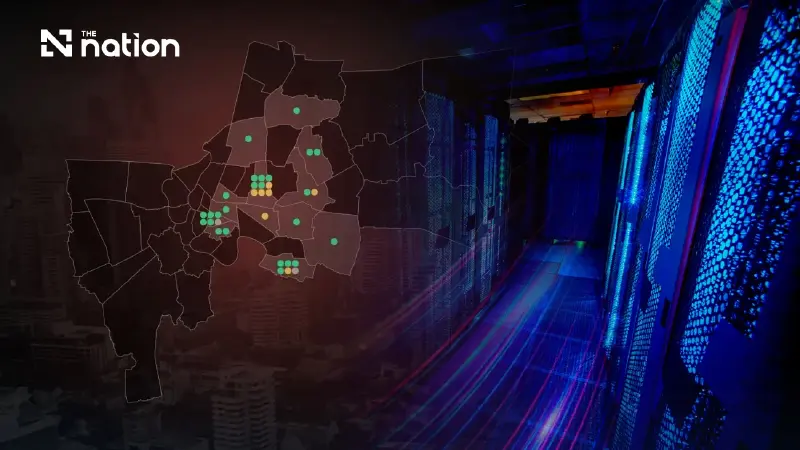


JustPow lists 34 operating, under-construction and planned data centres in Bangkok, with combined electricity demand of at least 247.2MW.
- Bangkok has 34 data centres (operating, under construction, or planned), mostly concentrated in densely populated inner-city districts, prompting the city's governor to halt new permits.
- The facilities raise significant resource concerns, with a projected electricity demand of at least 247.2 megawatts and annual water consumption of 4.43 million cubic meters, equivalent to the usage of thousands of households.
- Safety issues for nearby communities include the storage of hundreds of thousands of litres of backup fuel and the "Data Centre Heat Island" effect, which can raise local temperatures by several degrees.
- Regulatory loopholes allow these centres to be built in residential areas without specific environmental impact assessments (EIAs) because they are not legally defined as factories under current laws.
The siting of a data centre in central Bangkok near Praram 9 Hospital, along with concerns among nearby communities about a data centre in Hua Mak storing several hundred thousand litres of fuel, has prompted questions about how such facilities can be located in the capital.
Chaichanok Chidchob, Minister of Digital Economy and Society, said in an interview that data centres in Bangkok were located in areas where they were not permitted. Bangkok Governor Chadchart Sittipunt, meanwhile, announced that he had ordered a halt to new data centre permits in Bangkok and that urban-planning law and the environmental impact assessment (EIA) process would be reviewed.
JustPow examined how many data centres already operate in Bangkok, how many more are expected and where they are located.
How many data centres are there in Bangkok?
Based on public information, media coverage and information from agencies and companies connected with data centres, JustPow found that 34 projects in Bangkok were identified as data centres. They were divided into the following categories:
- 24 data centres in operation.
- 7 data centres under construction.
- 3 data centres planned for construction.
A review of how the projects are distributed across Bangkok found the following:
- Huai Khwang had the largest number of operating and under-construction data centres, with 9 projects.
- Bang Na ranked second with 6 projects.
- Bang Rak had 5 projects.
- Sathon, Bueng Kum and Bang Kapi had 2 projects each.
- Chatuchak, Ratchathewi, Bang Khen, Vadhana, Suan Luang and Prawet had 1 project each.
- 1 other project, Stellar DC, had no publicly identified location.
The figures indicate that nearly all of Bangkok’s data centres are located in inner-city districts.

What are the nationalities of Bangkok’s data centre owners?
The breakdown by the nationality of the companies owning Bangkok’s data centres was 10 projects owned by Thai companies, 5 by Singaporean companies, 3 by Japanese companies, 1 by a Malaysian company and 1 by a British company. Companies from the United Arab Emirates and Thailand jointly owned another 2 projects, while Singaporean and Thai companies jointly owned 1.
Most data centres already operating in Bangkok are colocation facilities. They offer space for customers’ servers at an internet data centre (IDC). Customers may rent servers and have them housed at a data centre, while the service mainly involves hosting server equipment. Most such facilities are located within buildings.
Nearly 10 large stand-alone data centres have their own sites and are either operating, under construction or planned.
How much water and electricity do Bangkok data centres use, and what other effects could they have?
The vast quantities of water and electricity needed to operate data centres around the clock have raised concern worldwide. Drawing on public information, media reports and information from relevant agencies and companies, JustPow reported the following electricity demand among Bangkok’s 34 projects:
- Of the 24 operating data centres, electricity use could be identified for 16 projects, totalling 127 megawatts.
- Of the 7 data centres under construction, electricity use could be identified for 6 projects, totalling 95.2 megawatts.
- For the 3 planned data centres, electricity use could be identified.
The data show that the operating, under-construction and planned facilities would require at least 247.2 megawatts in total. This is equivalent to the electricity used by the whole of Suphan Buri province in 2025 or by at least 247,200 households.
If treated as a province, Bangkok’s data centres would rank 23rd for electricity use among Thailand’s 77 provinces.
Water consumption was estimated using The Green Grid’s Water Usage Effectiveness (WUE) metric. A WUE value of 2.0, the standard baseline for a typical data centre, was applied to each Bangkok facility’s disclosed annual electricity consumption in kilowatt-hours per year (kWh/year) to estimate its water use.
Of the 24 operating data centres, 16 had electricity figures that could be used for the calculation. Their estimated water consumption was about 2.23 million cubic metres a year, equivalent to the use of 10,160 households.
Of the 7 projects under construction, 6 had electricity figures suitable for the calculation. Their estimated water consumption was about 1.67 million cubic metres a year, equivalent to 7,616 households. Of the 3 planned projects, 1 had an electricity figure suitable for the calculation. Its estimated water consumption was about 0.44 million cubic metres a year, equivalent to 2,000 households.
Bangkok’s 34 data centre projects would therefore use about 4.43 million cubic metres of water a year, equivalent to the use of 19,776 households.
Although the use of electricity and water is not the main issue in Bangkok, a capital where neither resource is in short supply, nearby residents remain concerned about other community and environmental effects. Some data centres keep several hundred thousand litres of fuel in reserve for power cuts because they require electricity around the clock. This has prompted safety concerns, while using the stored fuel to run generators during an outage could pollute nearby communities and release greenhouse gases into the atmosphere.
Data centres may also heat surrounding areas by releasing large amounts of heat from servers operating around the clock. This could raise nearby temperatures by 2 to 9 degrees Celsius, a phenomenon described as a “Data Centre Heat Island”.
The data indicate that Bangkok’s operating, under-construction and planned data centres are all in densely populated inner-city districts. The resulting data centre heat-island effect will compound the “Urban Heat Island” (UHI) effect already occurring in Bangkok.
Temperatures in heat-island areas, most of which are in inner Bangkok, average 2.8 degrees Celsius above those in surrounding areas. Heat from data centre heat islands will further intensify the problem.
Why can data centres be built in Bangkok?
Data centres are not currently defined under any law and do not qualify as factories under the Factory Act 1992. Even electronic equipment inside the buildings does not fall within the Act’s definition, so the law cannot be applied in these cases. Classifying a project’s purpose as goods storage also means it does not fall within a category of project required to prepare an EIA report under the Notification of the Ministry of Natural Resources and Environment on Projects, Undertakings or Operations Required to Prepare Environmental Impact Assessment Reports 2023.
Construction permission for data centres is therefore sought from local authorities under building-control and urban-planning laws. Most data centres qualify as high-rise and extra-large buildings under the Building Control Act 1979.
The Building Control Act 1979 covers building safety, including structures, equipment, fire protection, electrical systems, ventilation and drainage systems, and other safety systems. It also covers setbacks from public roads and open space between a property boundary and a building.
Under Bangkok’s urban-planning rules, the Bangkok Comprehensive Plan 2013 does not prohibit the operation of electronic data-storage centres in very high-density residential zones, shown in brown, provided they comply with building-density and land-use requirements. Clause 16(12) provides an exception for warehouses, freight terminals or goods-receiving and dispatch operations beside public roads with a right-of-way of at least 30 metres.
The storage of fuel as a backup during power failures represents another legal gap. If the amount is below the 500,000-litre threshold under the Fuel Control Act 1999, it is not subject to a safety inspection.
Data centres that communicate and transmit data must also obtain a Type One or Type Three telecommunications business licence from the Office of the National Broadcasting and Telecommunications Commission (Office of the NBTC).
Steps for obtaining permission to build a data centre in Bangkok
- A data centre applies for a construction permit as a “warehouse” through the Public Works Section of the relevant district office under the Building Control Act 1979.
- Officials review the documents under the Building Control Act 1979 and the Bangkok Comprehensive Plan 2013. The relevant local official signs the permit within 45 days of the application date.
- Once construction is complete, the operator must obtain permission to use the building from the district office before operations begin.
- The operator applies to the Metropolitan Electricity Authority for electricity as a corporate customer. A data centre may be classified as a medium- or large-scale user, depending on its electricity demand.
- The operator applies to the Metropolitan Waterworks Authority for a water connection. Officials survey the site and assess whether installation is feasible. The data centre’s water tariff may fall within the large-business category.
- To install a backup fuel tank for an emergency generator, the operator must apply for permission by submitting the prescribed form to the Department of Energy Business under the Ministerial Regulation on Oil Storage Premises 2024.
- A data centre that communicates and transmits data must also obtain a Type One or Type Three telecommunications business licence from the Office of the NBTC.
