
"Forwards, Midfield and Defence": How Thailand’s New Public-Private Drive Aims to Elevate Annual Growth Beyond 5%
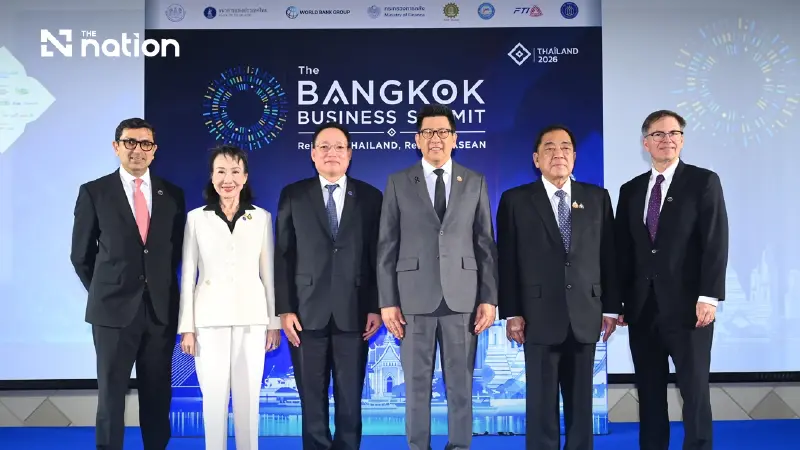


Closing the Bangkok Business Summit, Deputy PM Ekniti Nitithanprapas set out how Thailand plans to hit 5%-plus growth and high-income status by 2037
- Thailand has launched a public-private partnership, structured with a football analogy, to achieve over 5% annual growth and reach high-income status by 2037.
- In this model, the private sector acts as the "forwards," leading seven priority industries such as smart agriculture, next-generation automotive, and high-value tourism.
- The government forms the "midfield" and "defence," responsible for clearing regulatory obstacles, driving investment, and safeguarding fiscal and monetary stability.
- This collaboration is driven by a Joint Public-Private Committee (JPPC) and supported by initiatives like a "Thailand Fast Pass" to clear bottlenecks and a goal to join the OECD by 2028.
Closing the Bangkok Business Summit, Deputy PM Ekniti Nitithanprapas set out how Thailand plans to hit 5%-plus growth and high-income status by 2037.
Thailand's government used the closing press conference of the Bangkok Business Summit on Thursday to move from diagnosis to delivery, setting out who is responsible for what in a public-private drive to lift annual growth above 5 per cent and reach high-income status by 2037.
Deputy Prime Minister and Finance Minister Ekniti Nitithanprapas, closing the two-day summit, said the government and private sector had converged on a shared goal, a shared method, and a shared conviction that Thailand has the ideas and will to deliver — the three things he said the day's discussions had confirmed.
What was needed now, he said, was a platform for sustained collaboration, which the government has built through a Joint Public-Private Committee (JPPC) organised around four pillars: investment and new economic engines, trade and the community economy, human capital development, and improving public-sector efficiency.
A Pitch-Perfect Division of Labour to Drive Fast-Track Growth
Ekniti illustrated the division of labour with a football analogy.
The private sector, he said, forms the "forwards" — seven priority industries including smart agriculture and food processing, smart electronics and digital, next-generation automotive, wellness and medical hubs, trade and investment, and high-value modern tourism, distinct from traditional mass tourism — and he had asked the three main private-sector associations to nominate their sharpest "strikers" to lead each one.

The government forms the "midfield", passing the ball quickly to clear obstacles: Ekniti himself leads on investment, with fellow deputy prime ministers assigned to trade, human capital and deregulation, respectively.
The government also anchors the "defence", safeguarding fiscal and monetary stability — a role Ekniti said the numbers already vindicate, pointing to roughly 70 billion baht in stock-market inflows since the start of the year, lifting the SET index from around 1,300 to about 1,600, even as bond yields have risen in some other countries amid weaker investor confidence.
He credited the approach with tangible results already: investment growth of 10 per cent in the first quarter and nearly 14 per cent in the second — the fastest pace in 13 years — under what he calls an Investment-Led Growth Policy, backed by a "Thailand Fast Pass" scheme to clear regulatory bottlenecks flagged by industry.
On the JPPC itself, he noted it was originally conceived as a "consultation" committee, but he insisted on dropping that word from its name, arguing that the public and private sectors must act together rather than merely consult, with the committee now reporting progress to the prime minister every two months.
Ekniti said Thailand will elevate its global standing through two major upcoming events.
First, Bangkok will host the IMF–World Bank Annual Meetings from October 12–18, featuring projects based on the sufficiency economy philosophy; second, Thailand will assume the ASEAN chairmanship in two years, with informal talks already underway with Singapore to build a coordinated regional response to global challenges.

Shifting Focus from Economic Diagnosis to Actionable Execution
Payong Srivanich, chairman of the Joint Standing Committee on Commerce, Industry and Banking (JSCCIB) and the Thai Bankers' Association, stated that reinventing Thailand means upgrading the current economic base while unlocking new growth engines.
This transition demands globally credible standards, unified private-sector action, and consistent government policy.
He noted that Thailand's seven targeted industries, the World Bank's five "industries of the future", and the Board of Investment's (BOI) priority sectors have all converged around one shared agenda: inclusive growth that benefits government, business, SMEs, workers, and communities alike.
With strategic alignment in place, the focus must now shift to execution. This includes accelerating the low-carbon energy, digital, and financial infrastructure needed to turn current investments into durable growth, with summit momentum potentially leading to a future regional business summit for ASEAN industry.
Modernising Supply Chains and Targeting OECD Membership by 2028
Dr Poj Aramwattananont, chairman of the Thai Chamber of Commerce and the Board of Trade of Thailand, highlighted that geopolitical conflicts, new trade measures, environmental rules, and emerging standards are reshaping global commerce.
As a result, entire supply chains must adapt together rather than individual firms acting alone.
He urged Thailand to accelerate negotiations across goods, services, digital trade, and standards. At the same time, ASEAN governments must build an integrated regional value chain—linking customs, logistics, and standards—instead of competing by lowering standards or offering rival incentives.
Dr Poj tied these reforms directly to Thailand’s goal of joining the OECD by 2028, noting that accession will raise transparency, cut business costs, and bolster investor confidence, using the Joint Public and Private Sector Consultative Committee (JPPC) mechanism to put reforms into practice.
Moving Beyond Contract Manufacturing to High-Tech, Branded Industry
Pimjai Leeissaranukul, chairwoman of the Federation of Thai Industries (FTI), pointed to over 60 years of manufacturing experience and supply-chain credibility as the springboard for Thailand's next phase: becoming an "intelligent industry" driven by automation, IoT, and AI, and expanding its footprint in global supply chains.
She outlined three pillars for this transformation:
- Smart digital infrastructure to support modern operations.
- Innovation and brand building to shift Thai manufacturers from contract manufacturing (OEM) to original design (ODM) and own-brand manufacturing (OBM).
- Industrial infrastructure enhancements, including a new Power Development Plan aligned with 2050 net-zero targets, ASEAN-connected logistics, and regulatory reforms ahead of OECD accession.
She also highlighted the FTI’s "Made in Thailand" certification as a vital tool to help SMEs increase local content, enter global supply chains, and win government procurement contracts.
Global Backing with an Emphasis on Relentless Implementation
Carlos Felipe Jaramillo, World Bank Vice President for East Asia and Pacific, told the closing session that the central question is no longer what Thailand should do, but how to execute it.
He welcomed the strong alignment between the public and private sectors behind a shared vision with practical delivery mechanisms.
He pointed to October's Annual Meetings—focusing on AI, jobs, and private capital mobilisation—as a key platform for Thailand to demonstrate its path toward high-income status by 2037.
Reaching that goal will require sustained growth above 5% per year and determined effort, built on the solid foundation of 35 years of progress.
Jaramillo emphasised that the joint World Bank–Thailand reform agenda places the private sector at its core, reflecting global evidence that private enterprise is the primary driver of growth and jobs.
He concluded that success will hinge on disciplined implementation rather than design alone, supported by the OECD accession process and JPPC monitoring. The World Bank stands ready to support Thailand throughout the journey, expressing strong confidence in the country's potential to succeed.
