
Bangkok Panel: Take Growth Beyond the Capital to Save ASEAN Decade
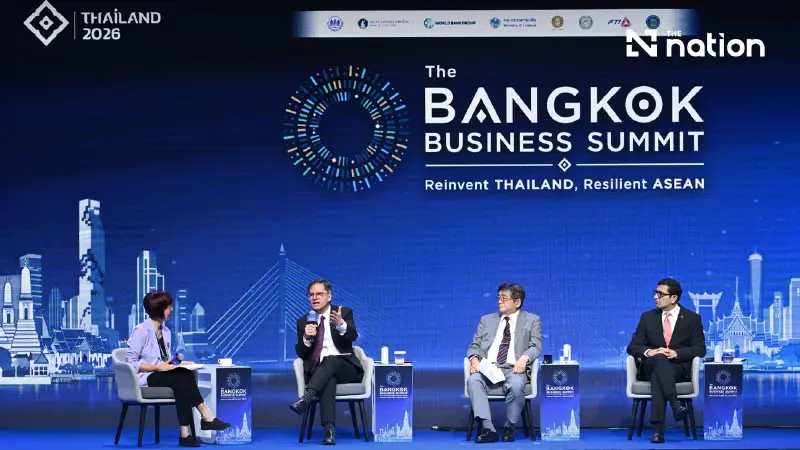


World Bank, IFC and MUFG leaders told Bangkok summit that growth must reach beyond the capital if Thailand and ASEAN are to de-risk the decade
- A panel of World Bank, IFC, and MUFG leaders warned that Thailand's economic growth must expand beyond Bangkok to its smaller cities and rural areas to secure its own future and de-risk the ASEAN decade.
- This shift requires focusing policy on job creation for micro, small, and medium enterprises (MSMEs), which employ 70% of the workforce, rather than just large corporations concentrated in the capital.
- Key strategies to enable this transition include mobilizing private capital, closing the technology gap for smaller firms (e.g., AI adoption), and aligning with international standards to attract investment.
World Bank, IFC and MUFG leaders told the Bangkok summit that growth must reach beyond the capital if Thailand and ASEAN are to de-risk the decade.
Thailand's next phase of growth will fail unless it reaches far beyond Bangkok, three of the region's most senior development and finance figures warned on Thursday, urging government and industry to push investment, technology and jobs into the country's smaller cities and rural areas rather than let gains concentrate in the capital.
That imbalance, they said, is not just a domestic problem: it bears directly on whether Thailand can help ASEAN de-risk a decade in which growth has slowed, public finances are constrained, and artificial intelligence is reaching only a fraction of firms.
Speaking at a panel titled "The Global Acceleration Economy: De-risking the Decade for ASEAN", held during The Bangkok Business Summit: Reinvent Thailand, Resilient ASEAN, the panellists set out why Thailand's next phase of growth cannot simply repeat the last one.
The panel argued that the country's ability to convert reform pledges into jobs — not the pledges themselves — will determine whether it meets its long-term ambitions.
The discussion, moderated by Annie Koh of Singapore Management University, brought together Carlos Felipe Jaramillo, World Bank Vice President for East Asia and Pacific; Masamichi Kono, Senior Advisor at MUFG Bank and a former Deputy Secretary-General of the OECD; and Sarvesh Suri, Regional Vice President for Asia and the Pacific at the International Finance Corporation (IFC).
It coincided with the launch of a new World Bank study, Building Thailand's Future Today, which the panel repeatedly cited as a diagnostic tool for the reforms ahead.
Three threads ran through the hour: how to make job creation, not growth alone, the organising goal of policy; how far Thailand has progressed — and how far it must still go — in aligning with international standards through its OECD accession bid and long-standing trade ties; and how private capital, not just public spending, must now do more to finance Thailand's transition, from AI adoption to climate adaptation.
World Bank: jobs first, and AI's 12% problem
Jaramillo said job creation "at scale" was deceptively simple to state and hard to deliver, built on three pillars: physical and human capital, an enabling environment for business and investment, and the mobilisation of private capital to build new enterprises.
The framework applied broadly across ASEAN and the Middle East, he said, but had to be adapted to each country's constraints — constraints the new World Bank study set out for Thailand, which he hoped would feed into government reform, including through the newly formed Joint Public-Private Consultative Committee for Economic Problem Solving (JPPCC).
On artificial intelligence, Jaramillo pushed back against both extremes of the debate, arguing AI would neither eliminate employment nor solve the country's problems outright.
Thailand, he said, has genuine advantages — a deep electronics manufacturing base, strong digital infrastructure, recent data centre investment and an established industrial ecosystem — but only 12 per cent of Thai companies currently use AI.
Closing that gap for small, medium and micro enterprises, he argued, was now the central implementation challenge, alongside correcting Thailand's overly Bangkok-centric pattern of growth, which has left smaller cities and rural populations underexposed to the gains of the new economy.
MUFG and OECD: standards, trade and the case for staying open
Kono addressed Thailand's OECD accession process, which formally began in 2018 when he helped launch the country programme as the organisation's then Deputy Secretary-General, and which entered technical review in 2024.
Some 25 OECD committees are now benchmarking Thailand's frameworks, policies and practices — spanning health, finance, agriculture and science and technology — against existing members' standards, he said, and he encouraged Thai businesses to engage directly rather than treat the process as a distant bureaucratic exercise.
Turning to his role advising MUFG, Kono said Japanese investors continue to see Thailand as an attractive regional base, pointing to ties dating back to Thailand's commitments under the 1997 WTO financial services agreement and to MUFG's ambition, through its Bangkok banking partnership, to help build a more prosperous ASEAN-plus-three network.
He argued the multilateral, rules-based trading system remained intact despite mounting headwinds and that bilateral and regional trade agreements were still being built on WTO foundations rather than replacing them — a point he returned to when urging Thai businesses to prioritise "free, fair and open markets" and the attraction of regional talent.
He also raised, unprompted, transition finance, saying MUFG was focused on supporting Thailand's net-zero commitments alongside climate adaptation — a priority linked to the country's devastating floods and to the need for a resilient industrial base and supply chain to stay attractive to foreign investors.
Financing adaptation was not straightforward, he said, but blended finance schemes combining public investment with private capital, which MUFG and other Japanese banks are extending across the region, offered a practical route forward.
IFC: from capacity to capability, and reaching the 70%
Suri framed his contribution around the return of the World Bank Group's annual meetings to Thailand after 35 years — a period in which the country achieved substantial economic transformation built on public investment, an expanding workforce, value-added exports and infrastructure spending, but one in which growth has since slowed.
Reversing that requires the public and private sectors to work jointly, he argued, toward Thailand's ambition of reaching high-income status roughly a decade from now.
He set out three requirements. First, government must recognise the private sector's role goes beyond filling gaps left by constrained fiscal space; its efficiency needs to be harnessed directly.
Second, Thai firms — despite a deep domestic market, developed capital markets and a strong manufacturing base — must shift from capacity to capability, pushing into higher value-added manufacturing exports, more productive agriculture, and a tourism sector moving from volume-based models toward ecotourism and value-based offerings, with government support to incentivise that innovation.
Third, and most pointedly, he warned this shift cannot remain confined to the "frontier" — the roughly 1 per cent of large corporates concentrated in Bangkok — but must reach micro, small and medium enterprises (MSMEs), which employ 70 per cent of Thailand's workforce.
A shared message, five weeks out
Asked for a single piece of advice ahead of Thailand hosting the World Bank and IMF annual meetings in five weeks' time, the panel converged on a common message even while emphasising different levers.
Jaramillo urged businesses to help communicate that "Thailand is not staying still" and to keep pressing government and industry to implement the reforms the new study identifies.
Kono repeated his call for open, rules-based markets and talent attraction. Suri urged Thai businesses to use the annual meetings — whose theme is mobilising capital for more and better jobs — as a platform to attract capital at scale and to look beyond the meetings to Thailand's chairmanship of ASEAN in two years, when the bloc could become the world's fourth-largest economy by 2030.
