
PM Anutin links Thai–China family ties to economic future
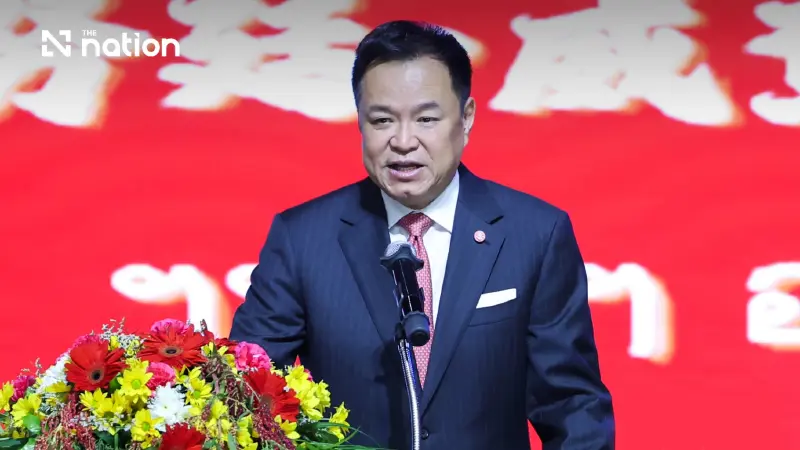


Anutin calls for two-way investment and a greater role for younger generations at the 60th anniversary of nine Chinese associations in Thailand.
Prime Minister Anutin Charnvirakul has reaffirmed that Thailand and China are “one family”, calling for their longstanding ties to support a future economic partnership involving investment, technology and opportunities for younger generations.
Anutin, who is also interior minister, delivered the opening address at the 60th anniversary celebrations of the Club of Nine Chinese Associations in Thailand on Sunday (September 6, 2026). The event took place at Chue Pung Tung Auditorium at the Teochew Association of Thailand in Bangkok’s Sathon district.
Recalling his official visit to Shanghai, Chengdu and Beijing in July, he said he had held talks with Chinese President Xi Jinping, Premier Li Qiang, provincial leaders and private-sector representatives.

Anutin said Xi had emphasised the family-like relationship and described China as a trustworthy and dependable strategic partner of Thailand. He also recalled Xi inviting Thailand to regard China as a close friend whose bond could be closer than that of relatives.
Two-way investment and future industries
The July visit led to the signing of 15 memorandums of understanding and the opening of a new Thailand Board of Investment (BOI) office in Chengdu, Anutin said. The office is intended to expand economic cooperation with western China, particularly in industries of the future.

He identified semiconductors, advanced electronics, artificial intelligence (AI), robotics, new-energy vehicles and clean energy as areas of focus.
Anutin described the cooperation as a two-way opening. Thailand wants innovative, technology-driven Chinese companies to invest and help upgrade its industries, while Thai businesses should have opportunities to enter the Chinese market and find partners. Thailand does not want to be merely a market or manufacturing base, he said, but to grow alongside China as a partner.
Six decades of people-to-people ties
The anniversary event was attended by Wu Zhiwu, chargé d’affaires of the Chinese Embassy in Thailand, Thai-Chinese Chamber of Commerce committee members, presidents of the nine associations and members of the Thai-Chinese community.
Before his address, Anutin signed the visitors’ book in Thai and Chinese and posed for photographs with association members.
He credited the club with contributing to Thailand’s development over six decades through business networks, job creation, social assistance and ties between the two countries’ peoples. It had been more than a focal point for the Thai-Chinese community, he said.
The ability of Thai people of Chinese descent to preserve their language, culture and close connections with China while taking pride in their heritage was a valuable strength for Thailand, Anutin said.
A partnership for the next generation
Looking towards the club’s next 60 years, Anutin urged the associations to extend those connections to younger generations, technology and new opportunities. Young Thais should see China not only as their ancestral homeland but as a place of global opportunity, while young Chinese people should see Thailand as somewhere to invest and develop innovations together.
He called on the current generation to build on shared roots and take the relationship beyond the idea that “China and Thailand are not strangers but brothers”, towards a partnership creating a shared future.
Anutin wished the associations, their members and families happiness and prosperity, and expressed hope that Thai–Chinese friendship would remain strong and flourish.
He also noted that he would turn 60 the following week. Rather than treating that age as a reason to stop planning, he regarded it as a beginning.
“But for me, this is just the beginning. We have to think about our children and grandchildren,” he said.
