
Bangkok pilot tests cool roofs for vulnerable households
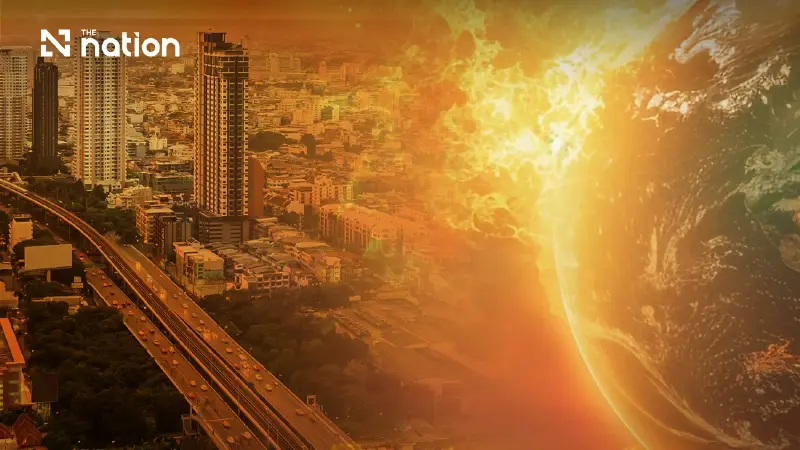


A German-funded project in Phasi Charoen combines heat shelters and school activities to protect residents most at risk from extreme heat.
Bangkok could see temperatures rise by up to 5°C by 2100 under a worst-case scenario of uncontrolled carbon emissions, according to climate projections cited by Associate Professor Dr Manat Srivanit of Thammasat University.
His team at the university’s Faculty of Architecture and Planning is running a German-funded heat-resilience pilot in Phasi Charoen district, using reflective roof paint, community heat shelters and household mapping to help protect older people, bedridden patients and low-income residents.
The project covers one school and one low-income community, combining practical cooling measures with education on heat risks.
Manat said differences in income, housing and access to cooling leave people facing very different health risks, even at the same air temperature.
“People who are better off can afford electricity to run air conditioners at home or drive to shopping centres to enjoy the cool air,” he said.
Cool roofs and priority household mapping
Manat contrasted those options with the circumstances of older people, young children, patients and low-income residents in crowded communities. Many have little choice but to remain in homes with corrugated-metal roofs that trap heat, exposing them to a heightened risk of heatstroke and potentially death, he said.
The team selected Phasi Charoen, on Bangkok’s Thonburi side, because of its high vulnerability to heat.
Community health volunteers and local leaders have worked with researchers to identify vulnerable households and record them in a detailed geographic information system (GIS) database. The maps show where bedridden patients and older residents live, allowing assistance to be prioritised.
The project has also partnered with a leading private-sector paint manufacturer to test reflective roof coatings on vulnerable residents’ homes. The treatment is intended to reduce indoor temperatures.
Community heat shelters provide free drinking water and equipment for measuring heat indices. Trained volunteers monitor local conditions and issue warnings at neighbourhood level.
Pupils become heat detectives
The school programme uses hands-on activities to help children and young people understand heat exposure, including a “Hot House” climate simulator and thermal-camera exercises.
Manat said the simulator drew on a concept developed in Singapore. Temperatures inside a tent are raised by 3–5°C above normal to give pupils an experience of conditions associated with the worst-case warming scenario described for 2100.
Children also take on the role of “heat detectives”, using infrared thermal cameras to scan surface temperatures around them. They compare the heat retained by hard surfaces, including concrete and asphalt, with conditions around grass and shaded areas beneath trees.
The programme also teaches pupils to calculate wet-bulb globe temperature (WBGT) values and use the information to plan outdoor play and water intake.
Radar and AI for disaster warnings
In a separate presentation at the academic seminar on technology for disaster response in the climate crisis, Associate Professor Dr Teerayut Horanont of the Sirindhorn International Institute of Technology (SIIT) discussed how satellite and mobile-network data could improve disaster preparedness.
He identified advance warning and accurate information for decision-making as central to reducing losses. Earlier warning systems had faced limitations in both physical data and real-time understanding of human behaviour, he said.
Teerayut has applied data from the Sentinel-1A radar satellite to flood-warning work. Its radar can see through thick rain clouds that obscure the ground from conventional imaging satellites during the monsoon season, he explained.
The radar information is overlaid in GIS layers to analyse floodwater, assess damage to agricultural land, count affected homes and identify evacuation routes that remain usable. Officials can use the information to plan relief-supply distribution and prepare shelters.
His research team has also used artificial intelligence (AI) to analyse human behaviour through mobile-phone network signals, examining movement patterns and an indicator he described as a “panic index”.
Teerayut cited mobile-network data from Tokyo during a major earthquake that showed people initially stopping before gradually leaving the city centre to walk home in an orderly pattern.
During the earthquake in Mae Lao district of Chiang Rai, the team used sharp increases in telephone communications as an indicator of public panic. The readings rose sharply whenever aftershocks occurred, he said.
Access to such information remains heavily constrained in Thailand by privacy laws, according to Teerayut. He contrasted this with the United States, which he said had introduced legislation after the September 11 attacks allowing certain privacy protections to be overridden for national security and public safety.
He expressed hope that Thailand would revise its policies to enable greater use of such data for the public benefit and create incentives for collaboration across disciplines.
From individual homes to city-level planning
For the heat-resilience project, Manat argued that treating individual homes would not be sufficient to address the wider risk.
Architects and urban planners need to work together at building-block, neighbourhood and city levels, he said, protecting natural sources of cooling and preventing uncontrolled urban expansion that increases heat accumulation.
He also highlighted what he described as a gap in responsibility for extreme heat and drought. Unlike flooding, which has the Office of the National Water Resources as an identified lead agency, these “silent disasters” still lack a single agency taking primary responsibility, despite the losses they cause in Thailand.
The climate-projection maps Manat cited were framed around the Paris Agreement’s goals and indicated a worst-case temperature increase of 3–5°C. He warned that higher temperatures would be accompanied by an increase in heatstroke deaths.
The research team hopes its teaching manual, heat-reduction planning board game and pilot map of the Phasi Charoen community will inform Bangkok Metropolitan Administration policy and support sustained budget allocations for low-income urban communities.
Source: Bangkokbiznews
