
Thailand’s flood defence plans face delays as major projects await construction
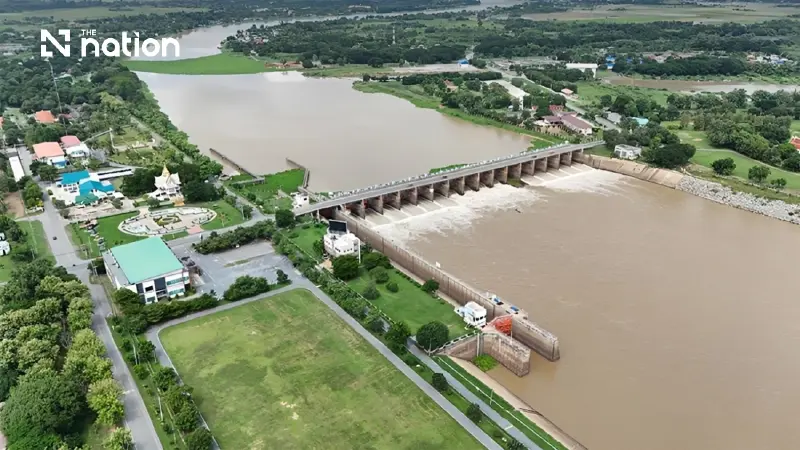


Major Chao Phraya flood-control projects worth hundreds of billions of baht remain pending, despite plans developed after the 2011 floods.
- Many large-scale water-management and flood defense projects developed after the devastating 2011 floods have still not begun construction, awaiting budgets or final approval.
- The most significant infrastructure projects from a revised nine-point plan, with a combined value of over THB480 billion, remain in early stages such as being newly approved, under study, or awaiting implementation.
- While smaller, lower-cost projects have been completed, major ongoing works like the Bang Ban–Bang Sai flood diversion canal face significant delays, with its construction period extended by four years to 2030 due to land acquisition issues.
The severe flooding seen from late September into early October 2026 has renewed concerns over Bangkok’s flood resilience, with comparisons drawn to the devastating 2011 floods.
Many water-management plans developed by successive governments after the 2011 disaster are still under development, awaiting budgets or only recently approved, with several major infrastructure projects yet to begin construction.

THB350 billion loan plan after 2011 floods
Following the 2011 floods, the government of former prime minister Yingluck Shinawatra issued an emergency decree allowing the Finance Ministry to borrow up to THB350 billion to develop a national water-management system.
The plan was divided into six key modules:
- Construction of reservoirs: THB50 billion
- Land-use planning and flood barriers: THB26 billion
- Conversion of agricultural irrigation areas into retention areas: THB10 billion
- Improvement of major waterways: THB17 billion
- Development of floodways and diversion channels: THB153 billion
- Improvement of data systems, forecasting and warning systems: THB4 billion
According to the Public Debt Management Office, nine projects with a combined value of THB284.755 billion were selected through the bidding process.
The ITD-PowerChina joint venture received the highest scores for five projects, including reservoir construction in the Ping, Yom, Nan, Sakae Krang and Pasak river basins worth THB48.551 billion, Chao Phraya basin land-use planning worth THB24.958 billion, and improvements to major waterways and river embankments worth THB16.703 billion.
Other successful bidders included Korea Water Resources Corporation (K-Water) for floodway and diversion-channel development, with a project value of THB150.484 billion, while Loxley’s consortium was awarded a data and warning-system project worth THB3.902 billion.
Five-route floodway master plan
The original floodway master plan included five major routes designed to divert excess water away from the Chao Phraya River basin.
The plan included:
- Western Floodway (WF): Designed to carry 1,200 cubic metres per second over 281 kilometres, linking Nakhon Sawan to Kanchanaburi and the Mae Klong River.
- Mae Klong River improvements: Increasing capacity to 1,910 cubic metres per second over 34 kilometres.
- Eastern Floodway 1 (EF1): Designed to carry 300 cubic metres per second over 133 kilometres through improvements to the Chainat–Pasak canal.
- Eastern Floodway 2 (EF2): Designed to carry 300 cubic metres per second over 388 kilometres through improvements to 13 canals.
- Tha Chin River improvements: Designed to carry 250–300 cubic metres per second through shortcut canals and water-control gates.
The concept was designed to divert water from the Ping River during major floods similar to 2011, reducing flows entering the Chao Phraya River and redirecting water through the Chainat–Pasak canal.
The project was also planned to integrate flood channels with four-lane roads, irrigation systems and 317 million cubic metres of canal storage capacity, with an expected reduction of more than 50% in flood-affected areas in the Chao Phraya basin and Bangkok.
However, the Central Administrative Court later ordered the government to conduct public consultations with affected communities before proceeding with design contracts, preventing construction from moving forward.

Nine Chao Phraya flood-control plans under later governments
After the 2014 coup, the government of former prime minister General Prayut Chan-o-cha revised the water-management strategy into nine major plans to reduce flooding in the lower Chao Phraya basin.
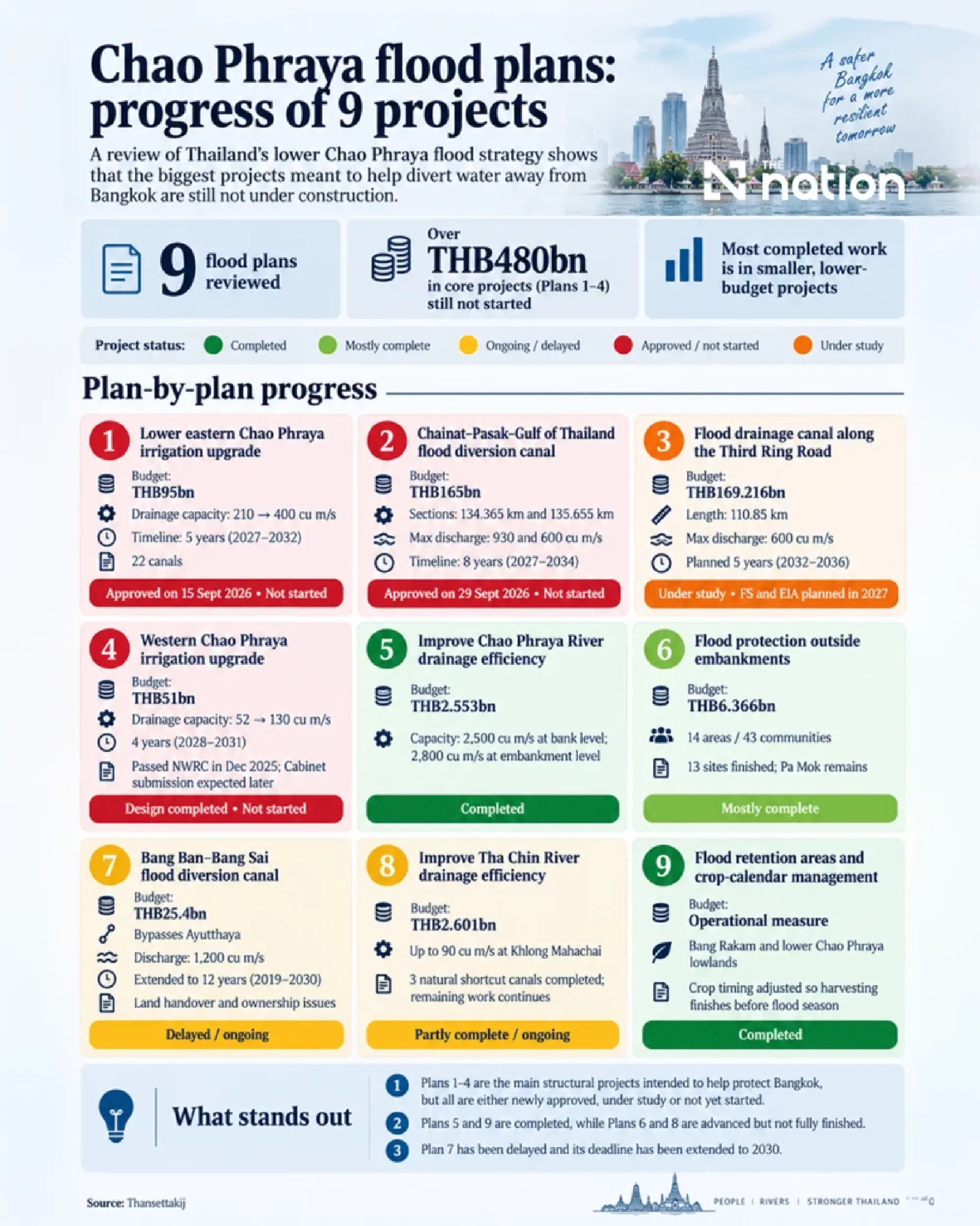
Progress on the nine plans is as follows:
- Lower eastern Chao Phraya irrigation system improvements
- Budget: THB95 billion
- Approved by the Cabinet on September 15, 2026
- Planned duration: 2027–2032
- Covers 22 canals and aims to increase drainage capacity from 210 to 400 cubic metres per second.
- Chainat–Pasak–Gulf of Thailand flood diversion canal
- Budget: THB165 billion
- Approved by the Cabinet on September 29, 2026
- Planned duration: 2027–2034
- Includes the 134.365-kilometre Chainat–Pasak section and the 135.655-kilometre Pasak–Gulf section.
- Flood drainage canal alongside the Third Ring Road
- Budget: THB169.216 billion
- Still at the feasibility-study and environmental-impact-assessment stage.
- Western Chao Phraya irrigation system improvements
- Budget: THB51 billion
- Design completed and approved by the National Water Resources Committee, but not yet implemented.
- Improving Chao Phraya River drainage capacity
- Budget: THB2.553 billion
- Completed.
- Flood protection outside embankment areas
- Budget: THB6.366 billion
- Completed in 13 of 14 areas, with only Pa Mok community remaining.
- Bang Ban–Bang Sai flood diversion canal
- Budget: THB25.4 billion
- Construction period extended from eight to 12 years due to delays in land acquisition.
- Tha Chin River drainage improvements
- Budget: THB2.601 billion
- Some canal improvements completed, with remaining work ongoing.
- Flood retention areas and agricultural calendar management
- Completed.

Major projects still not under construction
A review of the nine plans shows that completed projects are mostly lower-cost measures, including drainage improvements, community flood protection and flood retention management.
Meanwhile, the largest infrastructure projects — plans 1, 2, 3 and 4 — have a combined value of more than THB480 billion and remain either newly approved, under study or awaiting construction.
The Bang Ban–Bang Sai flood diversion canal, which began in 2019, has also been extended until 2030.
The situation highlights a long-standing challenge: Thailand identified key engineering solutions after the 2011 floods, including floodways, improved eastern and western drainage systems, land-use planning and retention areas, but many of the largest projects have yet to be completed.
Source: Thansettakij
