
ONWR puts Thailand’s reservoir storage at 82% on October 8
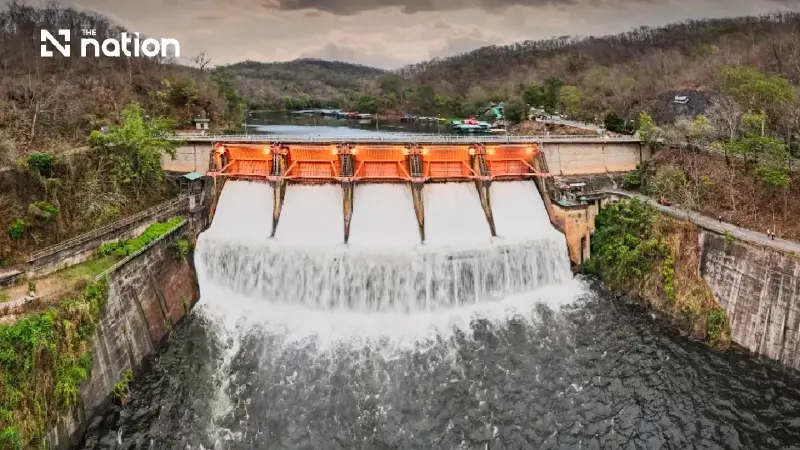


Chao Phraya Dam releases 2,350 cubic metres per second as river levels ease at two Thai monitoring stations and heavy rain persists in the South
- On October 8, Thailand's reservoirs held 66,058 million cubic metres of water, which is 82% of the country's total storage capacity.
- The amount of usable water was reported at 41,937 million cubic metres, or 74% of the usable storage capacity.
- Regional reservoir storage levels varied, with Western Thailand having the highest at 96% capacity, while the Northeast and South had the lowest at 70%.
Thailand’s reservoirs held 66,058 million cubic metres of water, equivalent to 82% of total storage capacity, the Office of the National Water Resources (ONWR) reported in its 7am update on October 8, 2026. Rainfall had decreased in upper Thailand, although parts of the South continued to face heavy rain. ONWR put usable water reserves at 41,937 million cubic metres, with the usable-storage level reported at 74%.
Chao Phraya Dam releases 2,350 cubic metres per second
Chao Phraya Dam was discharging 2,350 cubic metres per second, according to the 6am readings on October 8. Water levels stood at 16.05 metres above mean sea level upstream of the dam and 15.58 metres downstream.
Two monitoring stations in Nakhon Sawan recorded falling water levels. Station P.17 in Banphot Phisai district measured 35.65 metres above mean sea level, or 2.60 metres below the riverbank, while station N.67 in Chum Saeng district measured 25.73 metres above mean sea level, or 2.48 metres below the bank.
At station C.2 in Mueang Nakhon Sawan district, the flow rate was 2,009 cubic metres per second. The water level stood at 22.76 metres above mean sea level, or 2.94 metres below the riverbank.

Yala records the highest regional rainfall at 113mm
Yala recorded 113mm of rain, the highest figure among the regional rainfall readings in ONWR’s morning update. Heavy rain remained possible in parts of southern Thailand, while upper Thailand had less rain but continued to experience isolated thundershowers.
ONWR’s weather summary attributed the reduced rainfall in upper Thailand to a weakening southwest monsoon over the Andaman Sea, Thailand and the Gulf of Thailand. Southerly and southeasterly winds were prevailing over the lower Gulf.

The highest provincial rainfall readings in each region were:
- North: Phitsanulok, 80mm.
- Northeast: Amnat Charoen, 23mm.
- Central region: Samut Sakhon, 28mm.
- East: Chachoengsao, 55mm.
- West: Ratchaburi, 56mm.
- South: Yala, 113mm.
Regional reservoir storage ranges from 70% to 96%
Western Thailand recorded the highest regional reservoir storage level at 96% of capacity, while the Northeast and South were both at 70%, according to ONWR’s update.
- Northern Region: 20,796 million cubic meters (75%)
- Northeastern Region: 8,463 million cubic meters (70%)
- Central Region: 1,464 million cubic meters (78%)
- Eastern Region: 2,787 million cubic meters (88%)
- Western Region: 27,182 million cubic meters (96%)
- Southern Region: 5,366 million cubic meters (70%)
In the Eastern Economic Corridor (EEC), Nong Pla Lai reservoir stood at 106% of capacity. ONWR reported the following storage figures for the area’s three main reservoirs:
- Bang Phra Dam: 98 million cubic meters (84% of capacity)
- Nong Pla Lai Dam: 174 million cubic meters (106% of capacity)
- Prasae Dam: 283 million cubic meters (96% of capacity)
