
Thai army on October 22 accuses Cambodia of using Preah Vihear as a military base
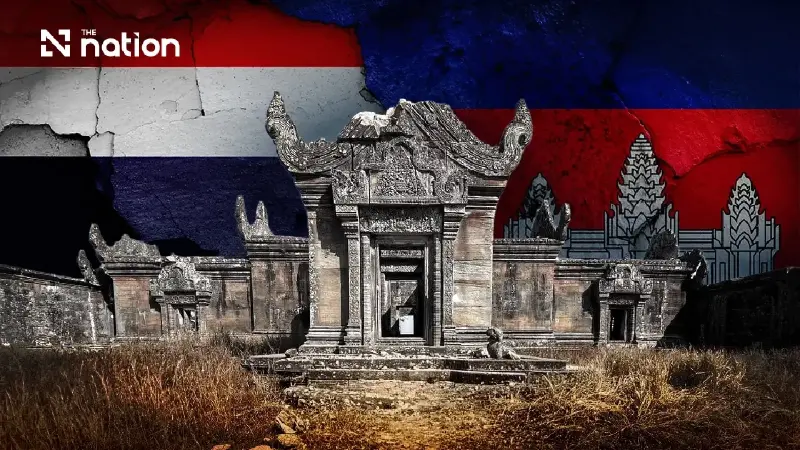


Thailand’s army cites self-defence and alleges Cambodia deployed weapons at Preah Vihear, rejecting claims of unlawful attacks.
- The Thai army alleges that Cambodian forces have converted the Preah Vihear temple into a military base, installing mortars, artillery, and ammunition stores.
- It argues that by using the temple for military purposes, Cambodia has caused it to "temporarily lose legal protection" under international law, justifying Thailand's military response as self-defense.
- The army refutes Cambodian claims of damage, accusing Cambodia of distorting a UNESCO assessment and using the heritage site as a "military cover" and "human shield."
- Thailand's military also challenges Cambodia's commitment to conservation, stating that deploying troops and weapons at the temple contradicts any such claims.
The Royal Thai Army on October 22, 2026 accused Cambodia of using Preah Vihear Temple as a base for attacks on Thai troops and civilians, rejecting Cambodian allegations that Thai military operations violated international law.
Speaking at army headquarters, Col Richa Suksuwanon, deputy army spokesman, relayed a rebuttal by Royal Thai Army spokesman Maj Gen Winthai Suvaree, who rejected Cambodia’s accusations in full.
Cambodia’s October 21 statement accused Thai forces of attacking Preah Vihear in breach of international law and cited an assessment by the United Nations Educational, Scientific and Cultural Organization (UNESCO) to support its claims about damage.
The Thai army set out its response in three parts
1. Army alleges military use of Preah Vihear
The Royal Thai Army alleged that Cambodian forces had converted the temple grounds into a military base, installing mortars, artillery, ammunition stores and anti-drone systems to support attacks on Thai military personnel and civilian communities.
Citing what it described as tangible evidence, the Thai army accused Cambodia of deliberately violating international humanitarian law by using the heritage site for military purposes.
The Thai army maintained that Thailand strictly observed international law and the 1954 Hague Convention for the Protection of Cultural Property in the Event of Armed Conflict. The army argued that military use of the temple had caused it to “temporarily lose legal protection” and that Cambodia was responsible for that loss of protection.
Thailand’s military response was an exercise of self-defence under Article 51 of the United Nations Charter, the army said. The Thai army maintained that its use of force was confined to threatening military targets and that its forces used precision weapons, with no policy of attacking civilian targets or historic monuments.
2. Army disputes Cambodia’s use of heritage assessment
The Thai army accused Cambodia of distorting an assessment by UNESCO’s World Heritage Centre and the International Council on Monuments and Sites, referred to as WHC–ICOMOS.
The Preah Vihear assessment, which the army described as a draft, was being used by Cambodia to portray itself as a “victim” and divert international attention, according to the army’s rebuttal.
The Thai army attributed damage to Preah Vihear’s integrity and outstanding universal value to Cambodia’s alleged military use of the site. The army accused Cambodia of treating the World Heritage property as a “human shield and military cover”.
3. Army challenges Cambodia’s conservation claims
The Royal Thai Army disputed Cambodia’s assertion that conserving and restoring Preah Vihear was a leading government priority, arguing that the alleged deployment of troops and weapons at the temple contradicted that commitment.
Maj Gen Winthai’s rebuttal maintained that stationing troops and weapons at Preah Vihear demonstrated a disregard for cultural heritage. Preserving the temple intact for future generations required keeping military bases, equipment and ammunition stores out of the temple grounds and surrounding areas, the army argued.
The Thai army called on the international community, UNESCO and the public to consider the information comprehensively and assess it against the facts.
The Royal Thai Army also called on Cambodia to stop using shared cultural heritage for what it described as propaganda serving political and diplomatic interests.
