
Thailand sends 50 teams to inspect 1,500 waste plants in five provinces
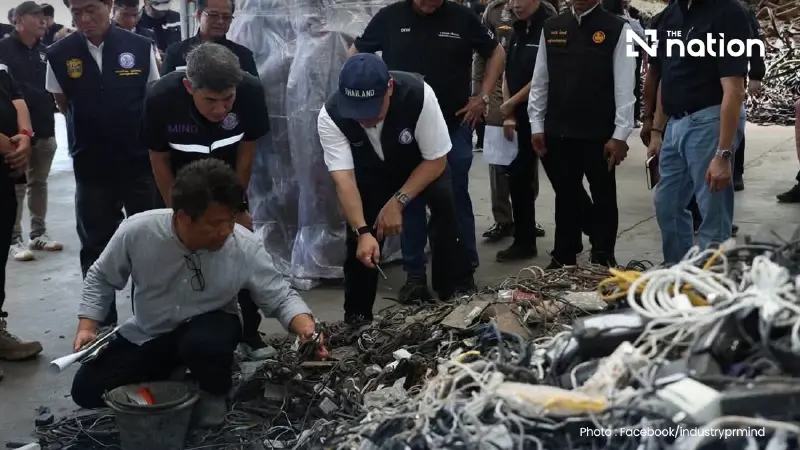


Thailand is deploying 50 inspection teams to more than 1,500 waste facilities in five provinces, with illegal operators facing closure, licence revocation and possible asset seizures.
Thailand’s Industry Ministry is deploying 50 inspection teams to more than 1,500 waste facilities across five provinces, with factories found operating illegally facing closure, licence revocation and possible further action over their assets.
Industry Minister Varawut Silpa-archa announced the operation while responding in Parliament to a question from Watcharapong Sirirak, a Rayong MP from the People’s Party, over illegal electronic-waste imports and industrial-waste disposal.
Varawut said Thailand currently has 3,049 factories licensed under categories 105 and 106, covering businesses involved in waste sorting, disposal and recycling. Around half are concentrated in Rayong, Chonburi, Chachoengsao, Samut Prakan and Prachinburi.

Ten inspection teams assigned to each province
Provincial industry offices have been instructed to inspect every relevant facility in the five provinces, covering more than 1,500 sites.
The ministry has established 10 teams for each province, giving a total of 50 inspection units.
“If we find that they are not operating correctly, they will be closed and their licences can be revoked,” Varawut said.
The ministry expects the inspections to provide a clearer picture within one to two months of which operators are breaking the law and what enforcement action will be required.
The crackdown follows continuing concerns over illegal imports of electronic waste, unauthorised sorting facilities and industrial waste being dumped or buried outside approved treatment systems.
Varawut stressed that Thailand should not become a destination for other countries’ waste.

Minister seeks tougher penalties
The Industry Ministry is also pushing for stronger legal penalties against illegal dumping and improper industrial-waste management.
Varawut said the present system could create a financial incentive to break the law because correct waste treatment can cost between 800,000 and 1 million baht, while fines for illegal disposal can be only around 200,000–300,000 baht.
That disparity can make paying a fine cheaper than treating waste legally, he argued.
Proposed legal amendments are now being considered by a House committee, with the ministry seeking substantially tougher penalties.
Authorities are also coordinating with the Anti-Money Laundering Office (AMLO) to explore whether serious illegal industrial-waste cases could be linked to financial offences, potentially allowing investigators to trace money flows and seize assets from operators involved in wrongdoing.

Hazardous waste could be removed before cases conclude
Watcharapong asked whether cargo declarations suspected of concealing electronic waste could automatically be placed on customs “red-line” status for X-ray inspection.
He also raised concerns about lengthy court cases and asked whether authorities could compensate affected residents, remove dangerous waste and rehabilitate contaminated areas before legal proceedings were concluded.
Varawut said authorities could act where evidence or seized material posed an immediate danger to the public rather than leaving hazardous waste untreated while a case moved through the courts.
The government could subsequently seek to recover the cost of treatment and rehabilitation from the responsible operator once legal responsibility was established.

Four Prachinburi companies face nominee scrutiny
Separately, the Department of Business Development is examining possible nominee arrangements involving waste businesses in Prachinburi.
Director-General Kittiwat Patchimnan said the department, the Prachinburi Provincial Commercial Office and law-enforcement agencies had inspected businesses and identified four companies whose structures could indicate the use of Thai nationals as nominee shareholders.
The information has been forwarded to relevant enforcement agencies for further investigation and possible prosecution.
Authorities are also examining the financial transactions of Thai shareholders who may have acted as nominees.
44 waste companies identified as higher risk
Kittiwat said authorities had broadened their examination of waste businesses in Prachinburi involving foreign shareholders.
They identified 44 legal entities considered higher risk, comprising 41 businesses dealing with non-hazardous waste and three handling hazardous waste.
Authorities are examining their ownership structures, business activities and financial links to determine whether any have violated laws governing foreign business ownership or used Thai nominees to conceal effective foreign control.
The wider inspection campaign will focus on determining whether licensed waste businesses in the five provinces are operating within the conditions of their permits and whether waste is being stored, processed or disposed of through legal channels.
Operators found breaching those conditions could face shutdown orders, licence revocation and other legal action, while authorities seek stronger penalties to make illegal dumping more expensive than proper waste treatment.
