
Thailand prepares for surge in solar and EV battery waste with new recycling estate
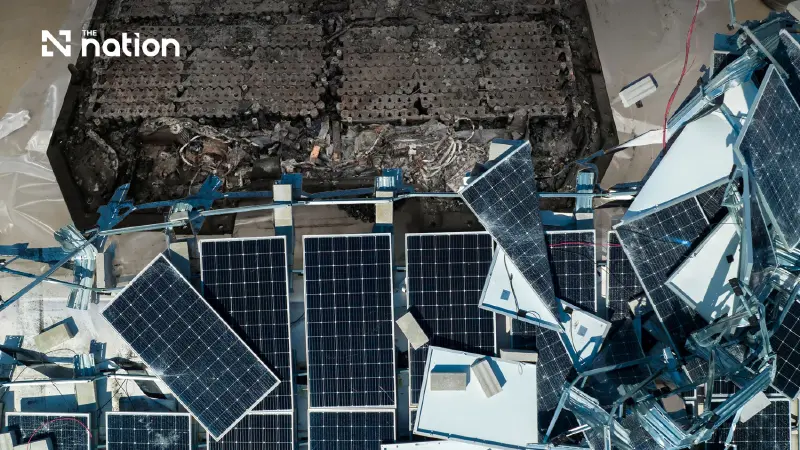


Thailand is preparing a dedicated recycling industrial estate for ageing solar panels and EV batteries while tightening industrial-waste laws and raising penalties.
Thailand is accelerating plans for a dedicated recycling industrial estate as the country prepares for growing volumes of discarded solar panels, electric-vehicle batteries and electronic equipment over the coming years.
Industry Minister Varawut Silpa-archa said on Saturday (October 17) that economic growth should not come at the expense of the environment, with illegal industrial-waste disposal and the coming wave of clean-technology waste among the ministry’s priorities.
Speaking on the government programme Talk with Anutin’s Cabinet, Varawut said some industrial and waste-related laws had been in force for 40–50 years and carried penalties too low to deter violations.
Under some existing provisions, fines are capped at 200,000 baht, while proper treatment or disposal of industrial waste can cost several hundred thousand baht or more.
“When punishment costs less than proper treatment, it does not deter offenders,” Varawut said, arguing that breaking the law must become economically unattractive.
Government targets tougher industrial-waste penalties
The Industry Ministry is working to amend the Factory Act and legislation governing industrial waste, while coordinating with the Ministry of Natural Resources and Environment, the Department of Special Investigation and the Customs Department.
Varawut said authorities want enforcement to extend beyond fines to tracing financial flows and, where appropriate, seizing assets belonging to business owners involved in illegal waste disposal.
The ministry is also pushing for penalties to rise into the eight-digit range, or tens of millions of baht, depending on the final legal amendments.
Ageing solar panels and EV batteries pose next waste challenge
Varawut said Thailand must also prepare for waste generated by technologies introduced as part of the clean-energy transition.
Solar panels installed about a decade ago are moving closer to the end of their expected service lives, which he put at around 15 years. Large volumes could therefore begin entering the waste stream within the next one to two years.
Electric-vehicle batteries will create another challenge as the domestic EV fleet expands.
To manage these materials, the ministry is pushing ahead with a recycling industrial estate that would bring recycling plants and hazardous-waste treatment facilities into a controlled area.
The proposed estate would include a central wastewater-treatment system and round-the-clock monitoring, with the aim of preventing batteries, solar modules and electronic waste from being mixed with ordinary rubbish.
The ministry had already been advancing recycling-estate plans earlier this year alongside new standards for solar equipment and energy-storage batteries.
Used EV batteries could get second life in energy storage
Varawut stressed that an EV battery no longer suitable for use in a vehicle does not necessarily need to be discarded immediately.
Some batteries can be reconditioned and reused in energy storage systems (ESS), extending their useful life before final recycling or disposal.
Batteries that have genuinely reached the end of their usable life, however, must be handled properly because their components can pose health and environmental risks.
Thailand is also seeking more investment in used EV-battery recycling as part of its automotive transition. Varawut recently highlighted the issue in discussions involving Japanese carmakers.
‘AI squared’ to bring technology into agriculture
Beyond waste management, the Industry Ministry plans to use advanced technologies to help raise productivity and incomes in agriculture.
Varawut described the approach as “AI squared”, linking technologies developed for advanced industry with an agricultural sector that employs almost 30% of Thailand’s workforce but generates only about 8% of GDP.
AI could be applied upstream to irrigation, soil quality and weather monitoring; in processing through automation; and downstream through e-commerce, social media, logistics and market analysis.
“The era of simply selling more is over. We have to sell at higher value,” he said.
Rice, for example, may sell as a raw commodity for around 7,000–8,000 baht per tonne, but processing it into flour or other export products could raise its value to tens of thousands of baht per tonne.
For sugar cane, the focus would be on raising yields per rai and improving sugar content so farmers can earn more from the same amount of land.
Four high-value agricultural processing estates planned
The Industry Ministry plans to discuss with the Agriculture and Cooperatives Ministry the establishment of four high-value agro-processing industrial estates, one each in the North, Central region, Northeast and South.
Each would be designed around agricultural products important to its region, such as rice, sugar cane and rubber.
Varawut said the objective was to ensure technologies discussed at policy level translated into production, processing and higher incomes on the ground.
Thailand to retain multi-pathway automotive strategy
The minister also reiterated that Thailand would not pursue electric vehicles as the country’s only automotive technology.
Instead, the government will follow a multi-pathway approach, supporting internal-combustion-engine vehicles, hybrids, plug-in hybrids, battery-electric vehicles and potentially hydrogen technologies.
Varawut said Thailand must also look after its long-established Japanese automotive manufacturers and domestic suppliers, which have supported jobs and helped build the country’s industrial base over six to seven decades.
Thailand has more than 3.2 million SMEs, many of which form part of supply chains across industries, particularly automotive manufacturing.
The Industry Ministry and the Small and Medium Enterprise Development Bank of Thailand, or SME D Bank, plan to provide both financing and technical knowledge to help suppliers adapt.
Parts manufacturers will need greater precision and flexibility so production lines can serve ICE, hybrid and EV models, especially because Thailand exports vehicles to markets with different technology requirements.
CBAM adds pressure for greener factories
Another challenge is tougher international environmental regulation, including the European Union’s Carbon Border Adjustment Mechanism (CBAM).
Varawut said Thai exporters would increasingly need access to clean energy, proper waste-treatment systems and greener manufacturing standards to remain competitive.
The ministry therefore intends to combine regulation with support, helping SMEs obtain knowledge and financing to upgrade factories and move towards Green Industry standards.
The broader strategy, he said, is to ensure Thailand’s industrial transition brings together cleaner production, stronger enforcement, higher-value agriculture and multiple automotive technologies rather than forcing businesses into a single development path.
