
Thailand and Malaysia agree to improve security, travel and trade
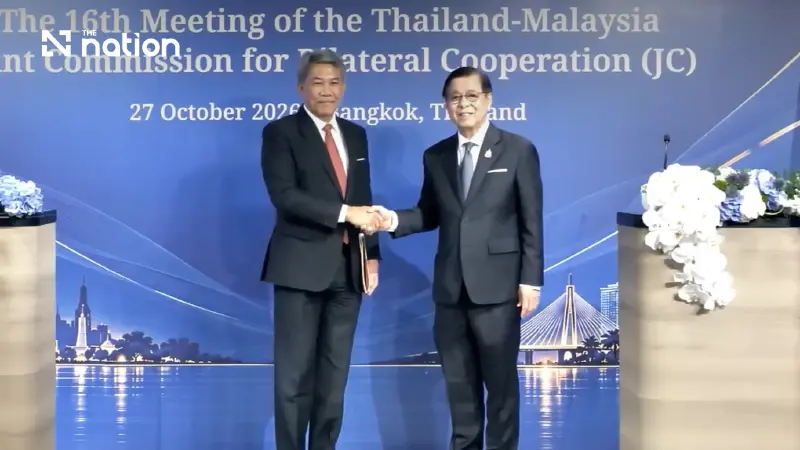


Thailand and Malaysia agreed to strengthen border security, ease cross-border travel and bolster trade and investment through transport, tourism and energy cooperation.
- The two nations will enhance border security through increased intelligence sharing, coordinated patrols to combat trafficking, and continued Malaysian facilitation of peace talks for Thailand's southern provinces.
- To improve travel, the countries will accelerate joint infrastructure projects, such as a new bridge and reviving a rail link, and will explore extending operating hours at border checkpoints.
- Both countries have committed to increasing bilateral trade to US$30 billion by 2027, strengthening cooperation in areas like the halal industry, cross-border payments, and a potential clean energy grid with Singapore.
Thailand and Malaysia have agreed to strengthen security along their shared border, make cross-border travel easier and expand trade and investment cooperation, with both governments seeking faster progress on joint development projects.
Thai Deputy Prime Minister and Foreign Minister Sihasak Phuangketkeow and Malaysian Foreign Minister Dato’ Seri Utama Haji Mohamad bin Haji Hasan co-chaired the seventh ministerial meeting of the Thailand–Malaysia Committee on the Joint Development Strategy for Border Areas (JDS) and the 16th meeting of the Thailand–Malaysia Joint Commission for Bilateral Cooperation (JC) at the Waldorf Astoria Bangkok on Tuesday (October 27), during Mohamad’s two-day working visit to Thailand.
The meetings followed Prime Minister Anutin Charnvirakul’s official visit to Malaysia in July and Sihasak’s trip to Kuala Lumpur in September. During bilateral talks before the meetings, the ministers also discussed regional developments and preparations for high-level exchanges marking the 70th anniversary of diplomatic relations in 2027.
“I don’t think we should do things business as usual. I think we should give a sense of urgency to the projects that we are working on,” Sihasak told a joint press briefing, urging both sides to identify further projects with a tangible impact.

Border security and southern peace dialogue
Thailand reaffirmed its commitment to peace talks aimed at ending violence in its southern border provinces, with Malaysia continuing to facilitate the process. Sihasak welcomed the appointment of Former Defence Intelligence director-general Lt-Jen (Rtd) Datuk Ahmad Norihan Jalal as Malaysia’s new facilitator.
“On the southern border provinces of Thailand, I reaffirmed the Thai government’s full commitment to the peace dialogue process. I thank Malaysia for its facilitation role and its understanding of Thailand’s policy,” he stated.
Sihasak emphasised that reducing violence and creating favourable conditions for dialogue were essential to achieving lasting peace and improving the lives of local communities.
He also welcomed cooperation between the countries’ armed forces, police and anti-narcotics agencies.
At the JC meeting, both sides called for greater use of the Joint Working Committee on Security Cooperation (JWC-SC) as a policy-level platform for border security management.
The two sides intend to step up intelligence sharing and coordinated border patrols to combat drug and human trafficking, while pursuing closer cooperation on cybercrime and cybersecurity.
Both countries also hope to sign a memorandum of understanding on defence cooperation in 2027.
Easier border crossings and transport connections
At the JDS meeting, both countries reviewed progress under the JDS Strategic Plan 2024–2027 and supported a more action-oriented approach to developing their shared border areas and improving the well-being of local communities.
On transport, Sihasak highlighted the completed road linking Thailand’s new Sadao checkpoint with Bukit Kayu Hitam in Malaysia, which the two prime ministers officially opened in July.
He also looked forward to a ground-breaking ceremony for the Su-ngai Kolok–Rantau Panjang Second Friendship Bridge, a project both sides agreed to accelerate.
The countries discussed reviving the Su-ngai Kolok–Rantau Panjang railway service and proposals to extend operating hours at border checkpoints to make travel and trade more convenient.
A new Joint Ministerial Committee on Transport Cooperation (JMC) will prepare a master plan for cross-border transport links between southern Thailand and northern Malaysia. Sihasak expressed hope that two memoranda covering the cross-border transport of passengers and goods could be signed at the committee’s first meeting.
Tourism forms another important part of efforts to improve mobility. Sihasak noted that Malaysians were Thailand’s largest group of foreign visitors in 2025 and pledged to make cross-border travel easier under the countries’ tourism cooperation roadmap.
He also stressed that existing infrastructure projects needed better coordination to ensure transport networks on both sides of the border were properly connected.

Stronger trade and investment cooperation
Malaysia was Thailand’s largest trading partner within ASEAN and its fifth-largest trading partner worldwide in 2025, according to Sihasak.
The two governments remain committed to raising bilateral trade to US$30 billion by 2027. They agreed to convene the fourth meeting of the Joint Trade Committee (JTC) at the earliest opportunity to strengthen economic cooperation and discuss a new trade target.
At the JDS meeting, both sides encouraged stronger links between special border economic zones on either side of the border, with a particular focus on the rubber and halal industries.
Sihasak called for closer cooperation on halal certification to expand trade in halal products between the two countries and in international markets.
Existing cross-border QR-code payment links will also be enhanced to make transactions easier and more secure.
Mohamad estimated bilateral trade at around US$28 billion, with the figure potentially reaching US$28.5 billion soon. He argued that more efficient border trade could help both countries exceed their target.
“But if we can enhance and facilitate the border trade, I think in no time that we can achieve more than 30 billion,” the Malaysian minister remarked.
He pledged that Malaysia would adopt a whole-of-government approach to facilitate cooperation across ministries and agencies, while highlighting the importance of closer people-to-people ties in encouraging business and investment.
The discussions also covered a proposed trilateral clean power grid connecting Thailand, Malaysia and Singapore.
Sihasak raised the initiative as a potential response to growing demand for clean energy among international investors. Relevant agencies were instructed to examine the proposal.
“Clean energy is a requirement these days for investors coming to the region, and we see the opportunity for our three countries to work more closely together in developing this clean energy grid,” he explained.
Education, labour protection and transboundary haze
Beyond security and economic cooperation, Thailand and Malaysia encouraged the early finalisation of memoranda covering education and labour, with a view to signing them during the eighth annual consultation between the two prime ministers.
These agreements are intended to expand educational opportunities for students and improve protection for workers.
At the joint press conference, Mohamad also raised concerns about recurring transboundary haze and called for stronger regional cooperation to address the problem.
Both countries agreed to review and strengthen the existing ASEAN mechanism for tackling haze pollution, including its enforcement arrangements.
The Malaysian minister highlighted the impact on Indonesia, Singapore, Thailand and Malaysia, stressing the need for a coordinated response to this recurring regional problem.
The Thai side also congratulated Malaysia on its successful ASEAN chairmanship in 2025, while Malaysia reaffirmed its support for Thailand’s ASEAN chairmanship in 2028.

Joint committee to monitor progress
Speaking after the meetings, Mohamad announced plans for a separate special working committee to monitor and review progress on joint border development initiatives.
He pledged to report developments to Malaysia’s cabinet at least quarterly, rather than relying solely on annual ministerial meetings.
Sihasak emphasised that closer coordination was necessary to turn individual infrastructure and development projects into meaningful improvements for communities along the shared border.
Both ministerial meetings adopted their respective Records of Discussion.
Thailand expects to host the eighth annual consultation between the two prime ministers in 2027, while Malaysia is due to host the eighth JDS ministerial meeting and the 17th JC meeting in Kuala Lumpur.
The upcoming meetings will provide further opportunities to advance cooperation as both countries prepare to celebrate 70 years of diplomatic relations.
