
Thailand intensifies industrial waste crackdown and considers asset seizures
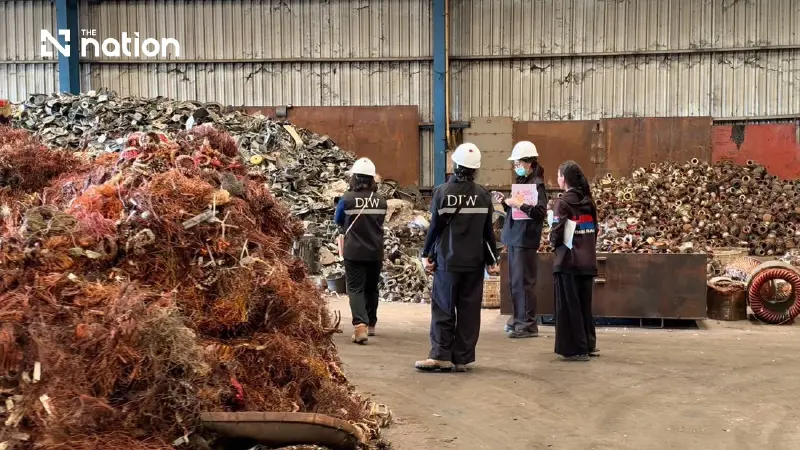


Industrial waste inspections reached 171 factories in two days as Thailand considered using anti-money-laundering laws against illegal dumping networks.
Thailand’s Industry Ministry has inspected another 91 factories on the second day of its industrial waste crackdown, bringing the total to 171, as officials consider extending anti-money-laundering measures to illegal waste disposal networks.
Industry Minister Varawut Silpa-archa told a ministry executives’ meeting on November 4, 2026, that the enforcement campaign launched on November 1 was among the ministry’s most important responsibilities.
The operation focuses on Category 105 factories, which sort or dispose of industrial waste through landfill, and Category 106 facilities, which process discarded industrial materials into raw materials or new products.
Inspectors examined 80 factories on the first day and another 91 on the second.

Varawut emphasised that the campaign must cover all 76 provinces, extending beyond the five initial priority provinces of Chonburi, Rayong, Chachoengsao, Prachin Buri and Samut Prakan.
He stressed that industrial development must go hand in hand with environmental protection, without imposing unacceptable costs on surrounding communities.
Strong economic growth and favourable gross domestic product figures could not be regarded as success if industrial waste pollution and public complaints continued, he argued.
Responsibility for managing waste generated by factories lay directly with the Industry Ministry, rather than solely with the Ministry of Natural Resources and Environment.
Inspection campaign to cover unregistered factories
Varawut instructed provincial industry offices to maintain strict oversight of waste-related operations, including facilities registered with the Department of Industrial Works, unregistered factories and businesses previously ordered to suspend operations.
He emphasised that inspectors must examine every relevant aspect of factory activities, particularly cases where previous enforcement orders had not been implemented.
The minister also instructed officials to maintain their efforts throughout the campaign.
“There must be no let-up after two or three weeks. Enforcement must remain firm,” he stressed.
Stricter deadlines and action against repeat offenders
Varawut outlined five priorities for the enforcement campaign, beginning with public safety and environmental protection.
Officials must examine the effects of industrial waste operations on communities, including contamination of water sources, agricultural land and areas used for landfill.
His second priority was rigorous enforcement of factory legislation, particularly Sections 37 and 39, which provide mechanisms for requiring corrective action and imposing stricter measures when necessary.
He instructed the Department of Industrial Works to establish appropriate deadlines for factory operators to remedy violations.
These could be 60, 80 or 90 days, depending on the circumstances, but should be sufficient from the outset to avoid repeated requests for extensions.
Once a deadline expires, operators that have failed to comply should face further legal action.
Varawut also called for clearer measures against factories that repeatedly cause environmental problems, including cases where violations recur two or three years after corrective action.
He indicated that repeated incidents should be considered when determining whether stronger enforcement measures were necessary.

Inspection teams ordered to track every case
The third priority involves proactive inspections and thorough follow-up.
Officials must monitor complaints and legal proceedings involving odours, excessive noise, smoke, wastewater discharge and other damage arising from factory operations.
Five inspection teams covering the initial priority provinces and another 71 provincial teams have been instructed to maintain clear records of enforcement orders and follow-up schedules.
These records should identify when instructions were issued and when subsequent inspections are due, preventing enforcement notices from being ignored.
The fourth priority is closer cooperation with other authorities, including the Finance, Commerce and Justice ministries, prosecutors, courts and local administrative bodies.
Varawut highlighted the role of district chiefs, municipal officials, subdistrict administrative organisations and village leaders in identifying unauthorised factories or warehouses where machinery is installed without proper approval.
Local authorities, he stressed, must take responsibility for monitoring potentially illegal activities in their communities.
His fifth priority concerns transparency, accountability and the ability to scrutinise enforcement decisions.
Varawut instructed the Department of Industrial Works to temporarily suspend the issuance of new licences for Category 105 and 106 factories, without introducing additional exemptions during the current period.
Anti-money-laundering measures under consideration
Permanent Secretary for Industry Pasakorn Chairat disclosed that the ministry had held further discussions with the Anti-Money Laundering Office (AMLO) on strengthening action against illegal industrial waste operations.
The discussions concern a proposal to classify illegal waste dumping and certain violations of factory and hazardous-substance legislation as predicate offences under anti-money-laundering law.
Such a change would provide additional legal mechanisms for investigating financial transactions, tracing money flows and seizing assets associated with illegal operations.
The ministry believes these measures could help dismantle networks involved in unlawful waste disposal by targeting the financial structures supporting their activities.
The proposal remains under discussion and has not yet been established as law.
Industrial waste management bill progresses
Department of Industrial Works Director-General Pornyod Klankrong also reported progress on proposed amendments to the draft Industrial Waste Management Act.
He explained that the department presented details of the draft legislation to the Industry Ministry’s legal development and reform working group on October 24.
The ministry also submitted the matter to the Cabinet Secretariat on October 19 for consideration.
The secretariat subsequently requested additional assessments from the Finance Ministry and the Revolving Fund Management Policy Committee.
On October 28, the Department of Industrial Works met representatives of the Comptroller General’s Department to discuss the preparation of supporting information and documents.
These materials will be used in obtaining the necessary assessments on issues relating to the proposed legislation.
The ministry intends to continue strengthening industrial waste controls through inspections, legal enforcement and legislative changes aimed at preventing environmental damage and holding non-compliant operators accountable.
