
Thailand weighs pollution control zone for Prachin Buri basin
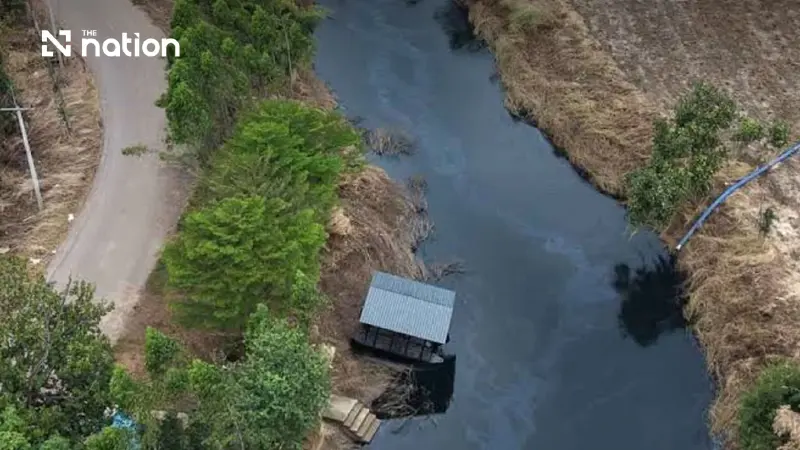


Thailand weighs a pollution control zone for the Prachin Buri basin after fish deaths and blackened water. Heavy-metal sediment tests and Bang Pakong River checks are planned.
- The Thai government is considering designating the Prachin Buri River basin a pollution control zone following reports of dead fish and blackened water.
- The move comes after requests from local communities and residents affected by the suspected pollution.
- An investigation is underway to identify the pollution source, with authorities collecting water and sediment samples from the Prachin Buri and nearby Bang Pakong rivers.
- No formal designation has yet been made, as the proposal requires further study before being submitted to the National Environment Board for a final decision.
Thailand is considering designating the Prachin Buri River basin and its tributaries as a pollution control zone following reports of fish deaths and blackened water. It also plans to extend water quality checks to the Bang Pakong River.
Deputy Government Spokesperson Lalida Perisvivatana outlined the measures on Sunday (November 8), noting that the Ministry of Natural Resources and Environment was gathering information to support a formal proposal.
Fish deaths were reported in Ban Tham subdistrict, while blackened water was reported near the Phet Chaloem floodgate. Authorities have yet to establish the cause of either incident.

Residents seek formal pollution controls
At its fourth meeting of 2026 on November 5, the Pollution Control Committee reviewed requests from community networks and affected residents to designate the Prachin Buri basin as a pollution control zone.
The committee recommended that the Pollution Control Department, the Office of Natural Resources and Environmental Policy and Planning, and relevant subcommittees conduct further studies before submitting a proposal to the National Environment Board.
No designation has yet been made. The National Environment Board, which has the relevant legal authority, must consider the proposal before any formal declaration can proceed.

Water quality checks to extend to Bang Pakong River
The Pollution Control Department has already collected water samples from the reported incident sites and surrounding areas to examine water quality and identify possible contaminants.
Laboratory results are pending, and investigators have yet to identify any contaminant or pollution source responsible for the incidents.
Further sampling is planned in the Prachin Buri and Bang Pakong rivers, alongside inspections of potential pollution sources in industrial areas and nearby locations.
These investigations aim to determine whether the reported problems along the waterways are connected and provide evidence to support appropriate corrective measures.

Heavy-metal testing to assess long-term risks
Officials also plan to test riverbed sediment for accumulated heavy metals to assess potential long-term contamination that water testing alone might not reveal.
Lalida emphasised that the investigation would examine several factors together, including water quality, potential pollution sources, water flows and hazardous substances deposited in sediment.
“Addressing the problem requires tracing pollution to its source, not simply testing water at individual locations,” she said.
“We need evidence on pollution sources, water flows and hazardous substances in sediment to develop targeted solutions.”
Lalida also reaffirmed the government's commitment to addressing pollution affecting local communities and protecting public health, livelihoods and ecosystems.
However, officials must await the laboratory findings before determining the causes of the incidents or assessing the safety of local water and aquatic life.
