
Nine dead after shooting at a Krakow landmark, five foreigners injured
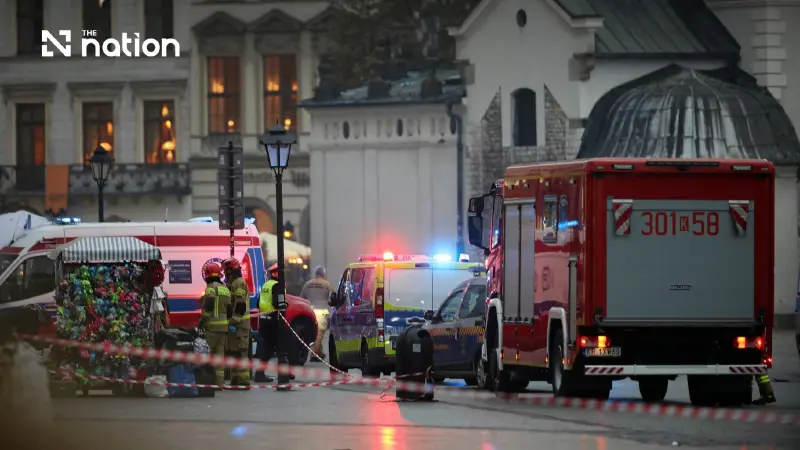


A gunman killed six, including a Briton, in Krakow, Poland, on November 7. The attack left 17 injured; police found three more bodies at his home and are probing far-right links.
- Nine people have died following a shooting in Krakow's Main Market Square; six were killed at the scene and three bodies were later found at the suspect's home.
- A British citizen was among the six people killed at the historic square, which is a popular tourist attraction.
- Five foreign nationals were injured in the attack, including citizens from Britain, Austria, Germany, Portugal, and Russia.
- The suspected gunman, a 24-year-old Polish citizen, has been arrested, with authorities investigating a potential far-right motive.
Six people, including a British citizen, were killed when a gunman opened fire in Krakow’s historic Main Market Square in southern Poland on Saturday (November 7). Police later found three bodies at the suspect’s home, bringing the number of deaths reported across the two locations to nine.
The shooting also left 17 people injured, including two police officers and the suspected attacker. Polish authorities confirmed that four women and two men died at the square, one of the country’s best-known tourist attractions.
The injured included five foreign nationals from Austria, Germany, Portugal, Russia and Britain.
The suspected gunman, a 24-year-old Polish citizen, was wounded in an exchange of fire with police before being taken into custody. Authorities have identified no other attacker, although the motive behind the shooting has not been established.
Police investigate suspected far-right influence
“Everything points to the fact that the shooter was influenced by far-right ideology,” Polish Interior Minister Marcin Kierwiński told a news briefing, adding that the suspected influence would form part of the investigation.
Kierwiński also confirmed that police officers and personnel from Poland’s Internal Security Agency had been deployed to the shooting scene and the suspect’s family home.
Katarzyna Cisło, a spokeswoman for the regional police, reported that the attacker wore military-style clothing and used a military-type weapon. Investigators also recovered a large cache of weapons and ammunition from his vehicle.
Another police spokesman, Andrzej Fijołek, told Polish broadcaster TVN24 that the man had used an AR-15 rifle and possessed a firearms licence.
A spokesman for the Lesser Poland regional administration, the region that includes Krakow, reported that the suspect remained in a stable but critical condition after undergoing several operations.

Three more bodies discovered at suspect’s home
Prime Minister Donald Tusk reported that the bodies of two women and one man had been found at the suspected attacker’s residence in Ostrowiec Świętokrzyski, less than 200 kilometres north of Krakow.
At an emergency meeting, Tusk reported strong indications that the three were members of the suspect’s immediate family.
Authorities used a drone to inspect the property because of security concerns, including the possibility that a substantial quantity of weapons was stored inside.
Local media reported that residents of the suspect’s building had been evacuated before counterterrorism officers entered to search the premises.
Tomasz Siemoniak, Poland’s minister coordinating special services, confirmed that the Internal Security Agency (ABW) and Military Counterintelligence Service (SKW) were assisting the investigation.

Unprecedented attack raises security concerns
The attack has shocked Poland, which has long regarded itself as safer than western European countries that have experienced similar violence.
The shooting has also heightened concerns following several stabbing attacks at schools in October, which Polish authorities previously linked to violent and extremist material circulating online.

Poland prepares national mourning
A spokesman for President Karol Nawrocki announced plans to designate November 8 and 9 as days of national mourning in memory of the victims.
Nawrocki also expressed sympathy for the victims, those injured and their families in a post on X.
Ukrainian President Volodymyr Zelenskyy described the shooting as shocking and expressed his deepest condolences to the victims’ families and loved ones on behalf of the Ukrainian people and himself.
European Union foreign policy chief Kaja Kallas described the incident as “a tragedy that will be felt far beyond Poland”.

