
DFT clarifies farmer groups can export rice without huge stocks
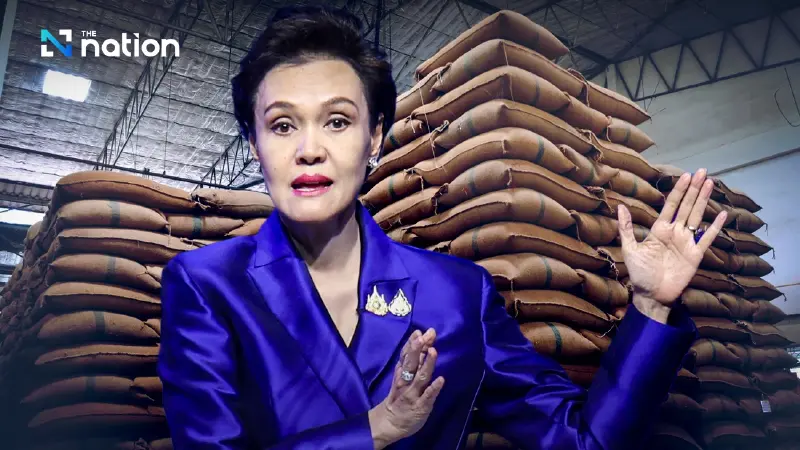


DFT says farmer groups and co-ops may export boxed or packaged milled rice without stockpiles, as DIT revises rules while keeping 100-tonne stocks for larger exporters.
Farmer groups and cooperatives can be exempt from stockpiling rules
The Department of Foreign Trade (DFT) on Sunday clarified that farmer groups and cooperatives can be exempt from stockpiling requirements when exporting rice—provided the exports are limited to boxed or packaged milled rice.
DFT director-general Arada Fuangtong issued the clarification following a policy debate on rice exports between Bhumjaithai Party member and caretaker commerce minister Suphajee Suthumpun and People’s Party PM candidate Sirikanya Tansakun.
Debate focuses on the 100-tonne minimum stock requirement
Sirikanya proposed abolishing the minimum stockpiling requirement of 100 tonnes so small farmer groups could export directly without relying on middlemen. Suphajee argued that a 100-tonne stockpile was small by exporter standards and remained necessary to ensure exporters could fulfil orders, warning that failure to deliver could damage Thailand’s reputation.
DIT amending rice stockpile regulations, DFT says
Arada said the Department of Internal Trade (DIT) is in the process of amending rice stockpile regulations to allow small farmer groups to export rice without stockpiling. However, exporters with registered capital of at least 5 million baht must still hold rice stocks of 100 tonnes or more.
She said the DIT held a meeting on Saturday to consider revisions to exporters’ stockholding conditions under DIT regulations.
Rice Trading Act committee reviews updated exporter stockholding conditions
On Saturday, the Operational Committee under the Rice Trading Act B.E. 2489 (1946) held its first meeting of 2025 (1/2568) to consider revising exporters’ rice stockholding conditions under Operational Committee Notification No. 150 B.E. 2560 (2017) on licensing for rice traders, licence conditions and licence revocation. The notification was amended by No. 153 B.E. 2567 (2024).

The proposed revisions divide business registration into two categories:
1) Farmer groups and cooperatives
Rice traders—both general exporters and exporters of boxed or packaged milled rice—would be exempt from stockpiling requirements.
2) Operators categorised by registered capital
- Registered capital 5–10 million baht: export stock requirement reduced from 500 tonnes to 100 tonnes.
- Registered capital 10–20 million baht: must hold 500 tonnes in export stocks.
- Registered capital over 20 million baht: must hold 1,000 tonnes in export stocks.
These requirements apply to general exporters. Exporters of boxed or packaged milled rice who do not have a specified registered-capital requirement are not subject to a stockholding requirement.
Public consultation backs proposed changes
Arada said the DIT, which served as the meeting secretariat, conducted a 15-day public consultation from January 2–16, 2025, in line with procedural rules. A total of 74 comments were submitted: 71 supported the proposal and three opposed it. Those who opposed the proposal called for the complete abolition of stockpiling requirements.
However, the secretariat (DIT) said stockpiles remain necessary for medium-sized exporters and above to help monitor deliveries and protect the reputation of Thai rice. Without stockpiles, failures to deliver could damage Thailand’s long-standing export image, it said. Stockholding requirements were therefore retained for medium-sized exporters and above.
DFT says it did not object to the DIT revisions
Arada said the DFT did not object to the revision of exporters’ rice stockholding conditions under the DIT’s regulations.
The meeting agreed to amend the conditions under Operational Committee Notification No. 150 B.E. 2560 (2017). Previously, companies with registered capital of no more than 20 million baht were required to hold at least 500 tonnes of milled rice in stock, while those with capital over 20 million baht had to hold at least 1,000 tonnes.
Under the revised rule, companies with registered capital of no more than 10 million baht must hold at least 100 tonnes in stock, while other thresholds remain unchanged, she said.
DFT cuts rice exporter registration time to 30 minutes
Separately, the DFT said it has improved its procedures to reduce the time needed to register as a rice exporter from up to three days to just 30 minutes.
Authority to approve exporter registration has been delegated to the Director of the Rice Trade Administration Division, acting on behalf of the DFT director-general, since December 27, 2024. Operators can register through the DFT SMART–I electronic system.
In 2025, a total of 47 exporters registered via the system—more than 20% of all registered rice exporters—covering established exporters as well as entrepreneurs, community enterprises, SMEs and small-scale exporters interested in entering the market.
