
Cabinet backs 17-45 baht rail fare cap for 2027
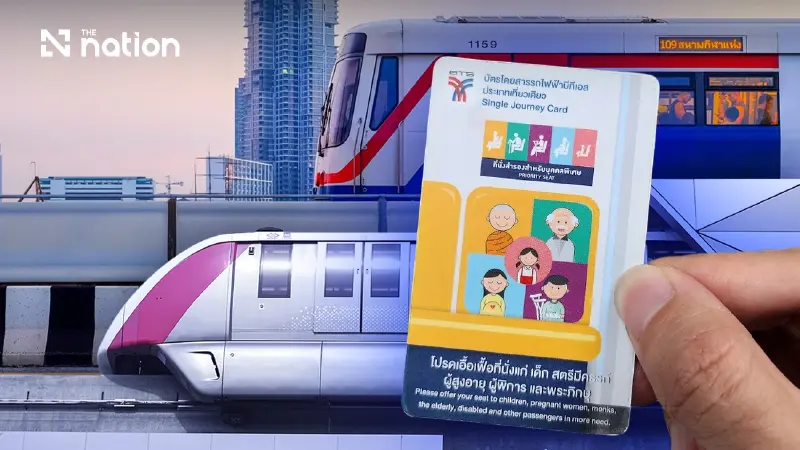


Thailand plans a 17-45 baht common electric rail fare from January 1, 2027, with one entry fee across all lines to cut living costs
- Thailand's Cabinet has approved a new fare policy for electric trains, setting a price cap of 17-45 baht per trip.
- The policy, scheduled to launch on January 1, 2027, will apply to all rail lines and is intended to reduce living costs for commuters.
- It will function as a common ticket system, charging passengers only one entry fee with a maximum fare of 45 baht, even when transferring between lines.
- Implementation requires establishing a central clearing house to manage revenue distribution and creating a compensation framework for private operators.
Thailand’s Cabinet has approved a common ticket policy for electric train services, setting fares at 17-45 baht per trip across all rail lines as the government seeks to reduce the cost of living for commuters.
Deputy Prime Minister and Transport Minister Phiphat Ratchakitprakarn said the measure would cover all colours and all lines in the mass-transit rail network, using a common-ticket model that charges passengers only one entry fee even when they transfer between routes.

The government aims to launch the scheme on January 1, 2027, presenting it as a New Year measure to ease household expenses.
One entry fee across all lines
Under the proposed fare structure, passengers would pay between 17 and 45 baht per trip, with the maximum fare capped at 45 baht regardless of how many lines they use during the journey.
Phiphat said the key principle was to remove repeated entry charges when passengers change trains, making the system simpler and less costly for daily commuters.
The policy builds on earlier fare-reduction efforts on the Purple Line and Red Line, where the government has already implemented a 40-baht fare model, before expanding the approach to the wider electric rail network.
Clearing house becomes the next challenge
After the Cabinet’s approval, the Transport Ministry will move to discuss the creation of a clearing house system to manage fare collection and revenue distribution among operators.
Phiphat said the new system must be able to collect fares under a single-entry model and allocate revenue properly between different rail lines and operators.
For lines operated under private concessions, particularly routes such as the Green Line, the government will still need to work out compensation arrangements. Phiphat said the state would have to find a way to compensate operators while ensuring that the benefit is passed back to passengers.
He added that the choice of which financial institution or mechanism would serve as the clearing house would fall under the Finance Ministry’s consideration.
State eyes wider control of rail network
The common-ticket policy is also tied to the government’s longer-term ambition to bring all electric rail routes under the Mass Rapid Transit Authority of Thailand, or MRTA.
However, Phiphat acknowledged that this cannot be done immediately because some lines are not owned by the state and would require the government to buy back or take over private concessions.
Some concession agreements are due to expire by 2029, while the cost of acquiring certain routes could run to around 100 billion baht, making a full takeover financially difficult in the short term.
As a result, the government has chosen the 17-45 baht common-ticket model as a practical first step while it studies longer-term ownership and funding options.
Future fund option under study
Phiphat said the government would discuss funding options with the Finance Ministry, including the possibility of raising capital through a future-fund-style mechanism or a market-based fundraising structure.
Such a model could be used to raise money to acquire electric rail businesses and bring more routes under state control. However, he said the process would likely take at least one to two years.
Once the state has a clearer ownership and funding structure, further ticket products could be developed, including one-day passes, weekly tickets and special fares for students, elderly passengers and people with disabilities.
New Year target puts pressure on agencies
The January 1, 2027 target leaves the Transport Ministry, Finance Ministry and rail operators with a tight timeline to settle the clearing house system, revenue-sharing rules and compensation framework.
The Cabinet’s approval gives the policy political momentum, but implementation will depend on whether agencies can turn the common-ticket concept into a working fare system across lines with different owners and operators.
For commuters, the promise is straightforward: lower and simpler electric train fares. For the government, the harder task is building the financial and legal machinery needed to make the 17-45 baht cap work across Bangkok’s complex rail network.
