
Phiphat pushes 17-45 baht phase 1 joint rail ticket to Cabinet next week
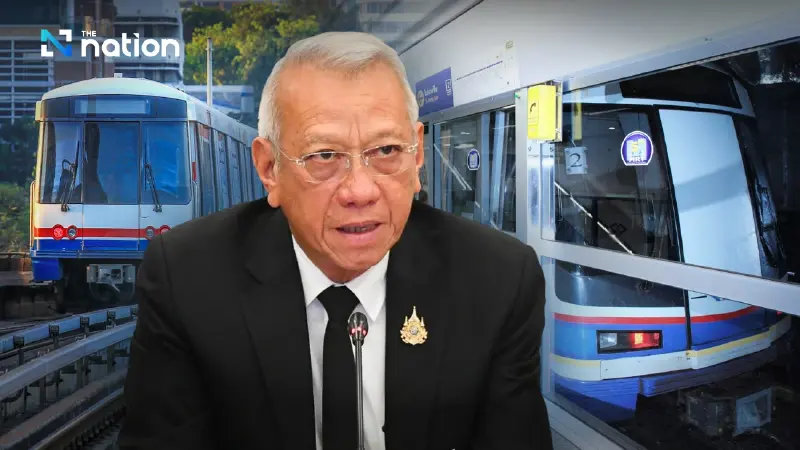


Transport Ministry pushes phase 1 joint electric rail ticket with 17-45 baht fares this year, while negotiating with firms on 40-baht all-day fares and advancing Landbridge.
Phiphat Ratchakitprakarn, Minister of Transport, said in an interview at Nation TV’s 26th anniversary event that, in his capacity as Minister of Transport, the urgent mission whose results Thai people would see in 2026 was to push forward logistics and transport, particularly the key joint ticket policy.
The proposal has already entered the legislative bill process and is being circulated among ministries for comments.
It is expected to be submitted to the Cabinet in the coming week.
The central idea of the joint ticket is Single Ownership, or ownership by a single entity.
The most important point is that this should be the Mass Rapid Transit Authority of Thailand (MRTA), which would own and manage all electric train systems in order to push all electric train lines of every colour to use a single joint ticket.
At present, electric train operations are divided among the State Railway of Thailand (SRT), the MRTA and the Bangkok Metropolitan Administration (BMA), with the private operator being the BTS Group.
However, especially for the Green Line, which is managed by BTS, the contract is currently midway through its term, with three years remaining.
Negotiations are therefore needed on what should be done during these three years.
The ministry’s biggest concern is the buyback.
If it buys the system back at a high price, it could be accused of having something improper behind it.
But if it offers too low a price, the operator would probably not sell, as it already knows how many passengers it has and how much revenue it earns each day.
The matter must therefore be handled very carefully.
Another problem is where the MRTA would find the money to buy back the entire system, as using budget funds would run into public debt constraints.
The Ministry of Finance has therefore advised raising funds through Thailand Fund on the stock exchange, but the timeline would not be in time for the upcoming New Year period.
As a result, the ministry will propose a plan to reduce the public’s expenses by setting fares at 17-45 baht per trip and not charging repeated entry fees.
“In the first phase, as we still cannot buy back the whole system, we will ask to use the 17-45 baht fare, with the entry charge collected only once for now. This is the first phase in which we are trying to settle the arrangement by the end of 2026 as a New Year's gift for the public. But we are still not giving up on negotiations with operators so that we can secure a 40 baht fare throughout the day in future.”
Phiphat also said that, besides pushing the joint ticket policy, the ministry was accelerating projects to ease traffic congestion in Phuket, including the Phuket expressway construction project.
A construction contract is expected to be signed by June 2026 or within the next one to two months.
The project will include a tunnel alongside the expressway, while government policy will set lower tolls.
As for the major investment project, Landbridge, he sought to clarify a misunderstanding over the public-sector budget.
He confirmed that the Thai government’s investment burden in the project is only land expropriation, with the budget estimated at THB13-14 billion.
This covers land along both sides of the 90-kilometre route, with the construction alignment to include tunnel boring in 12 sections.
He confirmed that information circulated saying the state would have to spend THB1 trillion was not accurate, as investment in construction and all operations would be the responsibility of the private sector, which would join the investment and study the feasibility of the investment model further.
The government maintains that the Landbridge project is another important network that will connect the country’s transport and logistics, as it has already laid rail foundations systematically.
The double-track railway route from Bangkok to Chumphon has been completed, and under the 2027 budget, it will continue from Chumphon to Surat Thani, Hat Yai and on to the Malaysian border, creating a double-track railway along the entire route and helping support freight transport both domestically and internationally.
At the same time, he confirmed that Landbridge in this era is not merely about linking the western and eastern sides of the South, but is an important channel for connecting north and south.
This is especially to accommodate containers from southern China via the rail system being built to connect to Nong Khai, Chiang Rai and Chiang Mai, for onward transport to the Middle East and Europe through Landbridge and onward by sea.
In addition, the Landbridge project also aims to win back market share.
At present, goods in southern Thailand have to be shipped through Penang Port in Malaysia, at around 300,000 containers a year.
If Landbridge succeeds, there will be no need to rely on Penang Port any longer, and Ranong Port can be used as a centre for exporting goods directly to China and India.
Phiphat also said that while Thailand’s Landbridge project is still underway, Malaysia’s Landbridge, which links Port Klang with the state of Kelantan, will officially open in 2027.
It is 640 kilometres long, while Thailand’s Landbridge route is only 90 kilometres.
The advantage of Thailand’s Landbridge is that it can save time and is more cost-effective.
Transport through Malaysia’s route, such as from Port Klang to the Strait of Malacca or from Kelantan to Singapore, takes about 1 to 1.5 days, while Thailand’s route can shorten ships’ travel time by 2 to 2.5 days.
Landbridge is therefore a geopolitical advantage, which is the factor that global shipping operators place the greatest importance on.
