
Thailand shelves 40-baht all-line rail fare plan as new range proposed
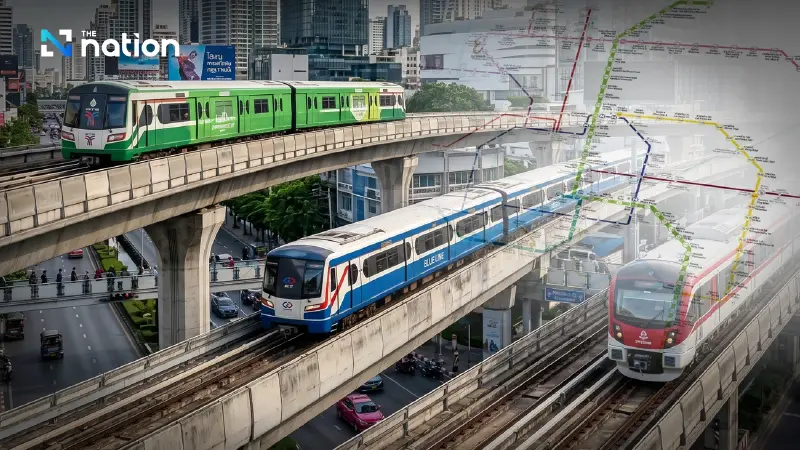


Siripong Angkasakulkiat says the THB40 all-day fare can continue only on the Red Line and Tao Poon-Khlong Bang Phai Purple Line, with a THB17-45 fare plan proposed.
- The Thai government has shelved its plan for a universal 40-baht flat fare across all electric rail lines, citing difficulties in renegotiating contracts with private operators.
- A new integrated fare structure has been proposed, with per-trip costs ranging from 17 to 45 baht, covering connecting journeys across all lines.
- The original 40-baht fare scheme will now only proceed on the state-owned Red Line and a section of the Purple Line.
- Under the new proposal, the government will reimburse passengers for any fare difference beyond the 17-45 baht range, a method that avoids altering existing private concession agreements.
Siripong Angkasakulkiat, Deputy Transport Minister, has given an update on the 40-baht all-day electric rail fare scheme for all colours and lines, saying the government has now considered that the scheme can proceed only for the Red Line suburban rail service and the Purple Line on the Tao Poon-Khlong Bang Phai section.
This is because both are state electric rail projects, and the Cabinet has already approved the scheme.
A proposal will be made to extend the scheme for another year from its scheduled end on Monday (November 30, 2026).
As for the policy to push the 40-baht all-day fare across every electric rail colour and line by 2027, he admitted it still cannot happen and must be dropped altogether, because the process would require time to negotiate with private operators to amend concession contracts.
Therefore, what can be done immediately for the public is for the ministry to propose to the Cabinet for approval an integrated electric rail fare adjustment, setting fares at 17-45 baht per trip, covering connecting journeys across all electric rail colours and lines, while scrapping repeated first-entry charges in the electric rail system.
“An all-day 40-baht fare can be implemented in principle only if ownership of the electric rail systems is transferred to the Mass Rapid Transit Authority of Thailand (MRTA). At present, however, there are still concession contracts with private operators. Therefore, what can be done immediately now is viewed as a policy to reduce the cost of living. The ministry will set fares so that people pay only 17-45 baht per trip and can connect to as many electric rail lines as they need. Any fare difference beyond that will be reimbursed by the government to the public. This approach will also avoid the need to amend concession contracts, because private operators will still receive the same revenue.”
Siripong also said the 17-45 baht per-trip fare range had been assessed by the ministry as not having much impact on the government’s subsidy burden.
The subsidy for the scheme is expected to come from the common ticket fund and accumulated revenue of the MRTA, with subsidies estimated at 4 billion baht a year.
The scheme could start immediately in 2027.
The ministry will propose the principle of implementing the scheme to the Cabinet for consideration next week.
After that, relevant agencies will study the details before returning to the Cabinet for approval and beginning to set this fare.
People eligible to take part in the scheme must tap to pay using EMV Contactless cards, including Visa, Mastercard or UnionPay debit cards bearing the EMV Contactless symbol.
The government will then reimburse the fare difference to the EMV card within 3 working days.
However, once the Cabinet approves the scheme, the state and private sectors will have to hold talks to establish a revenue management system, or Clearing House.
The previous Cabinet resolution assigning the Digital Government Development Agency (DGA) to handle the task will be revoked, and the role will instead be assigned to the Ministry of Transport and the Ministry of Finance, using Krungthai Bank’s existing system, which is already ready for management.
Private operators will also have to install EMV card readers to support travel under the policy.
Siripong also addressed negotiations with private operators to amend concession contracts, saying that once the government shifts to a 17-45 baht per-trip fare policy and pays compensation to passengers, private operators’ revenue will not be affected, and concession contracts will not be affected.
Therefore, there is no need to negotiate the buy-back of concessions from private operators; talks will only concern private operators using the Clearing House system under the government’s policy.
A source from the Ministry of Transport said there are now no negotiations to buy back electric rail concessions or to change contracts from PPP Net Cost to PPP Gross Cost.
There will only be a Cabinet proposal on the concept of Single Ownership for electric rail management, transferring ownership to the MRTA only for the Green Line, Gold Line and Red Line.
This would transfer management rights from the Bangkok Metropolitan Administration (BMA), which had been the counterparty to private operators, so that the MRTA becomes the counterparty instead.
Likewise, ownership of the Red Line would be changed from the State Railway of Thailand (SRT) to the MRTA, so fare management would move in the same direction.
In the future, when the Green Line concession ends in 2029, the MRTA would be able to manage all fares and assets.
The source also said the 17-45 baht per-trip fare policy was a price range calculated from the travel behaviour of current electric rail users.
Most journeys fall within this fare range, so it is believed it will not have much impact on the government’s burden in finding subsidy funding.
However, the source admitted that passengers would have to pay higher electric rail fares compared with the previous policy of an all-day 40-baht fare covering all colours and lines.
“This 17-45 baht policy will use compensation money from the common ticket fund to reimburse the public. In the first year, the common ticket fund will receive seed money from a proposal to the Cabinet to use the 2027 budget as initial funding for the fund. In subsequent years, if the money in the common ticket fund is insufficient for compensation, a budget request for that year will have to be submitted.”
