
Transport Ministry blames system failure for high-speed rail crane collapse
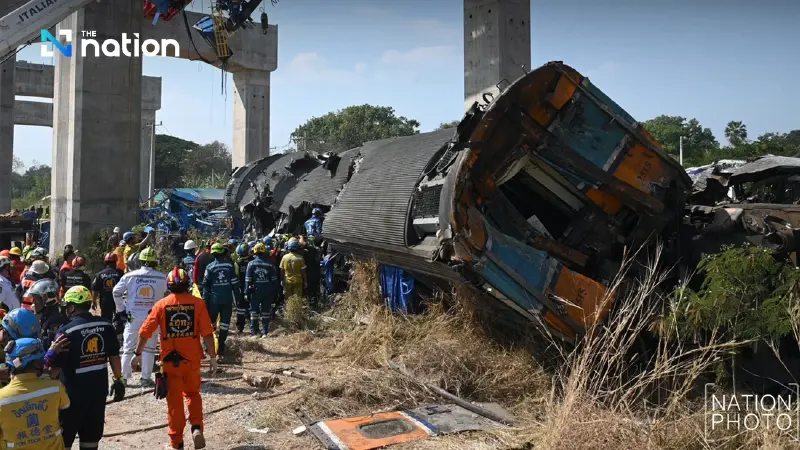


Transport Ministry says the Si Khiu crane collapse that killed 31 people stemmed from systemic safety failures
Transport Ministry has concluded that the deadly collapse of a construction crane on the Thai-Chinese high-speed rail project in Nakhon Ratchasima was caused not by an individual error, but by a “systemic failure” involving all parties responsible for the work.
The accident, which took place in Si Khiu district, killed 31 people and injured 71 others after part of a Launching Gantry crane collapsed onto a passenger train running below.

Jirapong Theppitak, deputy permanent secretary for transport and chairman of the fact-finding committee, announced the inquiry findings at the Transport Ministry alongside Piyapong Jiwattanakulpaisarn, director-general of the Department of Highways, and Anan Phonimdang, deputy governor and acting governor of the State Railway of Thailand (SRT).
Crane collapsed onto Bangkok-Ubon Ratchathani train
The incident occurred at about 9.15am on January 14, 2026, between Nong Nam Khun station and Si Khiu station in Nakhon Ratchasima province.
The front support base of a Launching Gantry crane being used on Contract 3-4 of the Thai-Chinese high-speed rail project fell from a height of more than 10 metres and landed on Special Express Train No 21, operating on the Bangkok-Ubon Ratchathani route.
The accident killed 30 passengers and one construction worker, bringing the death toll to 31. Another 71 people were injured.
Three train carriages were damaged. The second carriage was torn by the impact and caught fire, while the third carriage derailed.

The accident forced authorities to close the lower northeastern railway line for 10 days, affecting more than 14 train services.
The SRT later reopened the northeastern line from Kaeng Khoi to Nakhon Ratchasima on January 24 after clearing the wreckage and completing safety checks.
Mandatory safety step skipped
The engineering investigation found that the Launching Gantry crane, which is used to lift large concrete components, has a required operating procedure before it moves forward.
Under that procedure, the “middle leg” must be moved close to the “front leg” so the two support points can share the load.
On the day of the accident, however, workers skipped this mandatory step and ordered the crane to move forward immediately. As a result, more than 700 tonnes of weight pressed down on a single support point.
The PT Bar steel fasteners could not withstand the force and snapped, causing the crane base to collapse onto the train passing below.
Contractor accused of multiple safety breaches
The fact-finding committee said the contractor had neglected several safety requirements.
These included skipping a mandatory step in the operating manual, starting work without approval, failing to request a suspension of train services or “Window Time” from the SRT, failing to replace steel fasteners according to the required cycle, and failing to inspect the crane as required by law.
Supervision consultant failed to control site
The construction supervision consultant, or CSC, was also found to have seriously failed in its oversight duties.
The committee said there were no engineers or safety officers stationed at the work site, while approvals were signed both in advance and retroactively.
The CSC had also never inspected the crane itself throughout the period it was in use.
SRT criticised over weak project oversight
The SRT, as project owner, was also criticised in the investigation.
The committee found that the SRT had assigned engineers to oversee several contracts at the same time, beyond their capacity. This weakened supervision and allowed safety control to become lax.
The inquiry also said the SRT had allowed safety responsibilities to fall mainly to the CSC, even though the SRT still had a direct legal duty to supervise the project.
The committee concluded that the tragedy was “not an accident caused by bad luck”.
Instead, it said all parties had been aware of gaps in the safety system but allowed them to continue until they resulted in major loss of life.
The conduct identified by the investigation was considered a serious breach of contract and could lead to contract termination, blacklisting as an abandoned-work contractor, and revocation of the contractor’s registration in later procedures.
Five urgent safety measures proposed
The committee also proposed five urgent measures to the Transport Ministry.
- The first is to ban work above railway tracks while trains are passing below.
- The second is to abolish the practice of approving work retroactively.
- The third is to require all cranes to be inspected by independent experts.
- The fourth is to install real-time monitoring systems.
- The fifth is to strengthen penalties and raise contractor-selection standards for high-risk construction projects.
