
Thai Army Defuses Border Spat After Cambodian Troops Try to Block Razor-Wire Fence
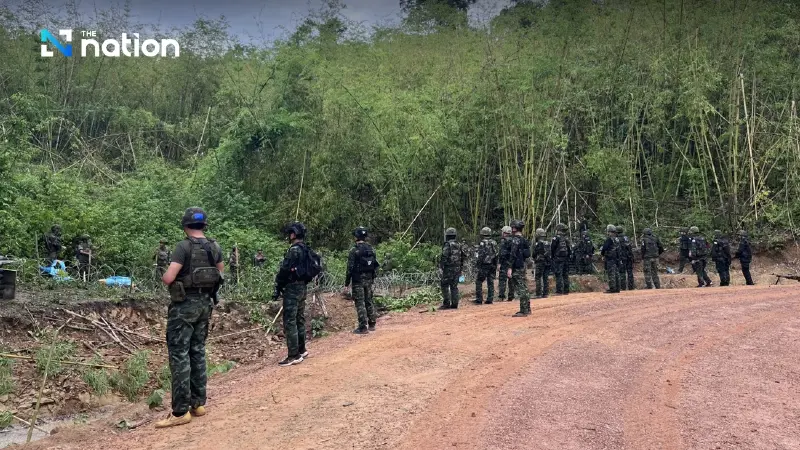


The Royal Thai Army says the situation at Ubon Ratchathani has returned to normal after armed Cambodian troops pulled back from Thai deployment lines
- A border standoff occurred when armed Cambodian soldiers attempted to obstruct Thai troops from installing a razor-wire security fence in the Chong Bok border area.
- The Thai Army defused the situation by initiating immediate face-to-face negotiations, successfully avoiding an armed confrontation.
- The two-and-a-half-hour standoff ended peacefully after the Cambodian forces agreed to withdraw, allowing Thai troops to resume their work.
- Thai officials asserted the fence was within their own territory and credited the rapid resolution to a bilateral agreement that mandates negotiation to resolve border misunderstandings.
The Royal Thai Army says the situation at Ubon Ratchathani has returned to normal after armed Cambodian troops pulled back from Thai deployment lines.
A border standoff between Thai and Cambodian troops was successfully defused on Tuesday morning after armed Cambodian soldiers attempted to obstruct Thai military personnel from installing security fencing along the frontier.
Maj Gen Winthai Suvaree, spokesperson for the Royal Thai Army, disclosed that the incident occurred at approximately 09:00 AM within the Chong Bok area of Nam Yuen District, Ubon Ratchathani Province.
Personnel from the Suranaree Task Force were conducting routine surveillance and fortifying their positions by laying down razor-wire fencing when the friction began.
During the operation, Thai forces detected five armed Cambodian soldiers crossing into the work area. The Cambodian contingent quickly swelled to roughly 20 personnel, who began shouting and actively attempting to block the Thai officers from continuing their work.
In response, Thai military personnel deployed strict de-escalation protocols, containing the perimeter and initiating immediate face-to-face negotiations to clarify the territorial facts. Following a tense two-and-a-half-hour standoff, the situation was resolved by 11:30 AM when the Cambodian troops agreed to pull back from the site.
The Royal Thai Army confirmed that the situation on the ground has returned to normal, though local units remain on high alert and are closely monitoring the border to safeguard national sovereignty.
The military emphasised that the razor-wire installation was conducted entirely within Thailand’s own deployment lines, in strict compliance with bilateral Joint Statement agreements.
Because the forces of both nations operate in exceptionally close proximity at Chong Bok, the perimeter defence measures were deemed entirely necessary for safety purposes.
Currently, the border flashpoint at Chong Bok has completely quietened down, with Cambodian forces fully withdrawn to their designated positions. Thai troops have resumed their security operations under heightened vigilance.
The area around Chong Bok—where the borders of Thailand, Cambodia, and Laos converge (often referred to as the Emerald Triangle)—has historically been a sensitive, heavily mined, and fiercely contested frontier.
While broader diplomatic ties between Bangkok and Phnom Penh have stabilised significantly in recent years, local border demarcations remain notoriously ambiguous in several mountainous corridors.
To prevent minor tactical movements from escalating into full-scale military confrontations, both nations operate under a mutually agreed Joint Statement framework.
This bilateral mechanism requires both militaries to adhere strictly to designated deployment lines and mandates immediate field-level negotiations, rather than armed retaliation, the moment an uncoordinated border crossing or territorial misunderstanding is detected. Tuesday's rapid de-escalation is viewed as a successful application of these localised communication protocols.
