
Anutin says Thailand need not counter Cambodia’s UNCLOS move over MOU44 dispute
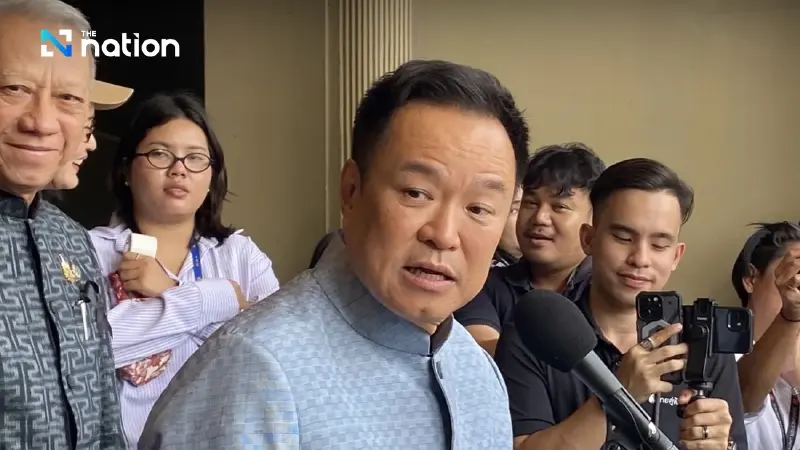


Prime Minister Anutin Charnvirakul says Thailand will not change tack after Cambodia launched a UN-backed compulsory conciliation process under UNCLOS over disputed Gulf of Thailand maritime claims following Bangkok’s cancellation of MOU44.
Prime Minister Anutin Charnvirakul has insisted that Thailand has no need to change tack or “counter” Cambodia’s international legal move, after Phnom Penh notified the United Nations and Bangkok that it was launching compulsory UNCLOS conciliation over their disputed Gulf of Thailand maritime claims following Thailand’s cancellation of MOU44.
Speaking at Government House after Tuesday’s Cabinet meeting, Anutin, who also serves as interior minister, said he had not yet been officially informed of Cambodia’s latest move and was not aware that any new problem had arisen.
He said Thailand had already informed Cambodia’s leadership of its position on MOU44 during the ASEAN Summit in the Philippines, adding that the Cambodian side had acknowledged the matter and expressed disappointment.
Cambodia later indicated that it would proceed under the United Nations Convention on the Law of the Sea, or UNCLOS, although Anutin said no timeframe had been set for the next step.
Cambodia turns to UNCLOS after Thailand scraps MOU44
Cambodia has formally launched a UN-backed compulsory conciliation process under UNCLOS after Thailand terminated the 2001 memorandum of understanding, known as MOU44, which had provided a framework for talks on the two countries’ overlapping maritime claims in the Gulf of Thailand.
The Thai Cabinet approved the termination of the 2001 MOU on May 5, saying the agreement had made no progress after 25 years and that Thailand would instead use UNCLOS as a reference framework for future negotiations.
The disputed area is strategically important because it covers about 26,000 square kilometres in the Gulf of Thailand and is believed to contain major oil and gas resources. Reuters reported that the area is estimated to hold nearly 12 trillion cubic feet of natural gas and large quantities of oil, with a potential value of around US$300 billion.
Under UNCLOS, compulsory conciliation allows a panel of independent experts to examine a dispute and issue recommendations, although the findings are not legally binding on either party.
PM rejects claims of mixed signals
Asked whether Thailand was being seen as saying one thing in public and doing another behind the scenes, Anutin asked reporters: “Who sees it that way?”
He said he did not view the situation in that manner, insisting Thailand’s position remained consistent.
Asked about public concerns that Thailand’s stance on the international stage appeared different from its strategic approach, Anutin said the country remained firm on its principles and had taken no step that would put it at a disadvantage.
“Thailand still stands on its own principles, and there is no point at which the country has been put at a disadvantage,” he said.
Anutin blames fake news over border reopening claims
Anutin also rejected claims that Thailand had quietly eased border restrictions with Cambodia, saying rumours had circulated throughout the week about checkpoints being reopened.
“People have been talking all week about opening checkpoints, opening this and opening that. Has it happened? No. These things were made up,” he said.
He cited claims that Cambodian students had been allowed to cross into Thailand to attend school, saying misinformation had continued to spread on the Thai side and had forced provincial governors to clarify the facts.
“No one can explain it more clearly than the governors who are directly responsible for border affairs,” Anutin said.
Thailand says no need to adjust international stance
The prime minister said Thailand’s recent international engagements had proceeded without difficulty, including a visit from Vietnam and his meetings with the French leader and the director-general of UNESCO.
He said none of them had raised the issue, adding that Thailand therefore had no need to adjust its position.
“Thailand does not need to change its stance because no one has raised this issue at all,” he said.
Asked whether the Thai government needed to respond to Cambodia’s increasing engagement with the international community, Anutin replied: “Why do we need to counter it?”
He said Thailand would continue to proceed in its own way, listening to public opinion and trying to act in line with the wishes of the Thai people as much as possible, while ensuring the country’s standing on the international stage was not damaged.
Anutin said the government would continue to uphold Thailand’s sovereignty, dignity and security, as well as the respect it commands from its adversaries.
“We already have clear principles guiding our actions,” he said.
