
Thailand approves THB58.9bn rice support and production reform plan
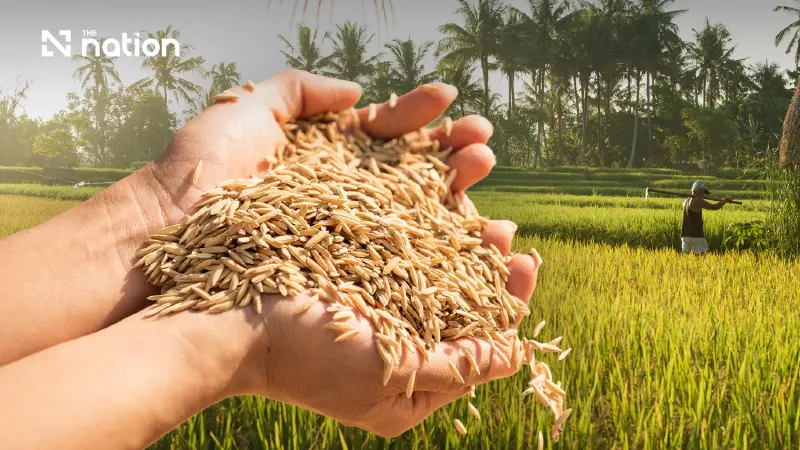


Thailand approves five rice measures worth THB58.9 billion to stabilise paddy prices and support longer-term production reform.
Thailand’s Cabinet has approved five rice support and production-reform schemes worth a combined THB58.91 billion, aiming to ease pressure on paddy prices as large volumes of the 2026/27 main crop enter the market in October and November.
Deputy Government Spokesperson Lalida Persvivatana said on Tuesday (October 20) that the measures were proposed by the Ministry of Commerce, overseen by Deputy Prime Minister and Commerce Minister Suphajee Suthumpun.
The package combines measures to stabilise paddy prices with longer-term production restructuring under the “New Rice Economy” concept.
Of the total funding, THB49.28 billion will be provided through loans, while THB9.64 billion will cover government compensation and other non-repayable expenditure.
Loans aim to delay rice sales
The largest measure is a THB40.93-billion loan scheme designed to delay sales of up to 3 million tonnes of main-crop paddy, giving farmers the option of storing their harvest and waiting for more favourable prices.
Loan rates are set at THB13,000 per tonne for Hom Mali rice, THB11,500 for Hom Mali grown outside designated production areas, THB6,500 for white rice, THB8,500 for Pathum Thani rice and THB9,500 for glutinous rice.
The programme will also provide support for storage and maintaining rice quality, subject to its conditions. The government will bear the interest costs for participating farmers and farmers’ institutions.
A second scheme, worth THB15.66 billion, will provide financing for cooperatives and other farmers’ institutions to collect and add value to up to 1.5 million tonnes of paddy for sale or processing.
Participating institutions will pay interest of 1% a year, while the government will compensate a further 3.5 percentage points, with the measure intended to improve liquidity and strengthen farmers’ bargaining power when selling their crops.
Measures target 7 million tonnes of additional supply
The Cabinet also approved THB564 million to compensate rice traders for interest costs incurred in holding stocks, with a target of 4 million tonnes. The measure is intended to remove some supply from the market when harvesting peaks.
Another THB1.68-billion scheme targets the absorption of 3 million tonnes of paddy by supporting purchases at market-leading prices under the programme’s conditions.
However, Lalida said the scheme must still complete the process for securing its funding source. The Cabinet Secretariat proposed that money from the fund used to assist farmers should be considered first, with implementation to begin once approval is obtained from the fund’s management committee.
The fifth scheme will provide THB84 million for the second phase of a programme promoting high-quality rice production. A total of 266 farmer groups will each receive THB300,000 to develop production, processing and sales channels, with the aim of increasing income from higher-value rice.
Finance Ministry trims compensation budget
Lalida said the Finance Ministry had reduced the compensation allocation for the main-crop paddy sale-delay loan scheme to bring the amount more closely into line with expected costs and the likely fiscal burden.
The five projects form part of the government’s effort to prevent farmers from having to sell immediately when large volumes of rice reach the market at the same time, while expanding purchasing channels and encouraging greater processing of high-quality rice.
“The government wants to ensure that farmers do not have to rush to sell their rice when supplies enter the market simultaneously,” Lalida said.
She added that the package was intended not only to support prices in the short term, but also to restructure production, raise the value of Thai rice and provide farmers with more stable incomes over the longer term.
