
Thailand Unveils Integrated Infrastructure Master Plan to Become Regional Logistics Hub
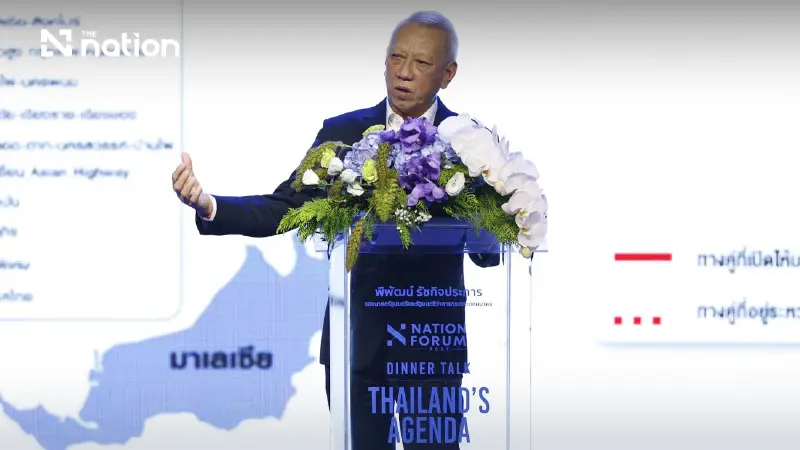


Phiphat Ratchakitprakarn outlines rail, deep-sea port and air cargo plans, calling the Gulf crisis an opportunity Thailand must seize
- Thailand's master plan aims to integrate its road, rail, sea, and air transport systems into a single, cohesive network to become a regional trade and logistics center.
- Rail transport is designated as the logistical backbone, with plans to add nearly 1,500 km of double-track railway to connect China with Malaysia and Singapore.
- The plan includes building new deep-sea ports on both the Gulf of Thailand and the Andaman Sea, linked by rail to create a new maritime trade route connecting the Pacific and Indian oceans.
- Air cargo capacity will be significantly expanded, starting with a new warehouse at Suvarnabhumi Airport, to boost high-value exports and establish Thailand as an aviation hub.
Phiphat Ratchakitprakarn outlines rail, deep-sea port and air cargo plans, calling the Gulf crisis an opportunity Thailand must seize.
Thailand will knit its road, rail, water and air networks into a single economic system to become the region's centre of trade and logistics, Deputy Prime Minister and Transport Minister Phiphat Ratchakitprakarn said on Tuesday (20 October 2026).
Speaking at the Nation Forum 2027 dinner talk, "Thailand's Agenda", under the theme "Infrastructure Blueprint for the Future", Phiphat said the global turmoil was a chance for the country to act.
"If we do not seize the opportunity now, it may slip away," he said.
One connected network
Thailand's geography lets it link China, ASEAN, India, the Middle East and Europe, he said, but many systems have not been connected efficiently.
"We must change our thinking from building stand-alone projects to developing a network connected across the whole country," he said.
Rail as the backbone
Rail is to become the main logistics network, carrying freight from China through Laos into Thailand and south to Malaysia and Singapore. The ministry plans a further 1,479 kilometres of double-track railway.
It will also push an "open access" policy that lets private operators run rail services so that state investment in infrastructure is used more fully.
Roads will act as feeders to the rail system, cutting reliance on road haulage and lowering logistics costs over the long term. Phiphat said work covers the southern motorway and the north-eastern (Isan) motorway, which is already open.
In the north, the M5 motorway between Rangsit and Bang Pa-in will be extended as an elevated road connected to the Don Mueang Tollway.
Ports on both coasts
Rail and road serve domestic and neighbouring routes, he said, but the ministry also wants to connect Thailand to the world through the sea. Laem Chabang, the country's deep-sea port, handles about 10.8 million twenty-foot equivalent units (TEU) of trade and is nearly full.
To become a global maritime hub, Thailand should build a second and third deep-sea port to match the new rail network, Phiphat said. The ministry's concept is for ports on both coasts, linking the Gulf of Thailand and the Andaman Sea by rail.
This would open a new trade route between the Pacific and Indian oceans.
Small volumes, large value in the air
Air freight also has strong potential, he said. Suvarnabhumi Airport handles about 1.7 million tonnes of cargo a year. Air-freighted goods account for less than 1 per cent of all exports by volume but about a third of export value, bringing in around 3.5 trillion baht.
Airports of Thailand has signed an agreement with AOTGA to invest in a third cargo warehouse, due to begin operating in 2029. It is expected to add 600,000–700,000 tonnes a year, taking total air cargo to 2.3–2.4 million tonnes, equivalent to about 44 per cent of export value, or 5.5 trillion baht.
"We should not overlook air exports. The volumes are small, but the value they create is large," he said.
If demand keeps growing, the ministry plans to extend cargo facilities to Don Mueang and U-Tapao, or possibly move some to Krabi Airport in the south. Phiphat said this would help Thailand become an aviation hub serving future industries, exports and investment.
He added that Thailand sits midway between two economic powers and that studies show linking the world by air and sea will create opportunities for the country.

A crisis as an opening
Phiphat said the Persian Gulf crisis was another chance Thailand must act on quickly. He recalled that after the Second World War Thailand attracted Japanese investors, whose presence has grown ever since.
In the same way, he said, today's crises in Europe and the Middle East create an opening.
"We are ready. We are complete. We are the rice bowl and the water source, the kitchen of the world," he said.
Confidence and a call to business
Phiphat said he was confident that, once the plans are completed, Thailand would be a hub for air and sea transport with rail linking southern China to Singapore through Malaysia.
He credited the government of Prime Minister Anutin Charnvirakul with overseeing the ministry.
"What could not be done in the past, I am confident we can do under Prime Minister Anutin," he said.
Whether the plans succeed, he said, also depends on how much business supports them and what advice it gives. The ministry is ready to accept criticism and information.
"I am confident Thailand can keep moving forward and must recover in the near term," he said. "This is Thailand's opportunity."
