
Anutin, Hun Manet face sovereignty test over border and maritime dispute
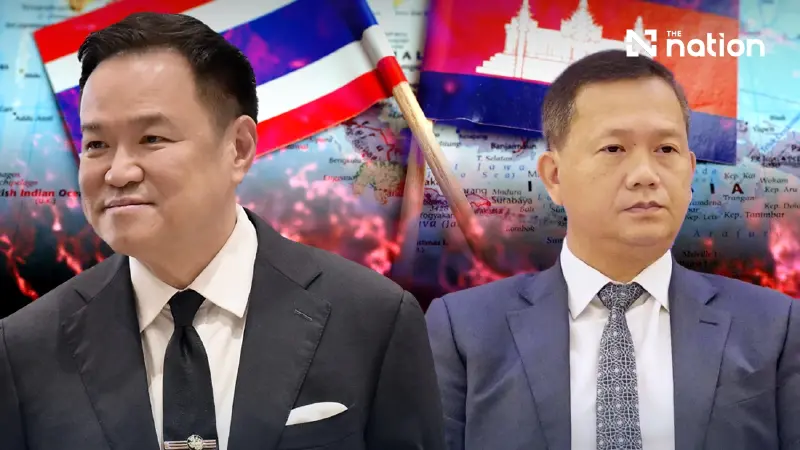


Thailand and Cambodia’s border dispute is turning into a political test for Anutin and Hun Manet as UNCLOS conciliation moves ahead
The Thai-Cambodian border dispute is becoming a political test for both Prime Minister Anutin Charnvirakul and Cambodian Prime Minister Hun Manet, as the two leaders try to defend sovereignty while managing growing pressure at home.
Both governments are facing domestic challenges. In Thailand, Anutin has only recently passed through an election and still has time to improve his administration’s performance. However, unresolved political issues, including the Khao Kradong land case and allegations surrounding Senate election collusion, continue to follow his government.
Criticism has also grown over what opponents describe as the consolidation of power under the so-called “blue regime”. The recent reshuffle involving the Phuket governor’s residence, officially linked to local problem-solving under government policy, has been viewed by critics as part of a wider attempt to rearrange local power. The government’s campaign against influential figures has also been questioned by those who see it as political theatre rather than a decisive clean-up.
Economic pressure is adding to the strain. Although tensions in the Middle East appear to be easing and global crude prices have moved closer to pre-conflict levels, retail fuel prices in Thailand have not fallen in line with actual costs. That has left the Anutin government facing criticism that it has not gone far enough in addressing living-cost concerns.
Another issue drawing questions is the TH-AI Passport project, worth 1.6 billion baht, which aims to buy AI services for free public use by five million people. Critics have asked whether the budget should instead be used to develop existing models, similar to approaches seen in other countries. The issue has also been linked politically to Digital Economy and Society Minister Chaichanok Chidchob.
Hun Manet faces pressure from a different direction. Cambodia is heading towards an election in 2027, while its economy is being affected by Thailand’s prolonged border closure. The impact has been reflected in daily interceptions of Cambodian nationals attempting to cross illegally into Thailand in search of work.
Cambodia’s casino revenue has also fallen sharply after international pressure to crack down on scam centres that have used such areas as bases for global fraud operations. The issue has affected the credibility of Hun Manet’s administration and given exiled opposition figures an opportunity to attack the Cambodian government.
These overlapping pressures have pushed Cambodia to seek a quicker endgame in the border dispute. Thailand, by contrast, holds advantages in military capability and economic strength, giving Bangkok an incentive to slow the pace and avoid being drawn into Cambodia’s preferred timing.
The remaining arena where Cambodia still has room to press Thailand is international diplomacy. Phnom Penh has moved beyond voluntary conciliation and turned to compulsory conciliation under the 1982 United Nations Convention on the Law of the Sea, or UNCLOS. Cambodia has submitted the matter to the UN secretary-general and appointed two commissioners on its side.
Thailand has responded by slowing talks on land border issues under both the Thai-Cambodian Joint Boundary Commission, overseen by the Foreign Ministry, and the Thai-Cambodian General Border Committee, overseen by the Defence Ministry. Discussions on restoring bilateral relations and other Cambodian requests have also been put on hold.
At the same time, Thailand is seeking broader diplomatic support through economic, investment, political and security cooperation. The focus is on countries with influence over Cambodia, including France, Russia, China and Vietnam, with the Foreign Ministry taking the lead.
On June 16, the Cabinet approved Thailand’s commissioners for the compulsory conciliation process. They are Professor Dr Rüdiger Wolfrum, a German expert in international law and the law of the sea, and Albert Hoffman, a South African expert in maritime law.
Deputy Prime Minister and Foreign Minister Sihasak Phuangketkeow will lead Thailand’s negotiating team, while Songchai Chaipatiyut, Thailand’s ambassador to Kuwait, will serve as deputy head.
Sihasak said that once Thailand and Cambodia each have two commissioners, both sides must agree on a fifth person to chair the process. This must be completed within one month before discussions can begin.
He stressed that UNCLOS conciliation is not a court process. Its outcome is intended to support and recommend ways to resolve the dispute, while the two countries will ultimately still have to return to negotiations.
Sihasak also made clear that the scope of conciliation should be limited to maritime boundary delimitation and the continental shelf. He said Cambodia’s attempt to bring joint development of offshore resources into the discussion was inappropriate, and that the focus should remain on clarifying the maritime boundary.
However, UNCLOS also allows room for provisional practical arrangements while a final agreement remains unresolved. Such arrangements can include joint development areas, similar to the model used between Thailand and Malaysia when negotiations over maritime boundaries took a long time.
The convention also discourages either side from taking unilateral action that could make a future agreement harder to reach. In practice, that means neither country should move alone to exploit undersea resources in the disputed area.
If the timeline outlined by Sihasak holds, the first round of compulsory conciliation between Thailand and Cambodia could begin around August. Thailand’s position is to reserve its rights and discuss only maritime boundary issues, but the final direction of the process remains to be seen.
From this point, every move by Anutin and Hun Manet will be closely watched. The border dispute has become more than a legal process under UNCLOS. It is now a contest over sovereignty, timing and political survival, with each leader trying to avoid giving the other side an advantage while protecting support at home.
