
Four tests and two pressures await Anutin government
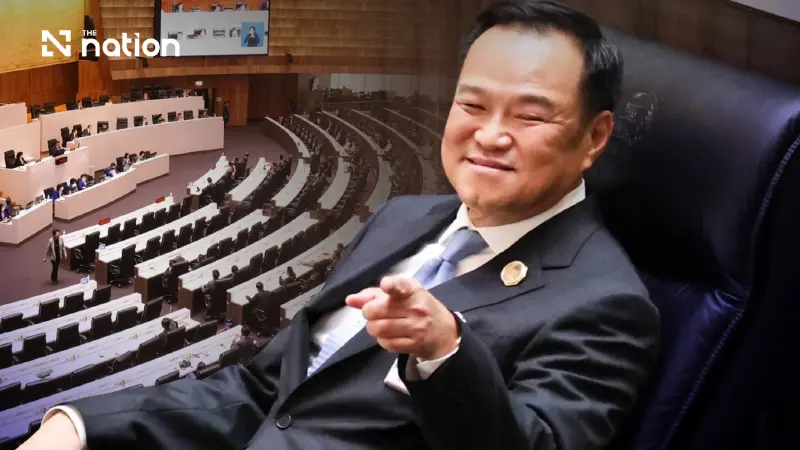


Thailand’s House returns on August 25 with a THB400bn loan decree, the 2027 budget, charter reform and a no-confidence battle ahead.
Prime Minister Anutin Charnvirakul’s government will enter its first full-scale political examination when the House of Representatives begins a new session on August 25, with its survival strategy likely to depend on preventing several separate controversies from merging into one broader opposition narrative.
The parliamentary session, scheduled to run until December 22, will confront the government with four major tests: a THB400 billion emergency borrowing decree, the fiscal 2027 Budget Bill, a proposed constitutional amendment and a no-confidence debate. The official parliamentary calendar confirms the August 25–December 22 sitting period, while the Royal Thai Government identifies Anutin as the current prime minister.
Two further pressures lie largely outside the government’s control: the investigation into alleged collusion in the Senate election and allegations of corruption involving recruitment examinations for local-government officials and employees.
Each issue presents a different type of risk. The borrowing decree and budget will test the government’s economic justification and fiscal discipline. Constitutional reform will test its political commitment. A no-confidence debate will allow the opposition to bring those disputes together with allegations involving the Senate election, recruitment examinations and the TH-AI Passport project.
The opposition, led by People’s Party leader Natthaphong Ruengpanyawut, must demonstrate that the controversies are connected strongly enough to form a persuasive case against the government rather than appearing as a collection of unrelated complaints. Parliament’s official English-language material identifies Natthaphong as Leader of the Opposition in the House of Representatives.
The government’s challenge is the reverse: to separate the issues, assign responsibility to the relevant ministers and prevent investigations outside Parliament from becoming a wider judgement on the Bhumjaithai-led coalition.
Loan decree clears legal hurdle but remains politically exposed
The first test is the emergency decree authorising the Finance Ministry to borrow up to THB400 billion to address the effects of the energy crisis and support the country’s energy transition.
The Constitutional Court has ruled that the decree complies with Section 172, paragraph one, of the Constitution. Its central ruling has been forwarded to the Secretariat of the House of Representatives, clearing the way for parliamentary consideration.
The court upheld the portion intended to assist people, farmers and businesses affected by the energy crisis unanimously. It approved the energy-transition component by a 7–2 majority.
Government chief whip Korrawee Prissananantakul has indicated that the decree could be placed before the House on August 26. His English spelling and position as government chief whip are used in current English-language reporting and official Thai diplomatic material.
The ruling gives the government a legal victory, but it does not remove the political argument.
In fact, with the constitutional question largely settled, opposition scrutiny can move more directly towards necessity, value for money and the proposed use of the funds. The most sensitive area is likely to be expenditure associated with the energy transition, where the government will have to explain both the urgency of borrowing and the safeguards governing disbursement.
The court also stressed principles that could become central to the parliamentary debate: fiscal discipline, consideration of the country’s financial position and the requirement that spending be lawful, efficient, transparent and open to examination.
The government must therefore do more than show that it has the legal authority to borrow. It must persuade MPs and the public that the planned expenditure is necessary, properly targeted and sufficiently protected against waste or misuse.
The decree is the opening test because it places three politically sensitive questions before the government at once: why borrowing is required, why the amount is justified and how the money will be controlled.
Budget debate will test the government’s priorities
The second major confrontation will come during the second and third readings of the fiscal 2027 Budget Bill.
Korrawee, who also serves on the budget scrutiny committee, expects committee consideration to be completed on September 2. The bill is then expected to return to the House during the second week of September, with three days provisionally allocated for debate.
The budget is more than an annual accounting exercise. It gives the opposition an opportunity to examine the government’s priorities ministry by ministry and programme by programme.
Particular attention is likely to fall on policies requiring substantial public expenditure and measures that the opposition characterises as “spend, hand out and move on” programmes. Its argument will centre on whether those policies produce adequate economic and social returns or merely create short-term political benefits.
For the government, the budget debate will require a broader defence than the borrowing decree. Ministers will have to explain not only individual allocations but also the direction of the administration as a whole.
A weakness identified in one programme can be used to challenge the credibility of other spending plans. The opposition may also attempt to connect budget allocations with its wider arguments over transparency, political oversight and the effectiveness of government policy.
The government has already designated Deputy Prime Minister and Finance Minister Ekniti Nitithanprapas as its principal figure on borrowing, budgetary and economic questions. His current positions are confirmed by the Royal Thai Government and Finance Ministry.
Ekniti’s explanations will therefore carry political weight beyond the Finance Ministry. They will help determine whether the government can present the borrowing decree and annual budget as parts of a coherent economic programme rather than separate demands for more public money.
Charter reform carries a credibility test and a timing risk
The third issue is a proposed amendment to Section 256 of the Constitution to introduce provisions governing the drafting of a new constitution.
Unlike the borrowing decree and budget, constitutional reform does not yet have a firm parliamentary timetable.
Government whips are waiting for a citizens’ constitutional amendment draft. Its supporters have notified the President of Parliament that they intend to collect the required signatures so that the proposal can be considered alongside drafts submitted by political parties.
The timing creates uncertainty. If the signature collection and verification process moves quickly, Parliament may be able to begin deliberations during the coming session. If it takes longer, consideration could be postponed.
The political risk for the government lies not only in whether the amendment passes, but also in how it handles the process.
A delay caused by procedural requirements may still allow critics to question the government’s commitment to a new constitution. Moving too quickly without accommodating the citizens’ proposal, however, could expose it to accusations that the process is being controlled by political parties.
Constitutional reform will therefore test the government’s ability to balance timing, procedure and political expectations. It must show support for an agreed process without appearing either to obstruct the proposal or to dictate the outcome.
No-confidence debate could unite separate controversies
The fourth and potentially most damaging test is the planned no-confidence debate.
During the parliamentary recess, the People’s Party, as the principal opposition party, and the Democrat Party continued gathering information for use against the government.
The issues under examination include allegations of corruption involving examinations for local-government officials and employees. The opposition is attempting to link those allegations to oversight by the Interior Ministry and to questions over possible political involvement.
These remain allegations and matters under examination, not established findings of wrongdoing.
The opposition is also preparing to raise alleged Senate election collusion and questions surrounding the TH-AI Passport project.
Some opposition figures have questioned the project’s terms of reference and implementation. The programme falls under the supervision of Digital Economy and Society Minister Chaichanok Chidchob, who is also secretary-general of the Bhumjaithai Party. The Royal Thai Government confirms his ministerial appointment.
A no-confidence debate gives the opposition something that the separate legislative debates do not: a single stage on which it can combine economic policy, government oversight, alleged irregularities and questions about political networks.
Its effectiveness will depend on whether it can establish clear lines of responsibility. Simply placing several allegations alongside one another will not necessarily show that the government or individual ministers were involved.
For Anutin, the counter-strategy is to divide the government’s response by portfolio.
Speaking during his official visit to Australia on August 20, the prime minister said he had no objection to a no-confidence debate because the Cabinet was prepared to respond through Parliament. The government confirms that his Australia visit ran from August 17 to 20.
Anutin has said Chaichanok should answer questions on artificial-intelligence policy, while Ekniti should handle borrowing, the budget and economic matters. Other ministers would similarly be expected to defend their own records.
This approach allows the government to present the debate as a series of policy questions requiring evidence and ministerial explanations rather than a single indictment of the administration.
It also carries a risk. If several ministers struggle to provide convincing answers, the opposition may argue that the problem is systemic rather than confined to one ministry.
Senate case remains the most unpredictable outside pressure
Anutin has tried to draw a firm institutional boundary between his government and allegations involving the Senate election.
He argues that the government and Senate are separate institutions, with the Senate forming part of the legislative branch, and that neither should intrude into the other’s sphere of authority.
“If there really was collusion, it would be reprehensible, but we were not involved,” Anutin said. “The government came in through an election by the people. We have never had anything to do with it.”
He has repeated that his administration was not involved in the alleged Senate election collusion and should not be held responsible for the Senate’s affairs.
Politically, however, formal institutional separation may not end the issue.
If the Election Commission reaches a conclusion in late August or September, the findings could dominate the new parliamentary session. If the matter were subsequently referred to the Supreme Court and the legal process involved individuals or political networks associated with major parties, pressure on Bhumjaithai could intensify.
Those outcomes remain conditional. No inference of wrongdoing should be drawn unless supported by the findings and subsequent legal proceedings.
Nevertheless, the case is difficult for the government because it cannot determine the timing, evidence or direction of the investigation. Its political impact could therefore be shaped by developments outside the parliamentary calendar.
The same problem applies to the allegations involving local-government recruitment examinations. Even if the government rejects responsibility, new findings or references to political oversight could provide the opposition with material during the no-confidence debate.
Winning votes may not settle the wider confidence test
The coming session can be understood as four tests inside Parliament and two major pressures outside it.
The four parliamentary tests are the THB400 billion borrowing decree, the 2027 budget, constitutional reform and the no-confidence debate.
The two external pressures are the investigation into alleged Senate election collusion and the allegations involving local-government recruitment examinations.
The government has more control over the first four. It can set out policy arguments, mobilise coalition MPs, assign ministers to respond and negotiate the parliamentary timetable.
It has much less influence over the pace or outcome of the two external processes.
The opposition’s opportunity lies in connecting the six issues. Its aim will be to argue that borrowing, spending, project scrutiny and external allegations form a wider pattern involving government judgement, accountability and political influence.
The government will seek to prevent that connection by insisting on separate evidence, separate responsibilities and separate legal or parliamentary procedures.
That contest will determine whether the session becomes a series of manageable debates or a cumulative political crisis.
A successful vote on the borrowing decree, budget or no-confidence motion would demonstrate that the coalition retains sufficient parliamentary support. It would not automatically resolve questions of public confidence.
The central test for the Anutin government is therefore not simply whether it can win inside the chamber. It is whether it can emerge from the session without allowing parliamentary scrutiny and external investigations to weaken long-term trust in the administration and its leading coalition party.
Source: Thansettakij
