
Bhumjaithai proposes four bills to redirect alcohol and tobacco taxes
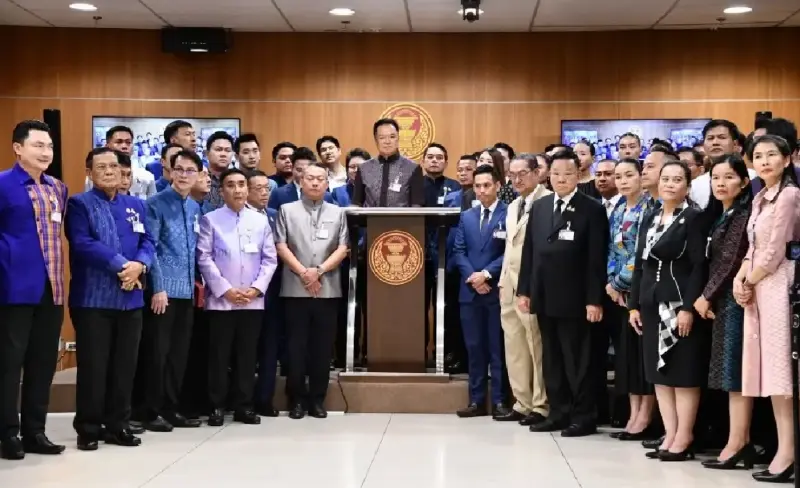


Bhumjaithai proposes routing alcohol and tobacco levies from Thai PBS, ThaiHealth, sports and elderly funds to the Treasury to support fiscal stability and discipline.
Bhumjaithai’s proposal to amend the law governing the Thai Public Broadcasting Service (Thai PBS), removing its earmarked alcohol and tobacco levy funding, signals the beginning of an effort to bring off-budget revenue into the budget system to shore up the government’s fiscal stability.
The proposed amendment to the Thai Public Broadcasting Service Act entered the legislative process with public consultation beginning on September 30.
Other bills submitted by the party follow a similar approach: bringing earmarked alcohol and tobacco revenue into the Treasury before allocating money to the agencies and organisations concerned.
These include an amendment to the Health Promotion Foundation Act submitted by Prime Minister Anutin Charnvirakul in his capacity as a member of parliament and Bhumjaithai leader.
Amendments to the Older Persons Act and the Sports Authority of Thailand Act were submitted by Supachai Jaisamut and fellow Bhumjaithai members of parliament.
The proposals share a similar rationale, citing requirements under the Constitution and the State Fiscal and Financial Disciplines Act 2018 for the state to maintain strict fiscal and financial discipline to ensure stable, secure and sustainable public finances.
“The State Fiscal and Financial Disciplines Act 2018 prohibits the introduction of legislation to collect taxes for the specific expenditure of state agencies. Although the law protects agencies whose funding arrangements were recognised by legislation before the Act took effect, the exemption is contained in transitional provisions and should be repealed so that it does not conflict with the principle of maintaining state fiscal and financial discipline.”
The amendments take the same approach to redirecting revenue to the Treasury: abolishing the earmarked levies collected from those liable to pay alcohol and tobacco taxes.
Under the amendment concerning the Thai Health Promotion Foundation (ThaiHealth), signed and submitted by Anutin, the changes would take effect on Friday (October 1, 2027).
Annual levy funding equivalent to 2% of alcohol and tobacco taxes collected would be abolished and replaced with allocations from the annual expenditure budget.
The provision for “government subsidies”, which requires the government to provide funding every year, would become “government subsidies as necessary”.
This would give the government scope to withhold subsidies where fiscal reasons and circumstances warranted it.
The Older Persons Act amendment would remove alcohol and tobacco levy revenue from the Older Persons Fund’s funding sources.
It would also revise provisions governing subsistence assistance for older people on low incomes to reflect the removal of that support.
The assistance would instead draw on three sources: (1) annual budget allocations; (2) donations; and (3) returns generated by the fund’s money or assets.
The existing law identifies alcohol and tobacco levy revenue and donations as the main sources of funding for this assistance.
However, an ageing society requires increasing government support each year.
The fund’s 2025 financial statements reported revenue of THB4.16 billion, comprising THB67 million in government support through the budget law, approximately THB4 billion a year in alcohol and tobacco levy revenue, THB5.2 million in subsidies and donations, and THB0.57 million in other income.
Expenditure reached THB4.606 billion, exceeding revenue.
Removing alcohol and tobacco levy funding and replacing it with budget allocations could increase the government’s burden as the older population grows.
Reflecting this concern, the bill’s sponsors asked during public consultation: “Are there problems or obstacles with the current law concerning revenue from alcohol and tobacco levies?” They also asked whether replacing that support with annual budget allocations, donations and returns from the fund’s money or assets “would resolve the problems”.
The Sports Authority of Thailand Act amendment concerns only the National Sports Development Fund, which finances sports promotion, support, development, protection, assistance and welfare.
It would remove alcohol and tobacco levy funding.
Although 10 other funding sources would remain, including annual budget allocations as necessary, questions could arise over whether sufficient money would be available to support and develop sport.
If the House of Representatives and the Senate approve the four bills affecting Thai PBS, ThaiHealth, the National Sports Development Fund and the Older Persons Fund, the government could bring THB14 billion in alcohol and tobacco levy revenue into the Treasury.
This comprises THB4 billion from ThaiHealth, THB2 billion from Thai PBS, THB4 billion from the Older Persons Fund and THB4 billion from the National Sports Development Fund.
The government could allocate that money to its own responsibilities.
The two organisations and two funds, however, could face reduced support, depending on the government’s assessment of their needs.
Former finance minister Korn Chatikavanij of the Democrat Party supported ending earmarked alcohol and tobacco levy allocations to strengthen fiscal and financial discipline.
However, he suggested that bringing the money into the Treasury or the national budget should prompt careful consideration of whether the government would spend it prudently and deliver value for money.
Beyond the four bills on alcohol and tobacco revenue under public consultation, another proposal would amend the Government Pension Fund Act.
It would reduce the minimum annual budget contribution to the reserve account from 20% to 5% of expenditure on pensions and retirement gratuities.
It would also allow money in individual member accounts to be invested in highly secure securities, with the source text referring to a proportion of at least 60% and to risk at the individual-member level.
The main stated reasons for this amendment are to improve the efficiency of annual budgeting and maintain the security of the Government Pension Fund’s reserves without affecting members’ rights or investments.
The House has closed public consultation on the pension fund amendment.
Preliminary results recorded 10,801 visitors and 1,069 respondents, with 1.96% supporting the proposal and 97.10% opposing it.
The drive to bring off-budget money under government control reflects an effort by the Bhumjaithai-led administration to demonstrate fiscal strength.
Yet questions remain over the transparency and value for money of its spending to date.
How the current parliament responds to these proposals therefore bears close scrutiny.
